Should You Buy Extended Warranty for LG OLED TVs?
Last updated: July 2026 | 🕒 7 min read
Disclosure: GearPulse360 participates in the Amazon Associates Program. This particular article contains no affiliate links; other content on our site may.
Should you buy extended warranty for LG OLED? It depends entirely on which series you own.
If you bought a G, Z, or M-series model, LG already backs the panel for five years — an extended plan mostly buys you labor coverage. If you bought a C-series or lower model, you’re on a one-year clock, and that changes the math considerably.
Standing at checkout with an LG OLED in your cart, the extended protection plan pitch is hard to ignore — a few extra dollars a month, the rep says, and you never have to think about a repair bill again. Before you say yes, it’s worth knowing exactly what LG already includes for free, because for a lot of buyers, part of what the plan is selling has already been paid for.
Extended plans generally add a modest recurring or one-time cost on top of the TV’s purchase price, scaling with screen size and coverage length — a standing cost layered onto the set, not a limited-time upsell. The real question isn’t whether that cost is small; it’s whether it’s covering a gap that actually exists in LG’s own coverage, or duplicating something LG is already giving you.
That gap looks completely different depending on the model. LG’s flagship OLEDs carry protection that most mid-range and budget models don’t get at all — we cover every current LG OLED model and where each one lands on this below. If you’re still deciding between a C-series and a G-series set, the warranty gap is actually one of the more overlooked parts of that decision — see our LG C6H vs LG G6 compared.
Table of Contents
The Short Answer: Should You Buy Extended Warranty for LG OLED?
Should you buy extended warranty for LG OLED TVs? For G, Z, and M-series owners, usually not — LG’s own 5-year limited panel warranty already covers the failure mode buyers worry about most. For C-series and other standard models, it’s a more reasonable purchase, since LG’s coverage on those sets drops to one year. The rest of this article walks through exactly why.
What You’re Actually Paying Extra For
Labor coverage after year one
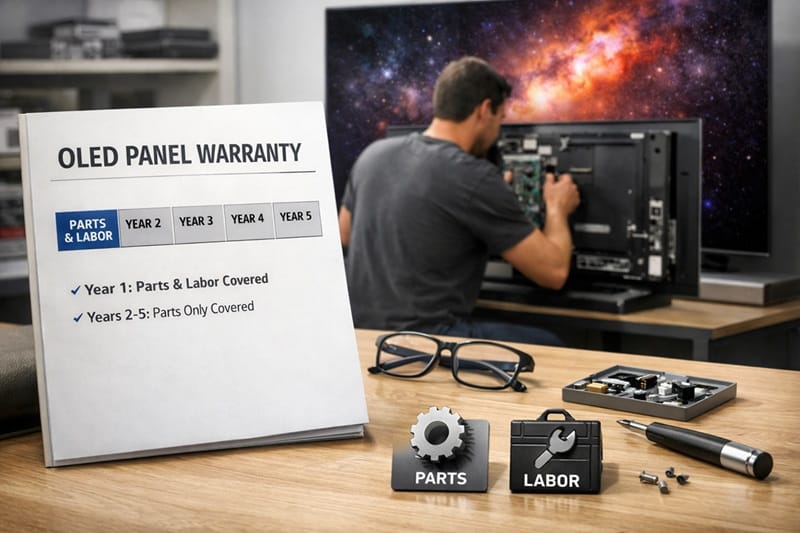
LG’s 5-year limited panel warranty applies only to the G, Z, and M-series, and it isn’t as complete as the “5-year” headline suggests. According to LG’s official warranty terms, parts, panel, and labor are covered in year one — but from years two through five, LG covers the panel itself only, and labor to install it is billed to the owner. That labor charge, not the panel, is the part an extended plan is actually filling in for flagship owners.
For every other LG OLED — the C-series and anything below it — this distinction doesn’t apply at all, because those models only carry LG’s standard one-year parts-and-labor warranty in the first place. An extended plan on one of those sets covers the entire post-year-one window — and for C-series buyers specifically, where you actually buy the set can shift this math too, since return windows and in-store support vary by retailer; see our Costco vs Best Buy LG OLED breakdown. It’s worth understanding whether where you buy a TV affects warranty in general before assuming an extended plan is your only option for closing that gap.
Clearer footing on image retention and burn-in claims
Burn-in is often the biggest concern behind this purchase, and it’s also the murkiest part of any OLED warranty to interpret. LG’s standard documentation doesn’t spell out image retention as a covered failure the way it spells out a dead panel — it’s treated under general defect language, which leaves real room for a claim to go either way. A third-party or retailer protection plan that explicitly writes burn-in into its terms removes that ambiguity, which matters more than it sounds like until you’re the one filing a claim.
That said, real-world burn-in risk on modern LG panels is lower than most shoppers assume under typical mixed viewing — see our does OLED burn-in still matter in 2026 breakdown for the full picture.
One repair bill you don’t have to absorb alone
For buyers on a C-series or entry-level OLED, an extended plan is really a bet against a single expensive repair happening in years two through five, after LG’s own coverage runs out entirely. There’s no partial manufacturer safety net underneath you the way G-series owners have — it’s the whole cost of a panel or board repair, or nothing.
Extended Warranty vs. LG’s Standard Coverage: The Real-World Difference
The practical gap is narrower than it first appears once you separate it by series. On an LG G5, the manufacturer already backs the panel for five years; the only real hole is labor cost in years two through five, which LG’s own warranty terms make clear the owner is responsible for. On an LG C5, there’s no such backstop at all past twelve months — the entire panel, board, and labor cost is exposed from year two onward.
That’s the actual comparison buyers should be making: not “extended warranty vs. no warranty,” but “extended warranty vs. exactly what LG already backs for my specific series.” For flagship owners, that’s a fairly thin labor-cost gap. For everyone else, it’s the whole warranty period past year one.
Who Should Buy an Extended Warranty for Their LG OLED
Long-term owners of C-series, B-series, or any non-flagship model
A household that bought a C-series or lower model and plans to keep it for five-plus years is exactly who this coverage is built for — one panel or main board failure in year three would otherwise come entirely out of pocket, since LG’s own coverage stops at twelve months. Worth checking LG’s own Premium Care plan (administered through Asurion) alongside third-party retailer options, since it’s the manufacturer’s own extension rather than an outside provider’s.
Anyone running heavy static content
A home office monitor, a 24-hour news feed, a fixed dashboard — anything that sits on-screen for hours a day puts real elevated burn-in territory on the table. A plan that names image retention directly, instead of leaving it to general defect language, removes the argument over whether a claim is covered before it starts.
G, Z, and M-series owners who specifically want labor covered
LG already insures the panel itself through year five on these series. Paying for an extended plan on top of that only makes sense if the labor bill in years two through five — not the panel — is the part that bothers you, and that’s a real, specific gap worth insuring against.
Buyers planning to keep any LG OLED past the five-year mark
Once even the flagship panel warranty has expired entirely, every owner — regardless of series — is back to zero manufacturer coverage, which is where an extended plan’s later years start to earn their cost.
Who Should Skip It and Rely on LG’s Standard Coverage Instead
G, Z, and M-series owners already covered by LG
LG is already on the hook for the panel itself through year five on these series, so paying extra to insure the same component a second time is mostly redundant. Worth registering the TV with LG directly first to confirm the 5-year coverage is active on record — the only real gap left is labor cost, and even that’s narrower than the marketing suggests.
Frequent upgraders (every two to three years)
If the set is getting replaced well before LG’s own warranty period would have mattered anyway, an extended plan’s later coverage years are dead weight you’ll likely never reach. That budget is often better put toward the upgrade itself — what you can get back for the old set matters more here than what an extended plan would have cost; see our breakdown of LG OLED resale value for what actually moves the number.
Typical mixed-content viewers
Switching between streaming, sports, and gaming rather than running static images for hours a day puts you in the group least likely to ever file a burn-in claim, which changes the value math regardless of which model you own.
Buyers who’d rather self-insure
Setting the plan’s cost aside in savings instead is a reasonable alternative, since most owners never file a claim — the saved amount can cover a repair directly if one is ever needed.
Our Verdict: Should You Buy Extended Warranty for LG OLED?
The right call depends on which LG OLED you actually own. G, Z, and M-series buyers are already carrying five years of panel protection from LG directly, so an extended plan is mostly paying twice for the same component — worth it only if the labor-cost gap specifically bothers you. C-series and standard-tier buyers face a real, uncovered gap starting in year two, which makes the extra cost a far more reasonable purchase.
Match the coverage to the series in your cart before you decide. See our LG OLED picks → to check where your model lands.
📍 Still weighing which LG OLED series fits your budget and viewing habits? See our full roundup of the best OLED TVs of 2026.
Extended Warranty for LG OLED — Common Questions
Should you buy extended warranty for LG OLED instead of relying on LG’s coverage alone?
It’s worth it mainly for C-series and lower-tier LG OLEDs, where LG’s own coverage drops to one year. For G, Z, and M-series models, LG already backs the panel for five years, so an extended plan mostly adds labor coverage rather than filling a major gap.
What’s the real-world difference between LG’s warranty and a third-party extended plan?
LG’s 5-year panel warranty covers panel parts only after year one, with labor billed separately, and it applies exclusively to G, Z, and M-series sets — the terms are laid out in the section above. A third-party plan typically bundles parts and labor together and can extend that same protection to models LG doesn’t cover at all past twelve months.
Does an extended warranty actually cover OLED burn-in?
It depends on the plan’s wording, not just its price. LG’s own warranty treats image retention under general defect language rather than naming it directly, which leaves room for dispute. Plans that explicitly list burn-in or image retention as a covered failure remove that ambiguity — worth confirming before you buy, since not every plan spells it out the same way. It also helps to know the actual odds: RTINGS’ real-life OLED burn-in testing found the risk under normal mixed-content viewing is far lower than the torture-test conditions that generate headlines.
Who makes the best extended coverage decision for the money?
Owners of non-flagship LG OLEDs planning to keep the set long-term get the clearest value, since there’s no manufacturer safety net past year one. Flagship G/Z/M-series owners get a much thinner benefit, limited mostly to labor costs. See our LG OLED warranty claim problems breakdown for what the claims process itself tends to look like in practice.
Will extended warranty prices change later in the year?
Plan pricing varies by retailer and coverage length rather than following a predictable seasonal pattern we can point to with confidence. It’s worth comparing plan terms at the time of purchase rather than waiting on a price alone.

iYaiii
Editor, GearPulse360
iYaiii is the editor and founder of GearPulse360, specializing in TV reviews and consumer electronics. He researches every recommendation before publishing.
✅ Based on LG’s official warranty documentation and RTINGS data — last verified July 2026