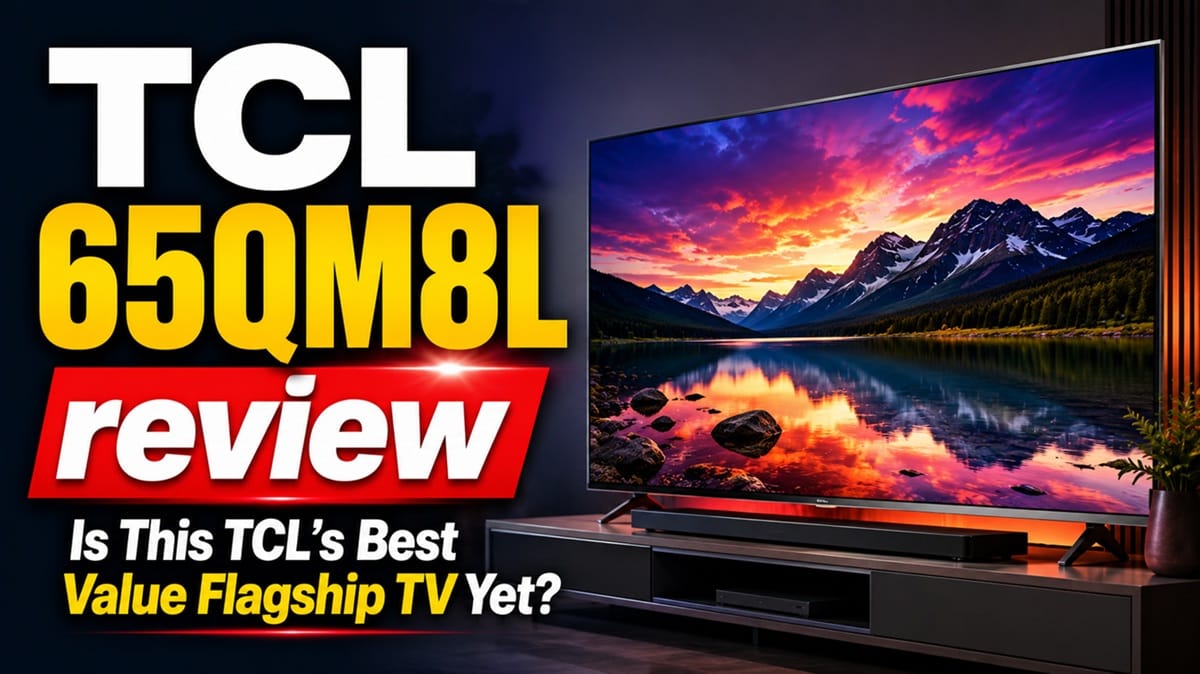
TCL 65QM8L Review: Is This TCL’s Best Value Flagship TV Yet?
Last updated: July 2026
🕒 9 min read
Disclosure: As an Amazon Associate I earn from qualifying purchases. This article contains affiliate links — we may earn a small commission if you buy through them, at no extra cost to you.
Do you actually need to spend OLED money to get a picture that looks like one? That’s the question hanging over TCL’s newest flagship this year. The SQD-Mini LED panel promises up to 4,000 local dimming zones and a claimed 6,000-nit peak brightness — numbers that read more like a step-up model than a mid-tier one. Shoppers land here after bouncing between Samsung’s Neo QLED lineup and Hisense’s U8QG, wondering whether TCL’s newest panel tech is a legitimate contender or just a bright number on a spec sheet.
Based on manufacturer specifications and published independent testing data, the 65QM8L looks like one of the stronger value plays in TCL’s 2026 catalog — though it isn’t the automatic pick for every kind of viewer, and we’ll get into exactly where it falls short before you commit to a cart.
📍 Still deciding between panel types entirely? Our best 4K TVs of 2026 roundup covers the full category picture before you commit to Mini-LED.
Table of Contents
Quick Verdict
At a Glance
★★★★★ 8.5 / 10
At a Glance
Picture Quality
Gaming
Audio
Value
👍 Best For: Mixed-use households wanting a big, bright, gaming-ready screen for movies and sports without OLED-level pricing.
👎 Skip If: You watch mostly in a dark room and want the deepest possible per-pixel black levels above everything else.
One-Line Verdict: A genuinely bright, well-specced Mini-LED flagship that undercuts the premium tier without feeling like a compromise.
🛒 Check Availability on AmazonProduct Specs at a Glance
Product Specs
TCL 65QM8L
SQD-Mini LED QLED · AiPQ Pro Processor · Google TV
| 💡 Peak Brightness (mfr. rated) | Up to 6,000 nits |
| 🔲 Local Dimming Zones | Up to 4,000 |
| 🎮 Refresh Rate | 144Hz native |
| ⚡ Gaming | VRR, Game Accelerator 288 |
| 🎬 HDR Formats | Dolby Vision, HDR10+, HDR10, HLG |
| 🔊 Audio | Bang & Olufsen-tuned |
| 📺 Smart Platform | Google TV |
Design & Build Quality
Materials & Finish
The 65QM8L carries over TCL’s ZeroBorder design language, with a slim bezel and a WHVA 2.0 Ultra Panel that’s built to hold contrast and color from wider seating angles than older LCD panels typically manage. Based on TCL’s official product page, the panel also carries an anti-reflective coating, alongside a manufacturer-rated 7,000:1 contrast ratio — specs aimed squarely at rooms with unpredictable ambient light rather than dedicated home theaters.
Ports & Connectivity
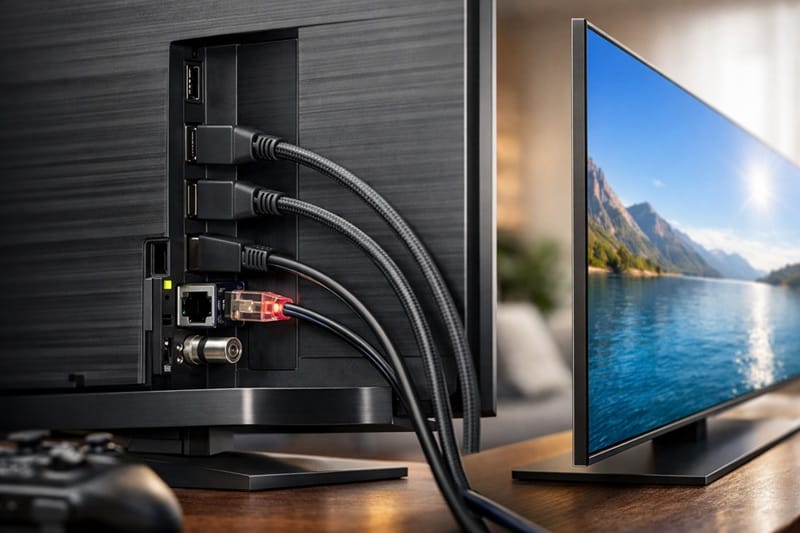
Cable routing sits behind a snap-on rear panel, which keeps things tidy if the TV is wall-mounted or floats away from a wall. TCL’s spec sheet confirms HDMI 2.1 bandwidth on the ports needed for 4K 144Hz gaming, though as with most TVs in this price class, not every HDMI input carries full 2.1 bandwidth — worth checking the port map before assuming every device gets the top refresh rate.
The remote follows TCL’s now-familiar layout, with dedicated buttons for the major streaming apps and a built-in microphone for Google TV voice search. It’s a small detail, but for households juggling multiple streaming services, having quick-access buttons instead of digging through a home screen genuinely saves time night after night.
Performance & Real-World Use
Movie Night
According to RTINGS’ published calibration data for the QM8L series, the panel is tested and tuned across its major picture modes rather than relying on out-of-box defaults, which matters for anyone planning to sit down and calibrate before movie night. Combined with TCL’s Super Quantum Dot color layer, the result on paper is a wider, more accurate color gamut than the outgoing QM8K generation.
Live Sports
144Hz native refresh plus VRR support through Game Accelerator 288 means fast camera pans during live sports shouldn’t introduce the judder that budget Mini-LED sets are known for. Motion handling has historically been a strong point across TCL’s QM8-series lineage, and the processing upgrades TCL lists for the 65QM8L build on that foundation rather than starting from scratch.
TCL 65QM8L Gaming: Console & PC Performance
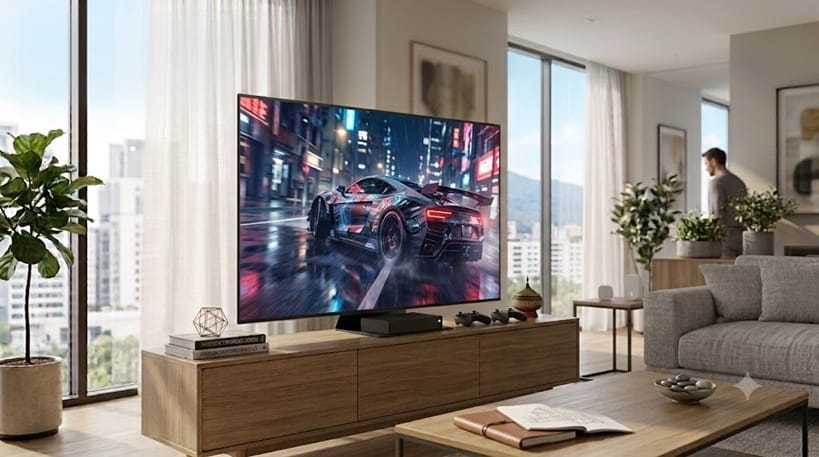
For gamers, the headline numbers are the 144Hz panel and VRR ceiling, both of which line up well with current-gen consoles and mid-to-high-end PCs. TCL’s Game Accelerator suite also targets reduced input lag in Game Mode, based on the manufacturer’s published gaming feature set for this series.
A dedicated Game Bar overlay is included as well, giving quick access to refresh rate, VRR status, and aspect ratio without leaving the game. For PC gamers specifically, that kind of on-screen confirmation is genuinely useful when troubleshooting whether a game is actually running at the refresh rate it claims to be.
Key Features Breakdown
SQD-Mini LED Panel
“SQD” stands for Super Quantum Dot — TCL’s term for a refined quantum dot layer designed to filter and sharpen the light coming off the Mini-LED backlight. In practice, that’s meant to translate into better color accuracy than older quantum dot layers without giving up the HDR contrast that Mini-LED backlighting is known for. It’s a meaningful distinction from a standard QLED panel, and it’s part of why TCL positions the QM8L as a flagship-tier product rather than a mid-range one.
Up to 4,000 Local Dimming Zones
More dimming zones generally means finer control over which parts of the screen go dark and which stay bright, which is the main lever LCD-based TVs have for closing the contrast gap with OLED. TCL’s published zone count for the QM8L series is a meaningful step up from the prior QM8K generation, though actual zone counts can vary by screen size — the 65-inch model typically carries fewer zones than the larger 85- and 98-inch variants in the same series. If you’re curious whether that extra zone count actually holds up at the largest size, our TCL 98QM8L review covers how the same flagship formula performs at 98 inches.
The Good, the Bad, and the Ugly
Pros
- ✅ Genuinely bright panel — TCL’s rated 6,000-nit peak brightness gives the 65QM8L real headroom for HDR highlights and bright-room viewing.
- ✅ 144Hz native refresh with VRR — a real advantage for console and PC gamers who want smooth motion without upgrading to an OLED.
- ✅ Bang & Olufsen-tuned audio — built-in sound that’s a step above the tinny default speakers found on many LCD TVs at this level.
Cons
- ❌ Not a true black-level match for OLED — LCD backlighting, even with 4,000 zones, can’t fully eliminate blooming around small, bright objects on a dark background.
- ❌ Google TV can feel busy — the smart TV interface leans heavily on recommendations and sponsored tiles, which some viewers find distracting compared to simpler platforms.
The Ugly
If your main concern walking in is whether a TCL can really compete with established Mini-LED names like Samsung’s Neo QLED lineup, the honest answer is: closely, but not identically. TCL’s dimming zone counts and brightness claims are frequently among the most aggressive on paper, but published independent testing across the QM8-series lineage has consistently found real-world brightness landing below TCL’s marketing figures once display settings stabilize. That’s not unique to TCL — most brands’ peak-brightness claims are best-case numbers — but it’s worth going in with tempered expectations rather than the number on the box.
Who Should Buy This — and Who Shouldn’t
Buy This If
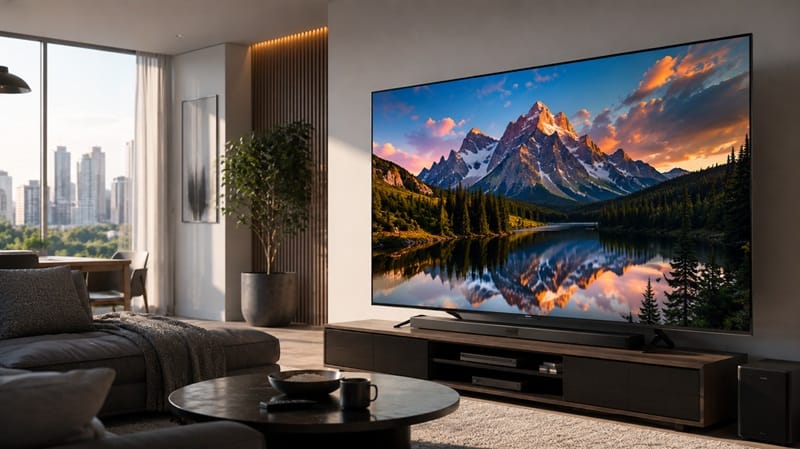
The 65QM8L makes the most sense for households that use one TV for everything — sports on Sunday, a movie on Friday, a few hours of gaming on a weeknight — and don’t want to pay flagship OLED prices to do all three well. It’s built for rooms with windows, mixed lighting, and no plans for blackout curtains — a daily driver rather than a dedicated theater set. Our TCL QM8K motion blur breakdown is a useful companion read if fast motion handling is your top priority, since the QM8L builds on the same processing lineage.
Skip This If
If you’re set up in a dedicated, light-controlled home theater and per-pixel black levels matter more to you than raw brightness, an OLED panel is still going to out-perform any Mini-LED TV, including this one. Buyers who already own a QM8K may also find the year-over-year jump too incremental to justify replacing a working set. In either case, a Samsung QN90F is worth cross-shopping if you want to stay in the Mini-LED category but prioritize a different processing and smart-platform experience.
If you like everything about the QM8L’s SQD-Mini LED formula but need more screen to fill the room, our TCL 75QM8L review covers the same flagship spec sheet at 75 inches. If a bigger screen at a lower price point matters more than flagship-tier dimming zone counts, TCL’s own 75QM64L review is worth a look — it trades some of the QM8L’s SQD-Mini LED refinement for size and a lower price. And if 65 inches is the size you want but the QM8L’s price is more than you’d planned to spend, TCL’s own 65QM64L review covers the budget-tier version of that same screen size.
For a deeper look at how Mini-LED stacks up against OLED on picture quality more broadly, see our OLED vs Mini LED compared breakdown.
TCL 65QM8L Review: Final Verdict
Is It Worth Buying?
Weighing everything covered in this TCL 65QM8L review, the picture that emerges is a familiar one for TCL’s flagship-tier Mini-LED sets: strong brightness, a real gaming feature set, and pricing that undercuts most of the premium competition without cutting obviously visible corners. It won’t fully close the gap with OLED on contrast, and it’s not the biggest leap over last year’s QM8K, but on paper its brightness and gaming spec sheet make it a fair match for a Samsung QN90F in the same category. For a closer look at how it fits into a wider Mini-LED shortlist, our OLED vs Mini LED for sports comparison is a useful next stop. 🛒 Check Availability on Amazon
Frequently Asked Questions
Is the TCL 65QM8L worth buying in 2026?
For mixed-use households that want strong brightness, gaming features, and solid HDR support without OLED pricing, the answer is a clear yes. It’s less compelling if per-pixel black levels are your top priority.
How does the TCL 65QM8L compare to RTINGS’ test data?
RTINGS maintains a dedicated TCL QM8L review with calibrated settings and test results across all four screen sizes in the series, which is a useful cross-check against TCL’s own marketing specs before you buy.
Is the TCL 65QM8L good for gaming?
Yes — the 144Hz native refresh rate, VRR support, and Game Accelerator 288 feature set make it a strong match for current-gen consoles and PC gaming, based on TCL’s published gaming specifications for this series.
Who should avoid the TCL 65QM8L?
Dedicated dark-room viewers who prioritize the deepest possible black levels above brightness and gaming features are better served by an OLED panel, where per-pixel dimming still has the edge over any Mini-LED backlight.
Does the TCL 65QM8L support Dolby Vision?
Yes, the 65QM8L supports Dolby Vision alongside HDR10+, HDR10, and HLG, giving it broader HDR format coverage than TVs that support only one or two standards.

iYaiii
Editor, GearPulse360
iYaiii is the editor and founder of GearPulse360, specializing in TV reviews and consumer electronics. He researches every recommendation before publishing.
✅ Based on spec analysis and TCL’s official and RTINGS data — last verified July 2026