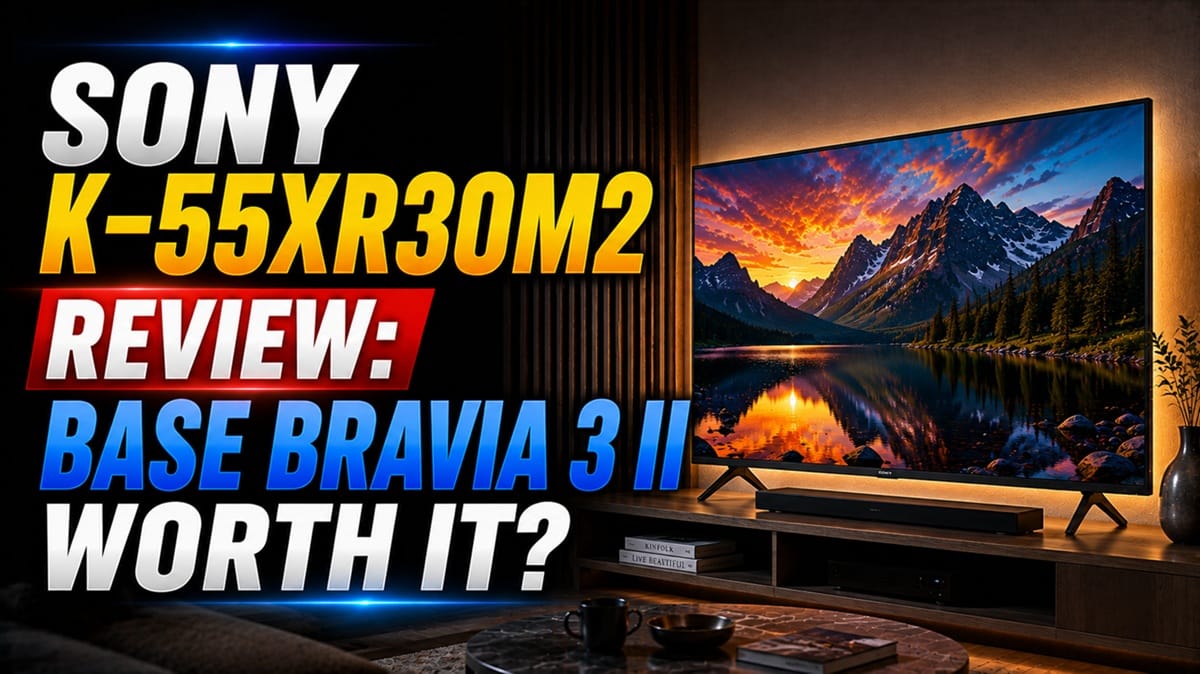
Sony K-55XR30M2 Review: Is the Base BRAVIA 3 II Size Worth It?
Last updated: August 2026
🕒 9 min read
Disclosure: As an Amazon Associate I earn from qualifying purchases. This article contains affiliate links — we may earn a small commission if you buy through them, at no extra cost to you.
Sony’s marketing photos and press coverage for the 2026 budget lineup lean on the 65-inch and 75-inch sizes — the ones with the anti-glare coating Sony highlights on its spec sheets. The 55-inch size, the one Sony actually sells the most of, rarely gets that same attention. The Sony K-55XR30M2 is that 55-inch entry point into the BRAVIA 3 II line — the size most shoppers land on when they want a mid-tier Sony without paying Mini-LED or OLED prices.
People landing on this Sony K-55XR30M2 review are usually deciding between it and a similarly priced LG or Hisense set at the same size, or wondering whether skipping the anti-glare screen and stepping down from the 65-inch model costs them anything in daily use. Sony’s own specification sheet for this exact model shows the answer depends on the room: the processing stays the same across sizes, but the anti-glare coating doesn’t carry over from the larger sizes.
Compared with something like LG’s 55QNED73B or a similarly priced Hisense U7SG-tier set, the K-55XR30M2 leans on Sony’s XR Processor rather than backlight-zone count to make its case. For a broader sense of how it stacks up against other budget and premium panel types this year, our best 4K TVs of 2026 roundup covers the wider field this model competes in.
Table of Contents
Quick Verdict
At a Glance
★★★☆★ 6.8 / 10
At a Glance
Picture Quality
Gaming
Audio
Value
👍 Best For: Budget shoppers who want a 55-inch everyday TV with genuine 4K/120Hz gaming support and Sony’s processing at entry pricing.
👎 Skip If: You want deep, zoned dark-scene contrast — Frame Dimming won’t deliver that — or you need an anti-glare screen for a bright room, which only ships on the larger BRAVIA 3 II sizes.
One-Line Verdict: A capable budget Sony for everyday viewing and gaming, as long as you don’t expect the local-dimming or anti-glare extras its bigger siblings get.
🛒 Check Availability on AmazonProduct Specs at a Glance
Product Specs
Sony K-55XR30M2 (BRAVIA 3 II)
Direct LED Panel · XR Processor · Google TV with Gemini
| 📺 Panel Size | 55″ |
| 🖥️ Panel Type | Direct LED, Frame Dimming |
| ⚙️ Processor | XR Processor |
| 🎮 Gaming | 120Hz, 4x HDMI 2.1 (VRR, ALLM) |
| 🌈 HDR | Dolby Vision, HDR10, HLG |
| 📡 Smart Platform | Google TV with Gemini |
Design & Build Quality
Materials & Finish
Sony uses the same Flush Surface design and black bezel across the whole BRAVIA 3 II line, and the 55-inch size follows that spec sheet exactly. What Sony’s product page confirms for this size is a Direct LED panel with Frame Dimming — the backlight architecture behind how this set handles contrast and dark scenes, covered in more detail in the Performance section below.
Sony’s official spec sheet lists a second gap at this size: no anti-glare or low-reflection coating field for the 55-inch model, while that field is filled in on the 65-inch and 75-inch BRAVIA 3 II pages. In a bright room, that’s the more noticeable of the two differences.
Ports & Connectivity
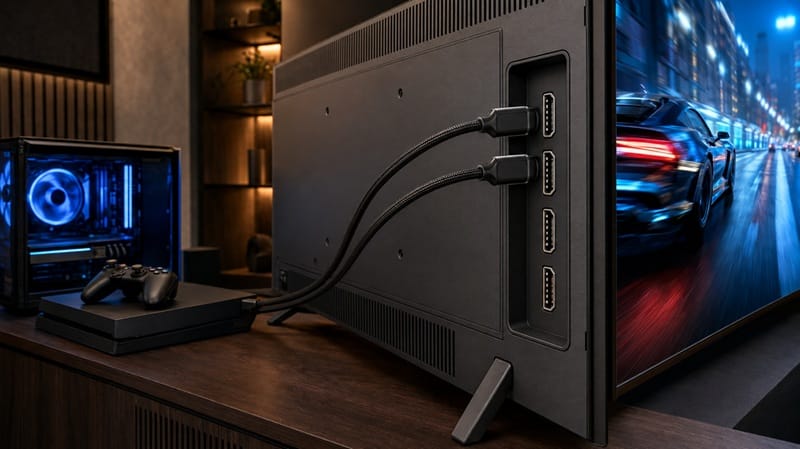
All four HDMI ports support HDMI 2.1 features — 4K at 120Hz, VRR, and ALLM on every single one, not just a labeled “gaming” port. Two are positioned on the side and two on the bottom, which keeps most cable runs manageable if the set is going on a stand rather than a wall mount.
The rest of the connectivity list includes two USB ports, Wi-Fi 6, Bluetooth 5.3, an eARC-capable HDMI connection, and a dedicated digital audio output — coverage that matches step-up Sony models rather than a stripped-down budget configuration.
Performance & Real-World Use
How the Sony K-55XR30M2 Handles Gaming and HDR
Gaming is the strongest part of the published specifications at this size. Every HDMI port carries VRR and ALLM at 4K/120Hz, so console and PC gamers aren’t limited to a single labeled “gaming” input — any of the four ports works the same way.
Dolby Vision, HDR10, and HLG are all listed, with the XR Processor handling tone-mapping across all three rather than leaving HDR content to a simpler chip. Without local dimming, how much that processing offsets the lack of zoned brightness control is the one thing a spec sheet can’t confirm on its own — it’s a detail worth checking against hands-on reviews once more of them exist for this exact model.
Everyday Viewing and Streaming
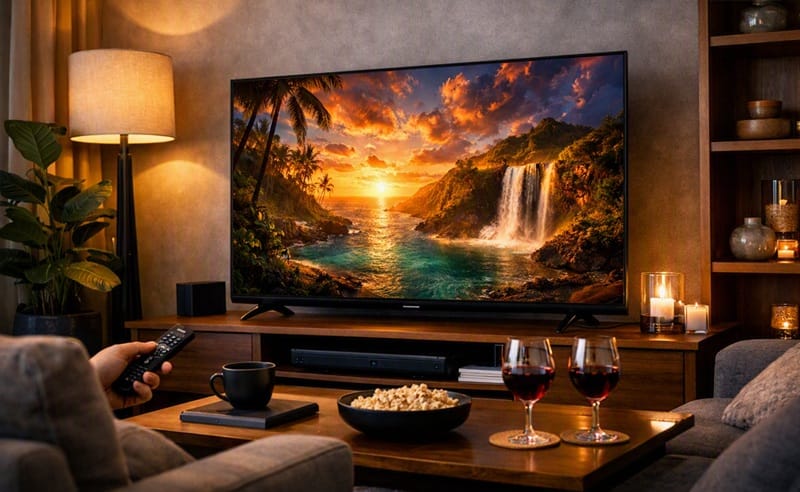
The XR Processor’s upscaling is the same engine Sony uses across pricier BRAVIA models, not a scaled-down version for this tier. The spec sheet also lists calibrated picture modes for Netflix, Sony Pictures Core, and Prime Video, plus a separate Dolby Vision mode set (Vivid, Bright, Dark, Game) on top of the standard Vivid/Standard/Cinema/Game/Professional/Graphics/Photo presets — a wider mode list than most sets publish at this price.
Where the Frame Dimming Backlight Shows Its Limits
Frame Dimming adjusts brightness for the whole panel at once rather than in independently controlled zones, which is the technical reason this model can’t produce the deep, localized black levels that a Mini-LED or OLED set manages. Buyers doing most of their viewing in a dark room will notice this sooner than someone gaming in a bright living room.
Key Features Breakdown
XR Processor at This Price Point
Sony has historically kept its top processing tier for pricier models, so finding the same XR Processor family on a 55-inch budget set is worth noting on its own. On paper, that shows up as Motionflow XR 480 motion handling paired with a native 120Hz panel — the same combination Sony lists on its step-up BRAVIA models, not a simplified version built for this price tier.
Google TV with Gemini
The Gemini-powered voice assistant adds conversational search on top of the standard Google TV app library. Chromecast and Apple AirPlay are both built in, per Sony’s spec sheet, so casting from a phone or laptop doesn’t require extra hardware either way.
The Good, the Bad, and the Ugly
Pros
- ✅ Full HDMI 2.1 across all four ports — no compromise input for gamers, unlike some budget sets that reserve 120Hz for just one or two ports.
- ✅ XR Processor included — the same processor family Sony uses on step-up BRAVIA models, confirmed on Sony’s product page rather than just implied by branding.
- ✅ Broad HDR format support — Dolby Vision, HDR10, and HLG cover nearly everything streaming services deliver.
Cons
- ❌ No local dimming — Frame Dimming controls brightness panel-wide, so dark scenes won’t hold the contrast a Mini-LED set can.
- ❌ No anti-glare coating — that extra is reserved for the 65-inch and 75-inch BRAVIA 3 II sizes, based on Sony’s own spec sheet.
The Ugly
Buyers going by marketing photos of the larger BRAVIA 3 II sizes sometimes assume every size in the family shares the same feature set — this one skips the anti-glare layer those photos often show. For a bright, sun-facing living room, that’s worth confirming before ordering, not after unboxing.
Who Should Buy This — and Who Shouldn’t
Buy This If
The K-55XR30M2 makes sense for anyone shopping for a 55-inch everyday TV who wants real 4K/120Hz gaming support without paying Mini-LED or OLED prices. It’s a bit like buying the performance engine in the base trim level — the processing is the same as pricier BRAVIA models, even though the backlight and screen coating are kept simple.
It’s also a reasonable fit for rooms that aren’t fighting much glare, given the anti-glare gap already covered above. For a broader look at how it stacks up against other panel types at similar prices, our OLED vs Mini LED compared breakdown covers the wider field.
Buyers who’d rather see a full lineup of budget-friendly 4K options side by side before deciding may also want to look at our Samsung Crystal UHD buying guide for a comparison point outside the Sony ecosystem.
Skip This If
Anyone who watches primarily in a dark room and cares about deep, localized black levels should look at a Mini-LED or OLED set instead — the Frame Dimming backlight here isn’t built for that. A bright room with a lot of ambient light is also a case where the missing anti-glare coating will be noticeable; LG’s 55QNED73B is worth cross-shopping for buyers in that situation.
Final Verdict
Is the Sony K-55XR30M2 Worth Buying?
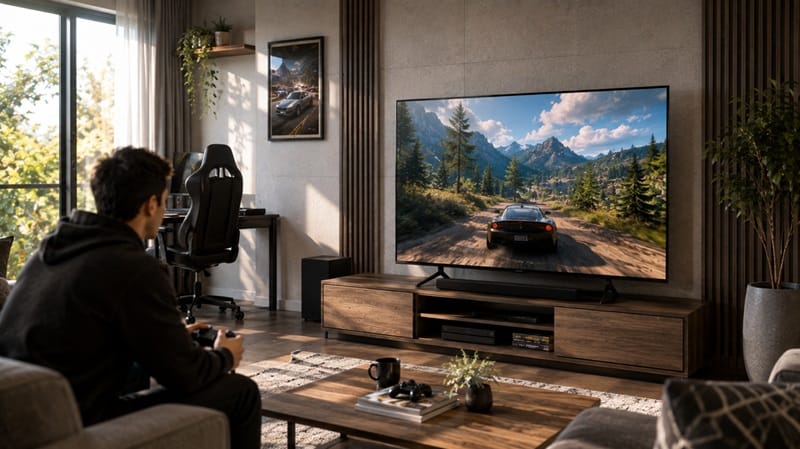
For a 55-inch budget Sony, the K-55XR30M2’s price is justified mainly by what’s under the hood — the XR Processor and full HDMI 2.1 support — rather than by the backlight or screen coating, which are simpler at this size. Buyers who specifically want the anti-glare layer that comes with the larger sizes can compare against the Sony K-75XR30M2 review in this same family, or cross-shop LG’s QNED lineup at the same 55-inch size. 🛒 Check Availability on Amazon
Frequently Asked Questions
Sony K-55XR30M2 review: is it a good TV in 2026?
For its price tier, yes — the combination of Sony’s XR Processor and full HDMI 2.1 support across all four ports is unusual at this level. The tradeoff is a Frame Dimming backlight instead of local dimming, so contrast in dark scenes won’t match a Mini-LED or OLED set.
Does the Sony K-55XR30M2 have anti-glare like the larger BRAVIA 3 II sizes?
No — Sony’s spec sheet for this size leaves the anti-glare and low-reflection field blank, while the 65-inch and 75-inch BRAVIA 3 II pages fill it in.
Is the Sony K-55XR30M2 good for PS5 or Xbox gaming?
Yes. All four HDMI ports support 4K at 120Hz, VRR, and ALLM, so there’s no need to reserve a specific port for a console to get the full gaming feature set.
Who should skip the Sony K-55XR30M2 and look elsewhere?
Buyers focused on dark-room home theater viewing, or anyone who needs an anti-glare screen for a bright room, should consider a Mini-LED alternative like LG’s 55QNED73B or step up to a larger BRAVIA 3 II size that includes the coating.
Does the Sony K-55XR30M2 support Dolby Vision and HDR10?
Yes, along with HLG — all three formats are listed on Sony’s specification page, and the XR Processor is confirmed to handle tone-mapping for each one.

iYaiii
Editor, GearPulse360
iYaiii is the editor and founder of GearPulse360, specializing in TV reviews and consumer electronics. He researches every recommendation before publishing.
✅ Based on Sony’s official specification data — last verified August 2026