Samsung 55M80H vs Samsung 55QN70H: Is Neo QLED Worth Giving Up True 144Hz?
Last updated: August 2026
🕒 10 min read
Disclosure: As an Amazon Associate I earn from qualifying purchases. This article contains affiliate links — we may earn a small commission if you buy through them, at no extra cost to you.
Samsung’s 2026 lineup gives these two TVs names that sound like they belong to different tiers entirely — “Mini LED” on one, “Neo QLED” on the other.
That naming gap usually maps onto a real price gap too, which makes it reasonable to assume the Neo QLED model is just the Mini LED model with a nicer badge and a bigger bill.
RTINGS’ lab testing on the 55M80H complicates that assumption in a way that isn’t obvious from either spec sheet. Despite carrying the “Mini LED” name, the 55M80H ships with no local dimming zones at all — a single-zone backlight behind a Mini LED panel.
That’s a structural difference from the 55QN70H’s Quantum Mini LED backlight, not just a marketing one, and it’s the reason the 55QN70H is our pick for most buyers here, even though the 55M80H wins outright on raw gaming input lag.
What follows breaks that gaming-vs-picture trade-off down by category — picture quality, gaming, and brightness — so you can see exactly where the M80H’s edge holds up and where it doesn’t. If you’ve already ruled out this size and want to see how a different Samsung tier pairing shakes out, our Samsung QN55LS03H vs Samsung 55M70H comparison covers a similar budget-vs-step-up matchup at 55 inches.
Table of Contents
Samsung 55QN70H — the stronger all-around pick, thanks to real zoned backlighting the 55M80H doesn’t have
The 55QN70H’s Quantum Mini LED backlight and quantum dot layer give it the more complete picture for movies, sports, and everyday HDR viewing. The 55M80H’s exception is narrow but real: RTINGS’ testing found excellent input lag and full VRR support, which matters if competitive gaming responsiveness is your priority over motion clarity.
How They Compare
Picture Quality
Gaming
Design
Value
BUY 55M80H IF…
› You want the lowest input lag and full VRR support for competitive gaming
› You’re using it mainly as a PC monitor and value text clarity and refresh headroom
› Deep local-dimming contrast isn’t a priority in your viewing room
BUY 55QN70H IF…
› You want real zoned local dimming, not a single-zone backlight
› Color accuracy and HDR color volume matter more than chasing 144Hz
› You want the model Samsung positions as the actual step-up tier
Ready to act on that verdict? See our picks for our Samsung Crystal UHD buying guide →.
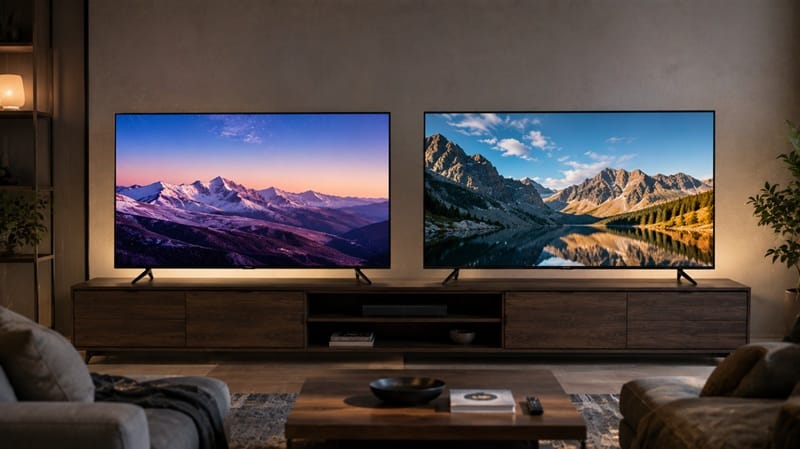
How the Samsung 55M80H and 55QN70H Actually Differ
What Is the Samsung 55M80H?
The 55M80H is part of Samsung’s new M Series, introduced in 2026 as an entry point below the Neo QLED lineup. It borrows gaming features — full VRR support, a 144Hz native panel, and HDMI 2.1 bandwidth on all three inputs — from Samsung’s higher-tier QLED sets, while sitting on more basic picture hardware.
RTINGS’ lab testing confirmed the panel has no local dimming feature at all, which is a meaningful gap for a TV marketed under the “Mini LED” name.
What Is the Samsung 55QN70H?
The 55QN70H sits inside Samsung’s Neo QLED 4K lineup for 2026. Based on Samsung’s own product listing, it uses a Quantum Mini LED backlight controlled by Quantum Matrix Technology, paired with a quantum dot layer Samsung markets as delivering 100% color volume.
Those brightness and dimming-zone figures come from Samsung’s own spec sheet — the company doesn’t publish an exact zone count or independently measured dimming performance beyond the marketing name, so treat them as manufacturer-stated rather than lab-confirmed.
The Key Structural Difference
Both TVs carry “Mini LED” somewhere in their branding, but only one of them actually dims in zones.
That single fact, confirmed through RTINGS’ testing of the 55M80H, is doing more work in this comparison than either model’s marketing copy lets on — and it’s the thread running through everything below.
Samsung 55M80H vs Samsung 55QN70H: Picture Quality and Local Dimming
“Mini LED” is supposed to signal smaller LEDs packed into more dimming zones — a direct upgrade path over standard LED backlighting. The 55M80H doesn’t deliver that upgrade.
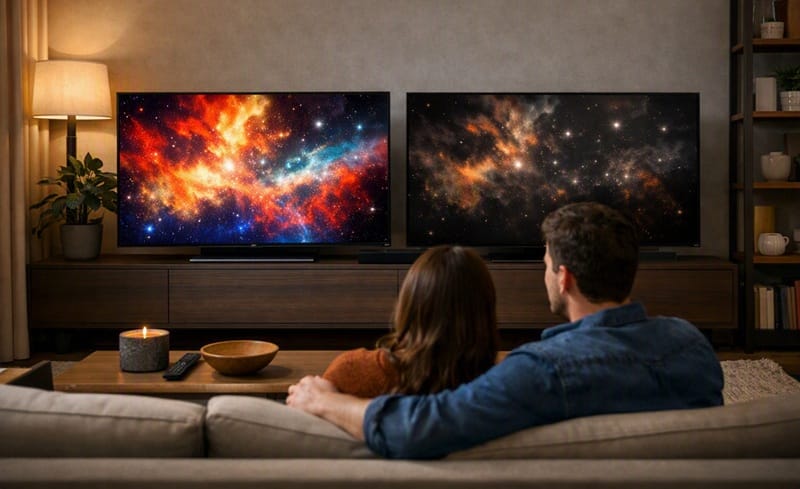
RTINGS’ lab testing found the 55M80H’s native panel contrast is decent on paper, but with a single backlight zone instead of several, blacks get raised across the board and look gray rather than deep.
Color volume fared better: RTINGS logged decent DCI-P3 coverage in both SDR and HDR, though accuracy in the wider BT.2020 space dropped off in lighter scenes.
The 55QN70H’s Quantum Mini LED backlight, per Samsung’s spec listing, is built around Quantum Matrix Technology and multiple dimming zones rather than one flat backlight — architecturally a different category, even though Samsung’s spec sheet stops short of publishing an exact zone count or independently measured dimming performance.
Call the 55QN70H’s contrast edge likely, not confirmed, until more granular data surfaces.
Gaming Performance: The 55M80H’s Numbers vs. What RTINGS Actually Measured
On a spec sheet, the 55M80H should be the gaming pick by a wide margin over a 60Hz-class model.
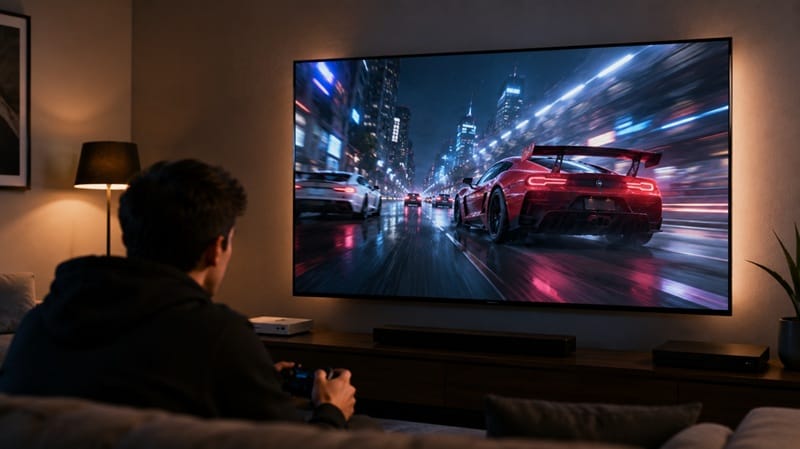
RTINGS logged excellent input lag on the 55M80H — almost no measurable delay at 120Hz across resolutions, full HDMI Forum VRR, FreeSync, and G-Sync Compatible support, plus a 240Hz mode at 1080p from a PC.
The catch shows up in motion clarity: RTINGS’ testing found high blur at every refresh rate it checked, including the panel’s max 144Hz, where most pixel transitions were too slow to complete cleanly.
A responsive TV and a smooth-looking one aren’t automatically the same thing, and this panel leans hard toward the first at the expense of the second.
The 55QN70H’s native panel refresh rate sits at 60Hz, based on Samsung’s current spec listing — the “Motion Xcelerator + DLG” figure in Samsung’s marketing is an interpolated number, not the panel’s true refresh rate, a gap we’ve also documented in our coverage of the 65-inch QN70H.
That’s a real ceiling below the 55M80H’s native 144Hz, regardless of how the QN70H’s own motion clarity eventually tests.
Brightness and HDR: Why the 55M80H Falls Short in Bright Rooms
Brightness is usually where a value-tier TV shows its limits first, and RTINGS’ numbers back that up here.
Peak HDR brightness on the 55M80H came back poor in RTINGS’ testing — not enough for an impactful HDR experience in bright scenes — and SDR brightness landed as only adequate for moderate glare rather than a consistently sunlit room.
Paired with the panel’s single-zone backlight, small HDR highlights don’t stand out the way they would on a TV with zoned dimming.
Samsung’s official 55QN70H product page markets its Quantum Mini LED backlight as delivering more precise backlighting for brighter highlights, on top of the quantum dot layer’s color volume claims — unverified independently, but consistent with a backlight built to do more than a single-zone panel can.
Where the 55M80H and 55QN70H Actually Fit in Samsung’s 2026 Lineup
“Neo QLED” reads like a premium name, but Samsung’s own lineup structure spells out exactly what that premium buys.
Samsung positions the M Series — the 55M70H and 55M80H — as its value Mini LED tier, sitting below the Neo QLED lineup and built without a quantum dot layer. The 55QN70H sits a step above it in the Neo QLED tier, with quantum dot color and zoned Quantum Mini LED backlighting as the stated differentiators.
RTINGS’ verdict on the 55M80H shows the gap isn’t limited to the backlight. Build quality was rated mediocre, described as mostly cheap plastic with noticeable flex across the back panel, and viewing angles came back mediocre too.
Samsung’s own regional product listings describe the 55QN70H’s chassis with an “AirSlim” design designation, a feature name the 55M80H’s listings don’t carry — a minor detail on its own, but one more data point pointing the same direction as the build-quality gap RTINGS measured.
The QN70H isn’t the only step up from the M80H, either. Samsung’s Neo QLED lineup runs a tier higher still with the QN80H, and the same local-dimming question applies there too. Our Samsung 55M80H vs Samsung 55QN80H comparison covers that wider gap using the same RTINGS testing baseline.
55M80H vs 55QN70H: Best Pick by Use Case
| Use Case | Winner | Why |
|---|---|---|
| Dark room movie nights | 55QN70H | Zoned backlight architecture vs. the 55M80H’s confirmed lack of local dimming |
| Bright living room, daytime viewing | 55QN70H | 55QN70H’s marketed brightness edge vs. the 55M80H’s RTINGS-confirmed weak HDR brightness |
| Competitive online gaming | 55M80H | RTINGS-confirmed excellent input lag and full VRR support |
| Fast-motion sports and shooters | 55QN70H | The 55M80H’s RTINGS-confirmed motion blur undercuts its high refresh numbers |
| PC monitor use | 55M80H | RGB subpixel layout for clearer text, plus 1080p @ 240Hz support |
Which Should You Buy?
For most buyers, the 55QN70H is the better all-around pick. Zoned local dimming and a quantum dot color layer address the two areas where RTINGS’ testing found the 55M80H falling short — contrast and HDR brightness — and those affect nearly everything you watch, not just a specific use case.
If your priority is competitive gaming and input lag specifically, the 55M80H’s RTINGS-confirmed responsiveness and full VRR support make a real case for it — just go in aware that motion clarity on fast-moving content won’t match the refresh-rate number on the box.
If your priority is PC monitor use, the 55M80H’s RGB subpixel layout and 240Hz 1080p mode give it a real advantage for text clarity and desktop use that the 55QN70H’s spec sheet doesn’t match. Curious how the M Series’ local-dimming gap plays out on a different model? Our Samsung 65M70H review covers the same finding on a step-down tier.
📍 Weighing more than just these two Mini LED and Neo QLED models? Our best 4K TVs of 2026 roundup puts them in context against the rest of this year’s field.
Samsung 55M80H vs Samsung 55QN70H: Common Questions
Is the Samsung 55QN70H better than the 55M80H for movies?
Yes. The 55QN70H’s zoned Quantum Mini LED backlight and quantum dot color layer are built to handle the contrast and HDR brightness that movie watching depends on, while RTINGS’ testing found the 55M80H’s single-zone backlight raises blacks and limits HDR impact.
Is the Samsung 55QN70H worth choosing over the 55M80H?
For most people, yes. RTINGS’ full review of the Samsung M80H rates it as a mediocre TV overall that doesn’t excel at any specific use, which makes the 55QN70H’s architectural advantages in backlighting and color worth the step up for typical mixed viewing.
Does the Samsung 55M80H actually have local dimming?
No. RTINGS’ lab testing confirmed the 55M80H has a single-zone backlight with no local dimming feature, despite carrying the Mini LED name.
Does it matter that RTINGS hasn’t independently reviewed the 55QN70H yet?
Not for the core decision. Samsung’s own spec sheet already establishes real architectural differences — zoned backlighting and quantum dot color — that the 55M80H doesn’t have, and those differences don’t hinge on a future lab review to be true.
Which one is better if I’m using it as a PC monitor?
The 55M80H. Its RGB subpixel layout is built for clearer text at a desk, and it supports a 240Hz mode at 1080p from a PC — both features the 55QN70H’s current spec sheet doesn’t match.

iYaiii
Editor, GearPulse360
iYaiii is the editor and founder of GearPulse360, specializing in TV reviews and consumer electronics. He researches every recommendation before publishing.
✅ Based on RTINGS lab testing and Samsung’s official product specifications — last verified August 2026