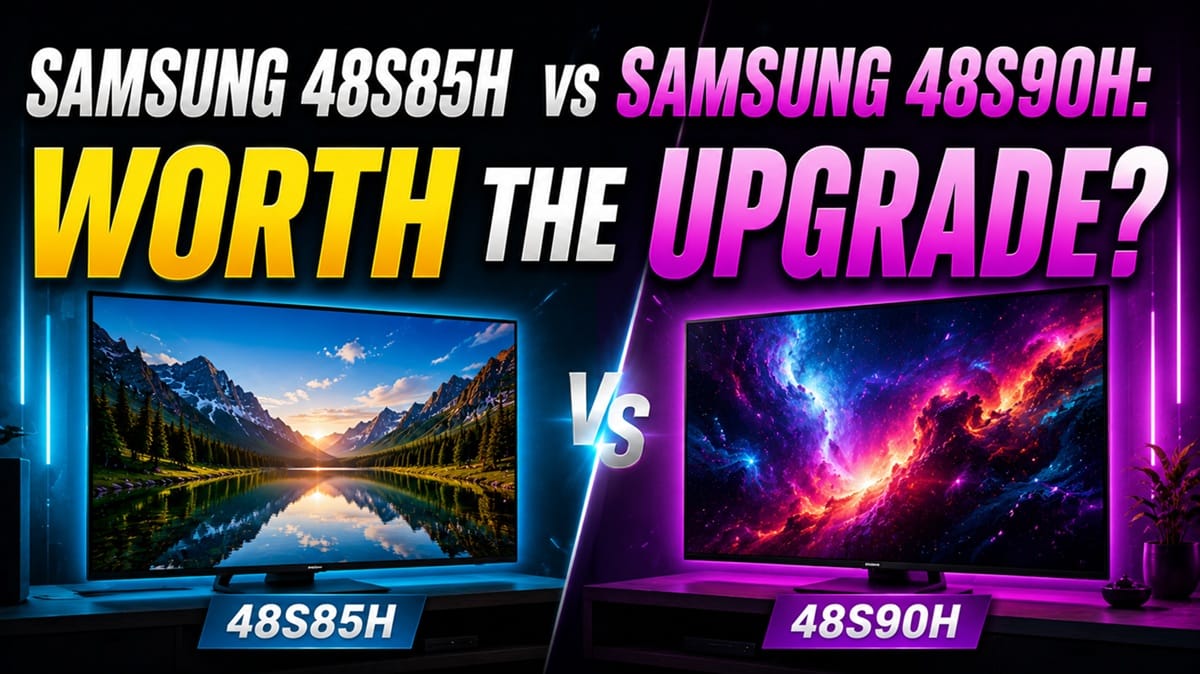
Samsung 48S85H vs Samsung 48S90H: Is the 48-Inch Step-Up Worth It in 2026?
Last updated: August 2026
🕒 9 min read
Disclosure: As an Amazon Associate I earn from qualifying purchases. This article contains affiliate links — we may earn a small commission if you buy through them, at no extra cost to you.
You’ve narrowed a 48-inch Samsung OLED down to two options, and on paper they look closer than they are. Both are OLED, both list HDR10+ and VRR, and both come from the same 2026 lineup — the kind of overlap that makes “just get the better one” feel like the safe call in a Samsung 48S85H vs Samsung 48S90H matchup.
For most buyers, the Samsung 48S90H is the one to get. It uses a newer generation of panel construction at this specific size, adds Glare Free screen treatment, and runs at a faster native refresh rate — differences that matter more at 48 inches, where the TV usually sits closer to a desk, bed, or window than a living-room 65-incher would.
That’s not automatic, though. If the room stays dark and reflections were never a problem, or the price difference doesn’t fit the budget, the 48S85H holds up as a legitimate pick rather than a downgrade. For a look at how the S90H compares one tier further up, our Samsung S90H vs S95H compared breaks down that next step.
Table of Contents
Samsung 48S90H — newer panel construction, Glare Free coating, and a faster 165Hz refresh rate justify the step up for most rooms.
The 48S85H stays glossy and tops out at 120Hz, which is fine in a dark, glare-free room where budget outweighs the extras. If your 48-inch OLED is going anywhere near a window, desk lamp, or bright overhead light, the 48S90H’s screen treatment shows up in daily use, not just on a spec sheet.
How They Compare
Picture
Gaming
Design
Value
Ready to act on that verdict? See our picks for our Samsung OLED roundup →.
How the Samsung 48S85H and 48S90H Actually Differ
What Is the Samsung 48S85H?
The 48S85H is Samsung’s entry point into 2026 OLED, and the 48-inch size is new to the S85H line this year. It runs Samsung’s NQ4 AI Gen2 processor, tops out at a 120Hz native refresh rate, and keeps a traditional glossy screen finish rather than the anti-glare treatment found higher up the lineup. Based on Samsung’s own product page for the 48S85H, it’s built around a standard WOLED panel supplied by LG Display.
What Is the Samsung 48S90H?
The 48S90H sits one tier up, pairing the newer NQ4 AI Gen3 processor with a 165Hz native refresh rate and Samsung’s Glare Free anti-reflective coating — a feature that debuted at 48 inches for the first time this generation. For a broader look at how WOLED, QD-OLED, and tandem panel constructions differ across brands, our OLED panel types explained guide covers the underlying technology in more depth.
The Key Structural Difference
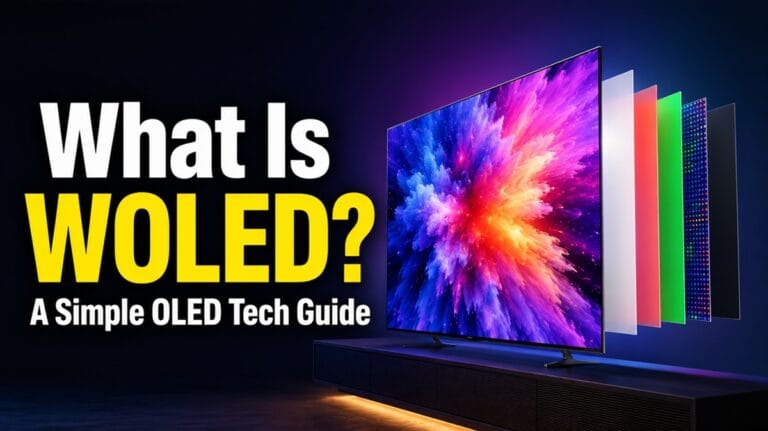
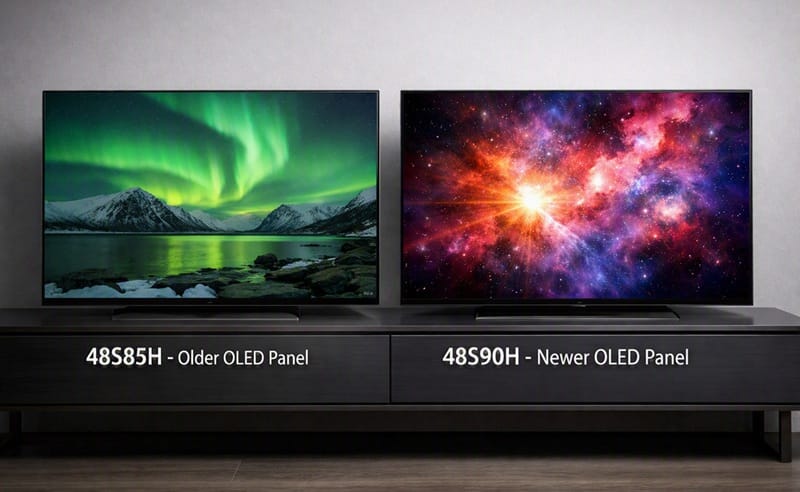
A spec sheet that lists both TVs simply as “OLED” hides the more important detail. According to RTINGS’ testing of the 65-inch S90H, Samsung uses a standard single-stack WOLED panel at most sizes in this series — except at 48 and 77 inches, where the S90H switches to an RGB tandem OLED panel, the same construction category used in LG’s higher tier 2026 sets.
That panel structure is newer than the standard WOLED panel used across the entire 48S85H line, and it’s specific to this size rather than something that carries across the whole S90H range.
Panel and Picture Quality: Who Wins?
Why the Panel Difference Matters
The tandem construction in the 48-inch S90H is built to push more brightness and better color purity out of the panel than a standard single-stack WOLED can manage at the same size — the kind of gain that shows up in HDR highlights and richer color rather than in deeper blacks, since both panel types already hit true black through per-pixel dimming. Based on Samsung’s own product page for the 48S90H, that panel upgrade ships alongside the newer NQ4 AI Gen3 processor, so the picture-quality gains at this size come from a paired hardware step rather than the panel alone.
What the Test Data Shows
According to RTINGS, the 65-inch S90H it tested measured very good peak brightness in SDR and nearly infinite native contrast, with strong DCI-P3 color coverage in the high-90% range. Those results come from the standard WOLED size class, so the 48-inch model — running the tandem panel — has a reasonable basis to match or exceed them on brightness and color purity specifically, based on how RTINGS describes the tandem construction elsewhere in the same review.
The 48S85H, based on manufacturer specifications and published third-party testing of the broader S85H line, still delivers accurate color and OLED-level contrast for its price tier — it’s working from the older panel generation the 48S90H has moved past at this size. For a deeper look at the 48S90H on its own, our full Samsung 48S90H review covers the rest of its spec sheet.
Screen Finish: Glossy vs Glare Free
Why This Matters More at 48 Inches
This is the dimension most buyers underestimate until the TV is mounted. The 48S85H keeps a glossy screen finish, which reflects window light, lamps, and overhead fixtures directly back at the viewer instead of diffusing them.
What the Coating Actually Does
The 48S90H’s Glare Free coating is a matte anti-reflective treatment that spreads and softens direct reflections instead of mirroring them. According to RTINGS’ testing of the S90H line, the coating handles direct reflections and total reflected light exceptionally well, though in a room with ambient light, black levels rise slightly more than they do on a glossy-coated OLED like the LG C6 under the same conditions — a small tradeoff for the reflection control it buys.
If the TV lives in a bedroom with blackout curtains or a dedicated home theater, that tradeoff barely matters. If it’s going on a desk near a window, in a kitchen, or in any room with daytime light, the Glare Free coating is the difference between actually using the picture settings you paid for and fighting reflections every afternoon.
Gaming Performance: Who Wins?
Both TVs are capable gaming displays for their tier. The 48S85H supports VRR, ALLM, AMD FreeSync Premium, and Nvidia G-Sync compatibility at up to 120Hz, with four HDMI 2.1 ports — a solid spec sheet for console gaming and casual PC use.
The 48S90H raises the ceiling to a 165Hz native refresh rate with the same VRR, ALLM, and FreeSync Premium Pro support, plus Nvidia G-Sync certification. According to RTINGS’ testing of the S90H line, input lag is very low across refresh rates and motion clarity at higher Hz is outstanding, with pixel transitions landing close to instantaneous at maximum refresh. For console gaming on a PS5 or Xbox Series X, the practical difference is smaller — both hit 4K at 120Hz with ALLM. The gap widens for anyone connecting a PC that can push past 120 frames per second.
Price and Value: Who Wins?
Samsung positions the 48S90H as a mid-tier step above the 48S85H, and the feature list backs that up rather than just the model number — newer panel construction, a screen coating, and a higher refresh rate are all included in the step-up. The 48S85H remains the stronger raw value if none of those extras matter for how the TV will be used.
Where the 48S90H earns its price is in a feature upgrade you can actually use, not a spec-sheet-only change. Buyers who’d otherwise default to the 48S85H but plan to put the TV somewhere with daytime light should weigh the coating difference against the cost directly, rather than assuming the cheaper model is automatically the better deal.
Samsung 48S85H vs Samsung 48S90H by Use Case
| Use Case | Winner | Why |
|---|---|---|
| Dark bedroom / dedicated home theater | 48S85H | No ambient light to reflect, so Glare Free’s main advantage doesn’t apply |
| Desk or office with window light | 48S90H | Glare Free coating handles daytime reflections that a glossy screen can’t |
| Console gaming (PS5 / Xbox Series X) | Tie | Both cap consoles at 4K/120Hz with ALLM — the 165Hz ceiling isn’t reachable from either console |
| PC gaming above 120fps | 48S90H | 165Hz native refresh rate is usable, the 48S85H’s 120Hz ceiling isn’t |
| Tightest possible budget | 48S85H | Lower entry price without giving up OLED contrast |
Which Should You Buy?
The Default Pick
For most buyers, the Samsung 48S90H is worth the step up. The newer tandem panel construction, Glare Free coating, and 165Hz ceiling are usable improvements at this size, and the price difference at 48 inches buys more than a model-number bump.
The Budget Case
If your priority is keeping cost down and the room stays dark most of the time the TV is on, the 48S85H is a legitimate choice rather than a compromise — you’re still getting OLED contrast, just from the older panel generation and without the screen coating.
The Future-Proofing Case
If your priority is future-proofing for PC gaming or a brighter room down the line, lean toward the 48S90H even if the room is currently dim — screen coating and refresh rate are much harder to retrofit than a graphics card upgrade.
Still weighing Samsung against other OLED brands entirely? Our are Samsung OLED TVs worth it breakdown looks at the brand’s OLED lineup as a whole, not just these two models.
📍 Choosing between these two 48-inch Samsung OLEDs? See how they stack up against the rest of this year’s field in our OLED TV roundup.
Samsung 48S85H vs Samsung 48S90H: Common Questions
Is the Samsung 48S90H worth the upgrade over the 48S85H for gaming?
Yes, if you’re gaming on a PC that can push past 120fps — the 48S90H’s 165Hz native refresh rate is the difference-maker there. For console gaming on a PS5 or Xbox Series X, both TVs cap out at 4K/120Hz with ALLM, so the practical gap narrows considerably.
Is the Samsung 48S90H worth the premium over the 48S85H?
For most rooms, yes. The Samsung 48S85H vs Samsung 48S90H decision really comes down to whether the newer panel construction, Glare Free coating, and higher refresh rate are worth paying for — and for most rooms, they’re functional upgrades rather than cosmetic ones. According to RTINGS’ review of the S90H line, the coating and panel gains are measurable, not just marketing claims. If the room is consistently dark and budget is the deciding factor, the 48S85H remains a sound choice without the premium.
Does the Samsung 48S85H or 48S90H have burn-in risk?
Both carry the same general OLED burn-in risk profile — low under normal, varied viewing, with Samsung’s standard pixel-shift and logo-dimming protections active on both models. Neither panel generation changes that fundamental risk in either direction based on currently available information.
How is next year’s Samsung OLED lineup likely to affect this comparison?
Hard to say with certainty, but the 48-inch size is where this year’s gap opened: Glare Free and the tandem panel construction reached 48 inches for the first time in 2026, features that were previously reserved for larger sizes or higher tiers. If Samsung extends either down to the 48S85H tier next year, the specific advantages covered here would narrow or disappear — but that’s not confirmed for any 2027 lineup as of this writing.
Do the Samsung 48S85H and 48S90H use the same OLED panel supplier?
Both source their panels from LG Display rather than Samsung Display, which is a change from earlier S90-series generations that used QD-OLED panels from Samsung’s own display division. The 48S85H uses a standard WOLED panel from that supplier, while the 48-inch 48S90H specifically uses a newer tandem OLED construction — same supplier, different panel generation.

iYaiii
Editor, GearPulse360
iYaiii is the editor and founder of GearPulse360, specializing in TV reviews and consumer electronics. He researches every recommendation before publishing.
✅ Based on spec analysis and Samsung’s official and RTINGS data — last verified August 2026