Best OLED TVs for Small Spaces in 2026: Top Picks for Apartments, Dorms, and Bedrooms
Last updated: June 2026
🕒 9 min read
Disclosure: As an Amazon Associate I earn from qualifying purchases. This article contains affiliate links — we may earn a small commission if you buy through them, at no extra cost to you.
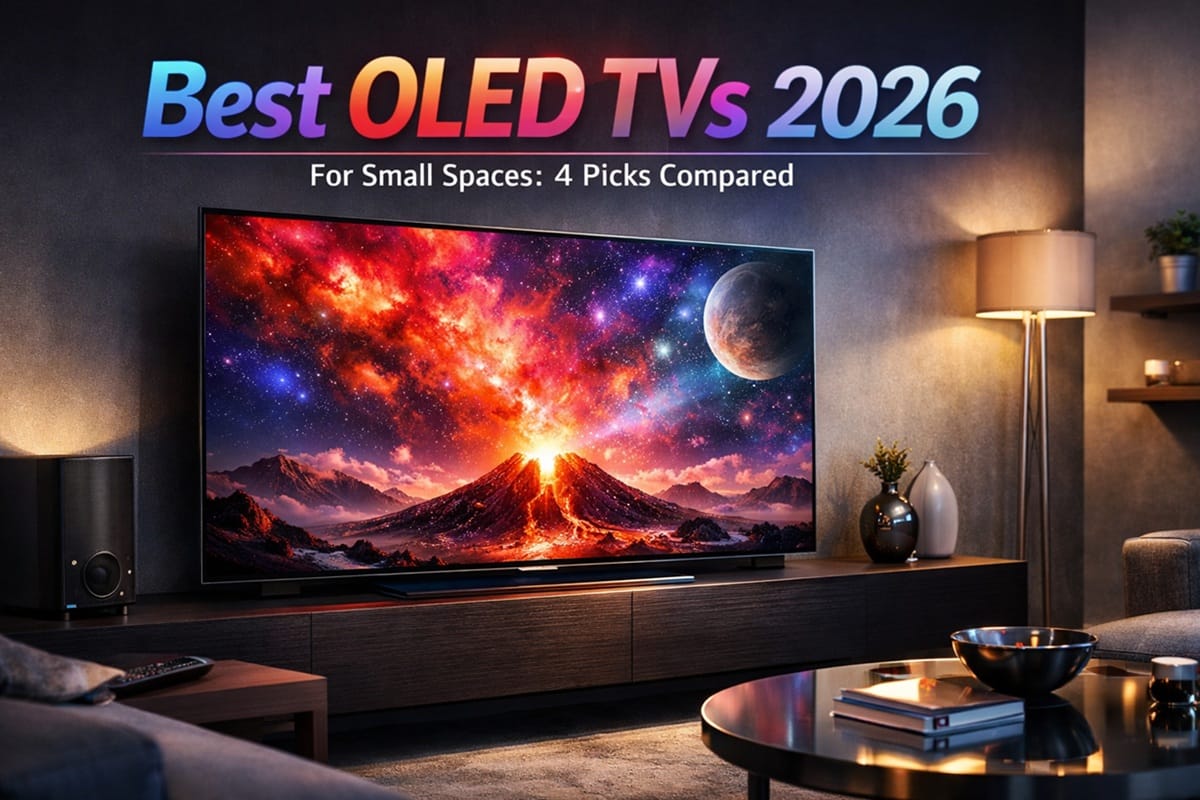
Your studio apartment doesn’t have a 65-inch wall, and that’s fine — OLED still works at 42 and 48 inches, you just have far fewer models to choose from than the bigger-screen guides suggest.
This guide is for renters, dorm residents, and anyone buying a secondary or bedroom TV who actually measured their wall before shopping. We’ll narrow the entire current LG lineup down to four OLED TVs that make sense at 42 or 48 inches, and we’ll be upfront about what you give up at this size compared to a larger OLED.
Our best overall pick is the smallest size LG currently makes — but it’s not automatically the right call for every small room, so read the “best for” line on each pick before deciding.
Table of Contents
Best OLED TVs for Small Spaces: Quick Comparison
| Pick | Model | Panel | Best For | Price |
|---|---|---|---|---|
| Best overall | LG C6 42″ OLED42C6PUA | WOLED | Smallest size, newest tech | Amazon ↗ |
| Best value | LG C5 42″ OLED42C5PUA | WOLED | Best price at 42 inches | Amazon ↗ |
| Bigger bedrooms | LG C6 48″ OLED48C6PUA | WOLED | Rooms with some daylight | Amazon ↗ |
| Best budget | LG C5 48″ OLED48C5PUA | WOLED | Most screen for the price | Amazon ↗ |
↻ Prices change frequently — click through for current pricing.
✓ Rankings reflect our independent editorial assessment — not Amazon customer reviews.
Best Overall OLED TV for Small Spaces: LG C6 42-Inch
If you want LG's current-generation OLED and your room truly can't fit anything larger than 42 inches, this is the one to get. The Alpha 11 AI Gen3 processor is the same chip LG puts in its 65-inch and larger sets this year, so upscaling and motion handling don't get scaled down just because the screen did.
The catch is that 42 and 48-inch C6 models skip LG's Brightness Booster technology entirely, which is the main reason this size class isn't simply a smaller version of the flagship experience. LG's own spec sheet shows the 42-inch panel running noticeably dimmer than the 55-inch and up sizes — in a dark bedroom or dorm room that rarely matters, but it's worth knowing going in.
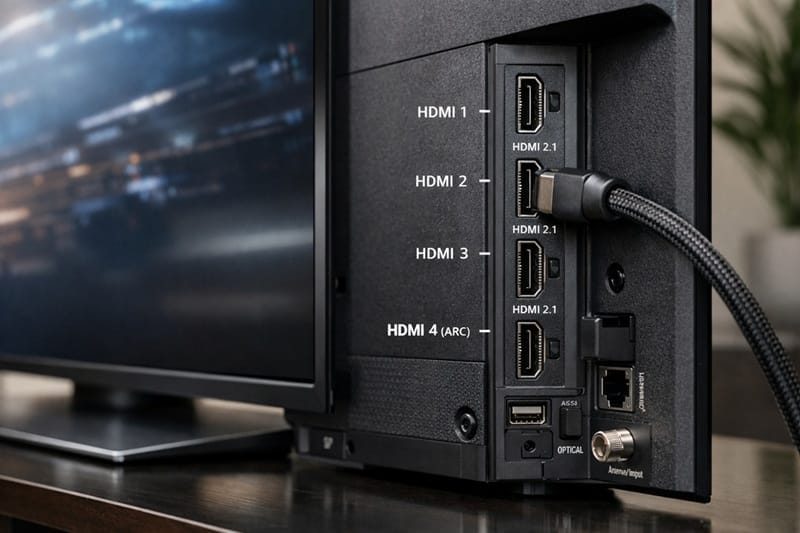
Gamers get the full feature set regardless of size: four HDMI 2.1 ports, 165Hz at 4K, and support for both NVIDIA G-Sync and AMD FreeSync Premium, based on LG's published specs for this model.
Best Value Pick: LG C5 42-Inch
This is the pick we'd actually buy for most small spaces. The C5 and C6 share the same WOLED panel and the same four HDMI 2.1 ports at 42 inches, and neither one gets Brightness Booster — so the newer chip in the C6 is the main thing separating them at this size, not picture quality.
RTINGS bought and independently tested this exact 42-inch panel, noting it's popular as a PC monitor thanks to its built-in processor and webOS, though it lacks a DisplayPort input and an ergonomic monitor stand. Read RTINGS' full LG C5 42 review →
If you're using this as a desk monitor or a small secondary TV rather than a primary home theater screen, the processor gap is the easiest place to save money without losing OLED's core picture-quality advantages.
Best for Bigger Bedrooms: LG C6 48-Inch
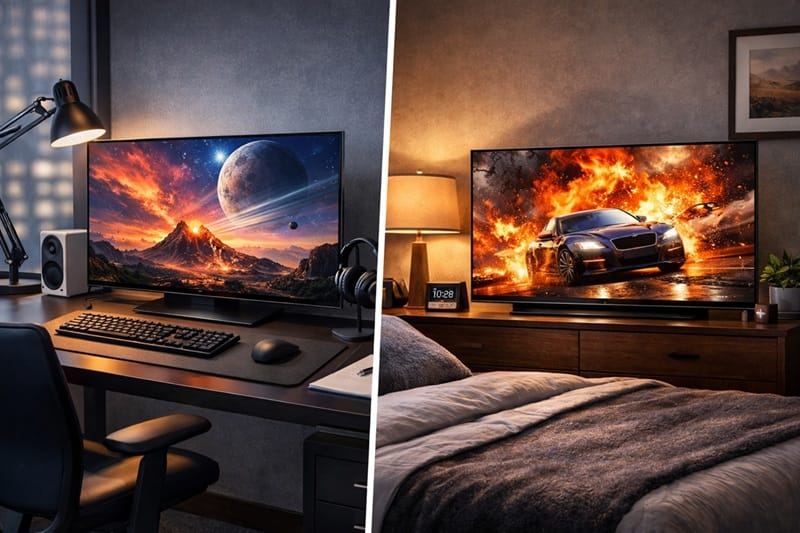
Step up to 48 inches on the C6 and you actually unlock Brightness Booster — checking LG's spec page confirms this is the one size in our small-space range where it's included. That matters more than it sounds: a bedroom with an east-facing window at 7am is a different lighting environment than a blacked-out dorm room at midnight.
Everything else scales up cleanly from our 42-inch top pick — same Alpha 11 processor, same 165Hz ceiling, same four HDMI 2.1 ports. If your space can fit 48 inches and gets any meaningful daylight, this is the small-space pick that's actually built for it.
Best Budget Pick: LG C5 48-Inch
If your priority is screen size over having this year's chip, this is the pick. It's the same panel and the same four HDMI 2.1 ports as the 48-inch C6, minus Brightness Booster and a processor generation — and based on current retail pricing, it's the cheapest way into 48 inches of OLED in this guide.
RTINGS hasn't published a dedicated test of the 48-inch unit specifically, so we're leaning on manufacturer specifications and the shared-panel comparison with the tested 42-inch model rather than independent measurements at this exact size. That's a fair tradeoff for the price, but it's something to factor in before you buy.
For a dorm common area or a bedroom where dollars matter more than the latest AI processor, this is the small-space pick that stretches furthest.
Still deciding between OLED and a same-size LED-based set for a small room? Our full OLED vs QLED comparison breaks down where each technology actually wins.
What to Look for in an OLED TVs for a Small Space
Brightness Booster: Why It's Missing at 42 and 48 Inches
LG's Brightness Booster technology — the feature that pushes peak brightness higher for HDR highlights and daytime viewing — is reserved for 55-inch and larger panels in both the C5 and C6 lines, with one exception: the 48-inch C6 gets a standard version of it. Every other small-space pick in this guide, including the 42-inch C6, ships without it.
Based on manufacturer specifications for the 42-inch C6, that's a deliberate sizing decision from LG, not a defect or a stripped-down panel.
Viewing Distance: How Close Is Too Close
Small rooms usually mean close seating, which changes what actually matters on a spec sheet. At a typical 4–6 foot viewing distance for a 42 or 48-inch screen, pixel structure and upscaling quality matter more than raw peak brightness — which is part of why the processor gap between the C5 and C6 is a more relevant differentiator at this size than it would be on a 65-inch set viewed from across a living room.
Stand Footprint and Wall-Mount Clearance
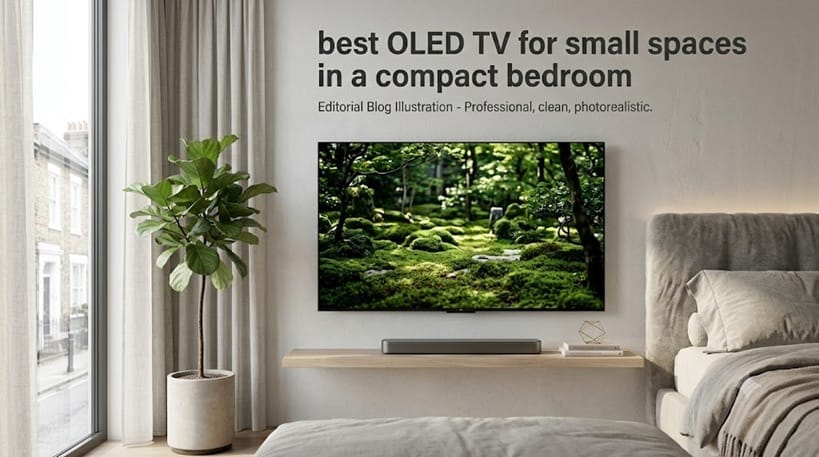
Renters and dorm residents often can't drill into a wall, which makes the included tabletop stand's footprint a real consideration. The 42-inch models use a narrower stand than the 48-inch versions, so measure your dresser or media console width before assuming either size will physically fit where you want it.
Processor Differences: Alpha 9 Gen8 vs. Alpha 11 Gen3
This is the main thing separating the C5 from the C6 at 42 and 48 inches, since neither size gets Brightness Booster on the C5 and only the larger one gets it on the C6. The Alpha 11 chip in the C6 handles AI upscaling and motion processing more aggressively, which shows up most in lower-resolution streaming content rather than native 4K sources.
Is OLED Actually Worth It at 42 or 48 Inches?
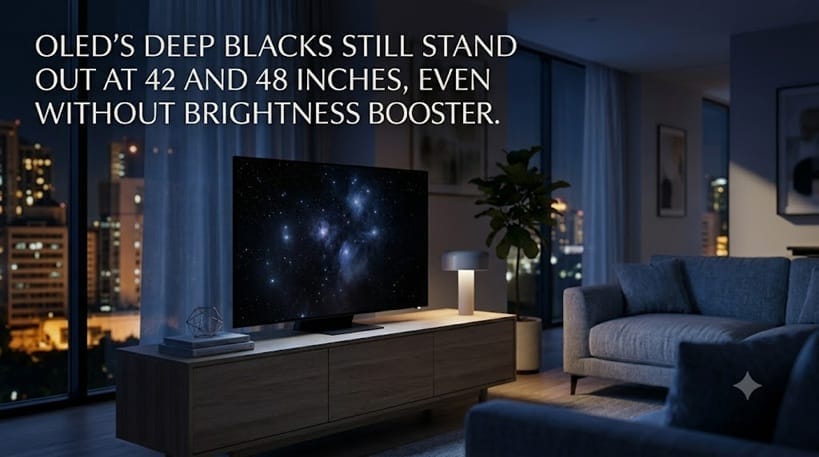
It's a fair objection: OLED's reputation is built on big-screen home theater setups, so does the technology still make sense once you shrink it down to a size that competes with budget LED TVs on price? Based on editorial research across this size range, the core OLED advantages — true per-pixel black levels and wide viewing angles — don't disappear at 42 or 48 inches. What does shrink is the brightness ceiling, since Brightness Booster is largely absent here.
If price is the main pull toward a smaller screen, our Hisense 32A4NV review covers what an actual budget LED set looks like at that price point — a fraction of the cost, without OLED's per-pixel contrast or wide viewing angles.
If a touch more color without OLED pricing matters more than the rock-bottom option, our Hisense 32QD4HSR review covers the Hi-QLED step-up in that same 32-inch, budget-tier class.
One practical note worth addressing honestly: RTINGS flags the 42-inch size as popular for use as a PC monitor, where static content sits on screen for hours at a time. It's the same general OLED burn-in consideration that applies to any screen used as a monitor — see the FAQ below for the specific habits that keep it from becoming an issue.
If you've already decided 42 inches specifically is your size, our best 42-inch OLED TVs guide ranks the category in more depth.
How We Picked These OLED TVs for Small Spaces
We started from LG's full current-generation OLED lineup at 42 and 48 inches — the only sizes that actually qualify as "small space" without overlapping the 55-inch-and-up guides on this site — and cross-checked every spec against LG's own product pages rather than relying on series or tier labels alone.
Pricing was checked against current Best Buy and Amazon listings rather than launch-day MSRP, since both the C5 and C6 see meaningful price movement within their first year. Where RTINGS had independently tested a specific size, we noted that explicitly; where they hadn't, we said so instead of implying hands-on data that doesn't exist.
We'll revisit these picks if LG adjusts pricing meaningfully or adds a small-space model with Brightness Booster across the board.
📍 Not sure 42 or 48 inches is even the right call for your room? Our full roundup ranks OLED TVs across every size and budget tier — see the best OLED TVs of 2026.
Small-Space OLED TV FAQs
Which OLED TV is best for small spaces overall?
The LG C6 42-inch (OLED42C6PUA) is our overall pick — it's the newest processor LG offers in a size that actually fits a small room. If brightness matters more to you than having the latest chip, the 48-inch C5 is the better fit at a lower price.
Is a small OLED TV worth it compared to a similarly sized LED or QLED?
Yes, for picture quality specifically — OLED's per-pixel contrast and black levels hold up at 42 and 48 inches just as they do at larger sizes. The tradeoff is brightness, since neither size gets LG's Brightness Booster on the C5 and only the 48-inch C6 gets it.
Will burn-in be a bigger risk on a small OLED used as a monitor?
It's a real consideration if you're running static content — taskbars, channel logos, HUD elements — for many hours a day, since RTINGS specifically flags the 42-inch size as popular for PC monitor use. The fix is straightforward: vary what's on screen, use a screen saver or auto-sleep timer, and keep brightness moderate rather than maxed out. None of this is unique to small OLEDs — it's standard care for any OLED panel used as a monitor. See RTINGS' full LG C6 OLED review →
Should I get 42-inch or 48-inch for my room?
Measure your actual viewing distance first — under about 5 feet, 42 inches is usually plenty, while 48 inches starts to make sense past that. If you want a deeper breakdown of 48-inch options specifically, our best 48-inch OLED TVs guide covers that size on its own.
Do I need a wall mount, or is a stand fine in a small room?
A stand is fine for most small-space setups and avoids drilling into a rental wall, but check the tabletop footprint against your furniture first — the 48-inch stand is wider than the 42-inch one. A wall mount frees up console space if your lease allows it — if you go that route, how high should a TV be mounted covers the placement question, including a bedroom-specific viewing-angle case.

iYaiii
Editor, GearPulse360
iYaiii is the editor and founder of GearPulse360, specializing in TV reviews and consumer electronics. He researches every recommendation before publishing.
✅ Based on spec analysis and LG's official data plus RTINGS — last verified June 2026