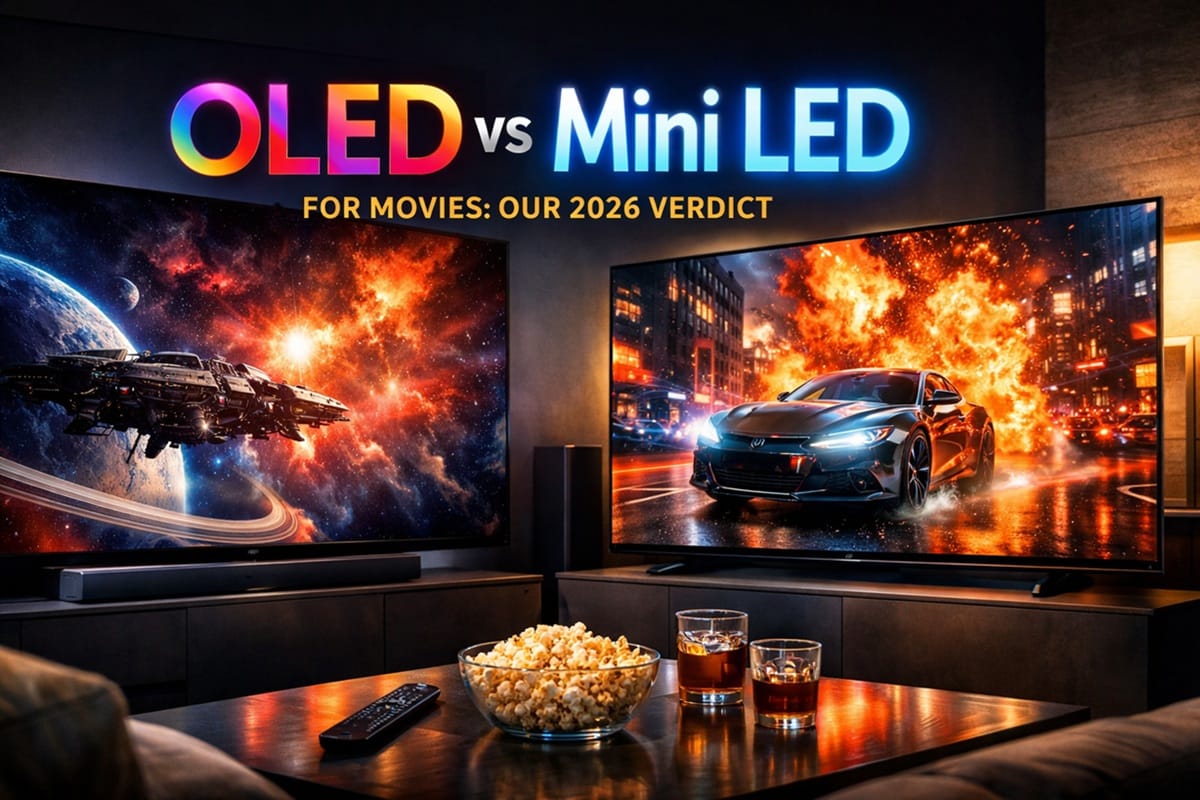
OLED vs Mini LED for Movies: Which Panel Type Wins for Film?
Last updated: June 2026 / 🕒 9 min read
Disclosure: As an Amazon Associate I earn from qualifying purchases. This article contains affiliate links — we may earn a small commission if you buy through them, at no extra cost to you.
You’re comparing two TVs for a movie-focused setup, and they land at a similar price — one’s OLED, one’s Mini LED, and both spec sheets claim the better picture. The panel type you pick changes what dark scenes, letterboxed bars, and HDR highlights actually look like once the lights go down.
For movie watching specifically, OLED is the better choice for most home theaters. Its self-lit pixels turn off completely in dark scenes, which is exactly the condition most films are shot and mastered for. Mini LED earns the win in one specific case: rooms with real daytime light, or budgets that need a much bigger screen.
This guide narrows things down to film and cinematic content only — not gaming, not live sports. If you want the full picture across every use case, our OLED vs Mini LED compared breaks down gaming response times, sports motion handling, and everyday brightness too.
Table of Contents
OLED — self-lit pixels deliver true black levels exactly where movies need them most
For dark home theaters and dedicated movie rooms, OLED’s pixel-level dimming avoids the blooming and halo effects that backlit displays show during space scenes, night-driving sequences, and letterboxed films. The exception is daytime viewing or extra-large budget screens, where Mini LED’s higher sustained brightness and lower cost per inch make more sense.
How They Compare
Picture & Black Level — OLED
Picture & Black Level — Mini LED
HDR Brightness — OLED
HDR Brightness — Mini LED
Viewing Angle — OLED
Viewing Angle — Mini LED
Value for Home Theater — OLED
Value for Home Theater — Mini LED
Ready to act on that verdict? See our picks for best OLED TVs for movies →.
How OLED and Mini LED Actually Differ
What Is OLED?
OLED stands for organic light-emitting diode. Each pixel generates its own light and can switch off individually, which produces a true black with no backlight glow behind it. LG’s OLED technology overview describes this as a self-lit pixel design, since there’s no separate backlight layer at all.
That self-emissive structure is also why OLED panels keep their picture quality consistent from off-center seats — useful for movie nights with more than one viewer. For a closer look at how the panel itself works, see our explainer on what OLED TV technology is.
What Is Mini LED?
Mini LED is a backlighting upgrade for traditional LCD panels. Instead of a handful of large LEDs behind the screen, it packs in thousands of much smaller ones, grouped into local dimming zones that brighten or dim independently.
The panel itself still relies on a liquid crystal layer to block or pass that backlight, so it can’t turn individual pixels fully off the way OLED can — it can only dim a zone covering many pixels at once.
OLED vs Mini LED Black Level: Which Wins for Dark Movie Scenes?
Picture quality in a movie context comes down almost entirely to how a TV handles black. Most films include extended dark scenes — space, night exteriors, dimly lit interiors — and how a panel renders those scenes affects the viewing experience more than resolution or color gamut.
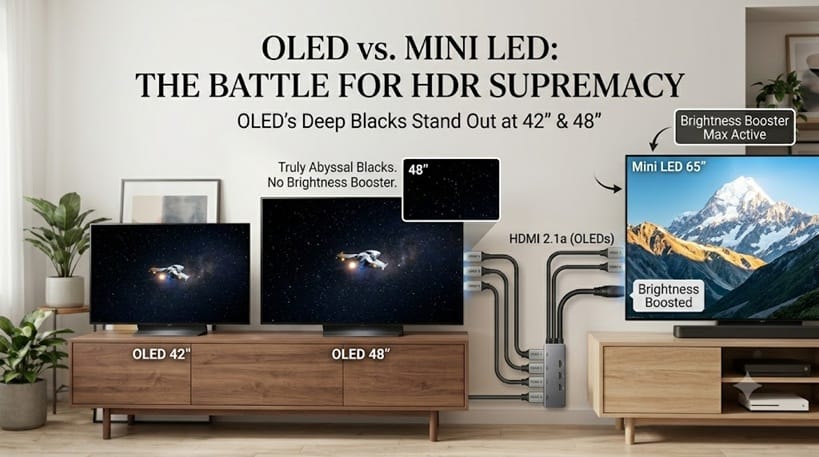
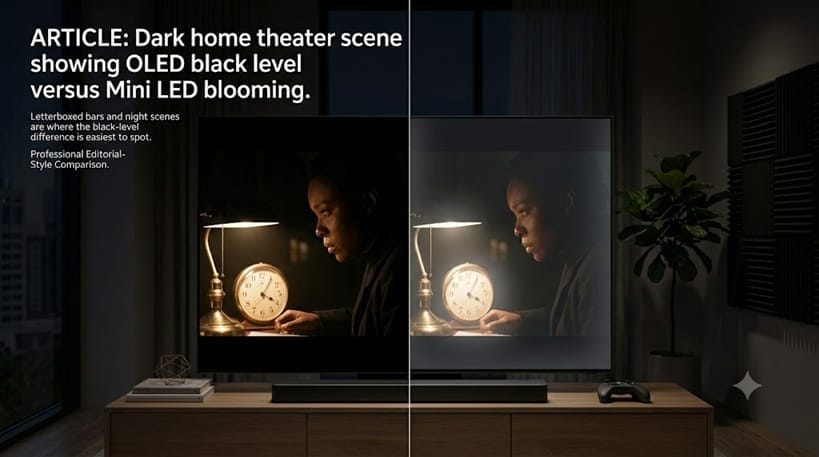
OLED wins this one clearly. Because each pixel emits and controls its own light, it can turn fully off, producing a black level with no measurable glow behind it. Samsung’s own comparison of the two technologies confirms that self-emissive OLED pixels produce deeper blacks than backlit alternatives, since Mini LED still has to dim groups of pixels together rather than one at a time.
Mini LED has closed some of that gap with higher zone counts, but the difference still shows up around bright subtitles or letterboxed black bars — the kind of high-contrast edge a movie throws at the screen constantly.
HDR Brightness & Highlight Detail: Which Wins?
HDR movie transfers are graded with bright highlights in mind — explosions, sunlit exteriors, neon-lit cityscapes. How much sustained brightness a panel can hold onto in those moments changes how punchy those scenes feel.
Mini LED wins this dimension. Backlight-based panels can sustain much higher full-screen brightness for extended HDR highlights without dimming the rest of the image to protect the panel. OLED has improved with newer high-brightness panel variants, but it still trails dedicated Mini LED backlighting in sustained peak output, based on independent testing data.
That gap matters more in a bright living room than in a dark dedicated theater, where OLED’s lower brightness ceiling is rarely the limiting factor.
Viewing Angle for Home Theater Seating: Which Wins?
Movie nights rarely involve just one viewer sitting in the exact center seat. Whoever ends up at the end of the couch or in an armchair off to the side needs the picture to look right too.
OLED wins here. Because every pixel emits its own light, color and contrast stay consistent even from a sharp off-axis angle. Mini LED panels still rely on an LCD layer in front of the backlight, and that layer’s natural viewing-angle falloff means contrast and color can shift noticeably for anyone not sitting dead center.
Some premium Mini LED models add wide-angle filters to narrow this gap, but they typically trade off some contrast or brightness to do it.
OLED vs Mini LED Value: What Costs More for a Home Theater Setup?
Value isn’t just about the sticker price — it’s about how much screen and performance you get for your home theater budget.
Mini LED wins on raw value. It scales to much larger screen sizes for noticeably less money than OLED, which makes it the practical choice for buyers who want a bigger canvas before they want perfect blacks.
OLED narrows that gap at mid-range sizes, where pricing has come down considerably, but it still costs more once you start looking at 77-inch-plus screens for a dedicated theater room.
OLED vs Mini LED by Movie-Watching Scenario
The right pick changes depending on the room and the kind of movies you watch most. Here’s how that breaks down by scenario.
Which Should You Buy?
For most buyers setting up a dedicated movie room with controllable lighting, OLED is the stronger investment — the black-level and viewing-angle advantages line up directly with how films are mastered and watched. If you’re building out a full dedicated room rather than just picking a panel type, our best OLED TVs for home theater guide covers the room-level considerations — screen size for seat distance, Dolby Atmos passthrough — that go beyond this panel-type comparison alone.
If your TV doubles as your living room screen during the day with windows letting in light, Mini LED’s brightness advantage may matter more in practice than OLED’s deeper blacks. Our LG 55QNED84B review looks at exactly that kind of pick — a mid-range Mini LED set built more for everyday, bright-room viewing than a dark dedicated theater.
If you’re trying to maximize screen size on a fixed budget — especially at 85 inches and up — Mini LED currently delivers more screen for the money than OLED can match.
📍 Already decided OLED is the right call for your movie room? See our full roundup of the best models worth buying this year on the best OLED TVs of 2026 page.
OLED vs Mini LED for Movies: Common Questions
Is OLED better than Mini LED for watching movies?
Yes, for most home theater setups. OLED’s per-pixel black levels match how films are mastered for dark, controlled-lighting rooms. Mini LED only pulls ahead when the room has real ambient light or the budget calls for a much larger screen.
Is OLED worth the extra cost over Mini LED for a home theater?
For a dark, dedicated movie room, yes — the black-level and viewing-angle gains are the exact things that show up most during film watching. For a brighter, multi-purpose living room, the extra cost is harder to justify since Mini LED’s brightness advantage matters more there.
Does Mini LED have more blooming than OLED in dark movie scenes?
Yes, to some degree. Mini LED dims zones of pixels together rather than individual pixels, so bright elements on a dark background — subtitles, letterbox bars, starfields — can show a faint halo. RTINGS’ comparison of the two technologies confirms that higher zone counts reduce this effect but don’t eliminate it the way OLED’s per-pixel control does.
Will Mini LED close the black-level gap with OLED?
It’s been narrowing the gap with higher zone counts and better dimming algorithms each generation, but Mini LED still can’t match true per-pixel control because it dims groups of pixels rather than individual ones. Closing that gap completely would require backlight zones approaching pixel-level density, which isn’t where current Mini LED roadmaps are headed.

iYaiii
Editor, GearPulse360
iYaiii is the editor and founder of GearPulse360, specializing in TV reviews and consumer electronics. He researches every recommendation before publishing.
✅ Based on spec analysis and LG’s and Samsung’s official data plus RTINGS — last verified June 2026