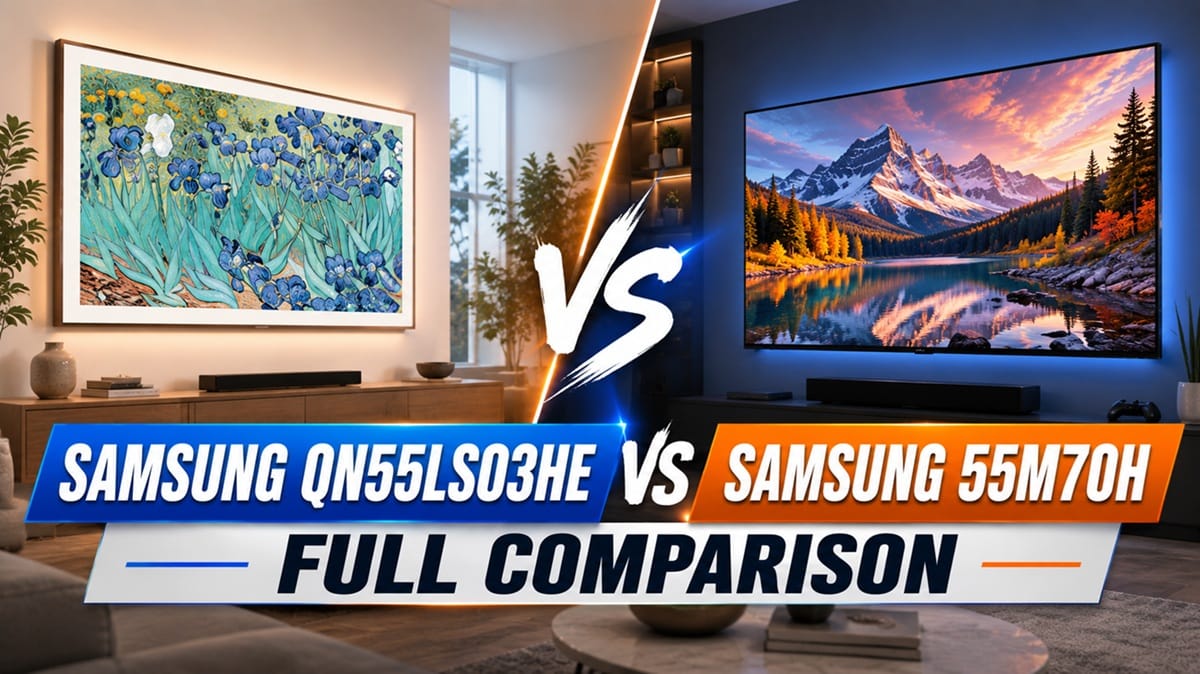
Samsung QN55LS03HE vs Samsung 55M70H: Is Art Mode Worth Giving Up Local Dimming?
Last updated: August 2026
🕒 9 min read
Disclosure: As an Amazon Associate I earn from qualifying purchases. This article contains affiliate links — we may earn a small commission if you buy through them, at no extra cost to you.
Both of these show up under the same “55-inch Samsung” search, and on the surface that seems reasonable — same brand, same year, same screen size. But a Samsung QN55LS03HE vs Samsung 55M70H comparison isn’t really two versions of one TV.
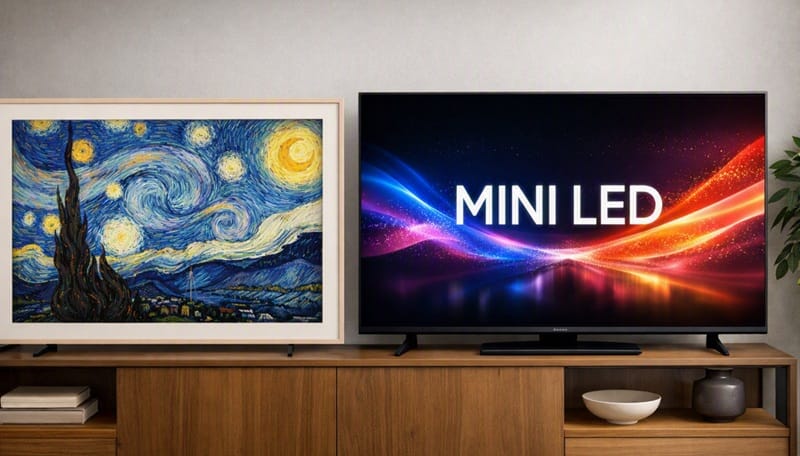
One is Samsung’s art-forward Lifestyle TV, built to look like a picture frame on your wall. The other is a bare-bones Mini LED-branded set built to hit a low price point. They’re not competing for the same buyer by design, which is exactly why the overlap in search results is confusing.
RTINGS’ testing data for both models puts the QN55LS03HE ahead on more than just design. It measures better across brightness, color coverage, motion handling, and gaming responsiveness — none of it tied to Art Mode. The 55M70H’s real advantage is price, not performance.
That gap matters more in some rooms than others. If you’re weighing this against other options in the same price range, our Samsung QN55LS03HE vs Samsung QN55LS03H comparison covers the step-up Frame Pro tier for readers who want to see how far the Frame lineup goes before it stops making financial sense.
Table of Contents
Samsung QN55LS03HE — the better TV, not just the better-looking one
Based on RTINGS testing, the Frame measures brighter in HDR and SDR, covers more of the DCI-P3 color space, handles motion noticeably better, and supports full HDMI 2.1 gaming where the 55M70H is capped at HDMI 2.0 and 60Hz. The exception: if the budget can’t stretch to the Frame, the 55M70H still works as a basic secondary-room TV — just don’t expect it to compete with similarly priced alternatives on picture quality.
How They Compare
Picture Quality
Design & Room Fit
Gaming Performance
Value
BUY THE FRAME IF…
› You want Art Mode and a wall-ready look when it’s off
› Your room gets bright ambient light or direct glare
› You want 144Hz and full HDMI 2.1 gaming
BUY THE 55M70H IF…
› You need a simple secondary-room TV
› Budget matters more than design or gaming specs
› You have no interest in Art Mode or wall-mount aesthetics
Ready to act on that verdict? See our picks for our Samsung Crystal UHD buying guide →.
How the Frame and the 55M70H Actually Differ
What Is the Samsung QN55LS03HE?
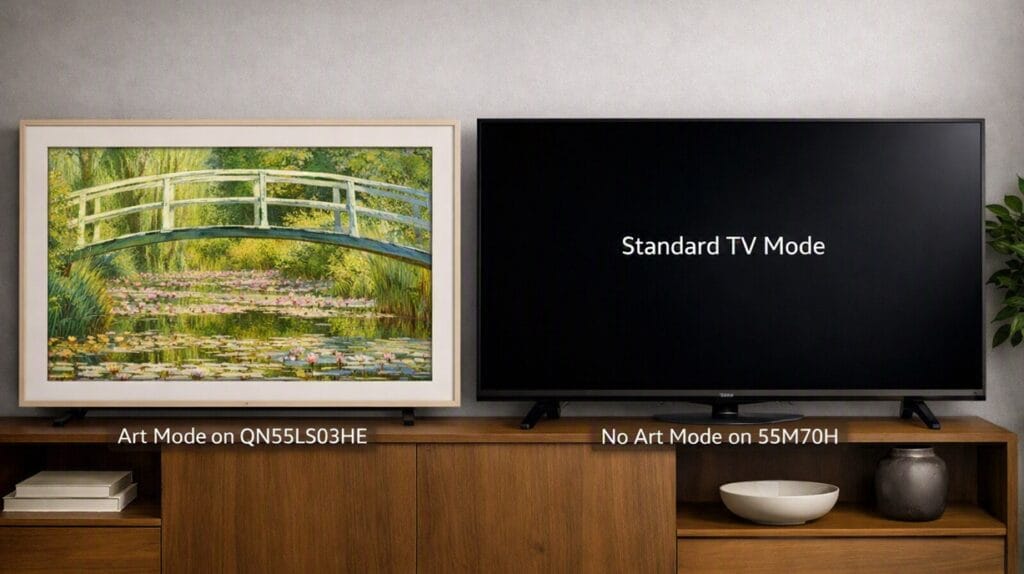
The QN55LS03HE is the entry point into Samsung’s 2026 Frame lineup — a Lifestyle TV built around Art Mode, replaceable bezels, and a matte anti-reflective coating that’s meant to make the screen read as a piece of wall art rather than a black rectangle when it’s off.
According to our full Samsung QN55LS03HE review, it shares its 55-, 65-, 75-, and 85-inch sizing with the rest of the 2026 Frame family, and it sits one tier below the pricier Frame Pro, which adds local dimming and a wireless One Connect box.
What Is the Samsung 55M70H?
The 55M70H is Samsung’s entry-level 2026 set, marketed under the “Mini LED” name but built around a much simpler goal: hit a low price point with basic 4K, HDR10+, and Samsung’s Vision AI smart features.
Based on our Samsung 65M70H review of the closest published sibling size, the M70H series shares its core panel and processing across the 43- through 85-inch range, with no meaningful differences beyond screen size.
The Key Structural Difference
One detail is easy to miss from the spec sheet alone: despite the Mini LED branding, RTINGS’ testing confirms the 55M70H has no local dimming feature at all.
The smaller LEDs in its backlight don’t divide into independently controlled zones — they just light the whole panel uniformly, the same way a standard LED TV does.
The QN55LS03HE doesn’t have local dimming either, but Samsung never marketed it as a contrast feature on this tier. The real difference isn’t the missing feature itself — it’s that one product’s marketing implies a capability it doesn’t have, and the other doesn’t make that claim in the first place.
If local dimming itself is the deciding factor, the M70H doesn’t lose to every Samsung Lifestyle TV on that front. The step-up Frame Pro does have a basic edge-lit system — see our Samsung QN55LS03H vs Samsung 55M70H comparison for how that changes the picture-quality gap.
Picture Quality: Samsung QN55LS03HE vs Samsung 55M70H
Picture quality is where most buyers assume the cheaper Mini LED-branded set should win, or at least tie. RTINGS’ published test results don’t support that assumption.
Brightness: HDR and SDR
In HDR, the Frame reaches measured brightness levels of 427 cd/m² on a hallway lighting pattern and 352 cd/m² on a bright skyscraper scene, with its most accurate tone-mapping setting. According to RTINGS’ 55M70H review, the set’s HDR brightness is simply bad, with peak levels too low to make specular highlights stand out at all.
In SDR, the pattern repeats — the Frame is rated bright enough to handle moderate glare, while the M70H is described as not bright enough to overcome direct glare in a moderately lit room.
Color and Contrast
Color tells a similar story. The Frame covers 86.16% of the DCI-P3 color space and 59.09% of the wider BT.2020 gamut in RTINGS’ SDR color volume testing; the 55M70H covers 82.45% and 56.48% of the same two spaces.
Neither TV has local dimming, so both suffer from raised, gray-looking blacks rather than true black — but the Frame’s higher native contrast and better color coverage still put it ahead on nearly every picture-quality metric RTINGS tested.
Design & Room Fit: Frame vs. 55M70H
The QN55LS03HE’s reflection handling isn’t a minor styling detail — RTINGS rates its matte, glare-free display as doing an excellent job cutting daytime reflections.
The 55M70H’s glossy screen, by contrast, is rated poor at handling direct reflections from windows or lamps — a real difference for anyone putting a TV in a bright living room rather than a dedicated dark theater space.
Art Mode and Room Presence
Art Mode lets the Frame display curated artwork or your own uploaded photos when you’re not watching, with a brightness sensor that adjusts each image to match the room’s lighting and a motion sensor that can trigger the display automatically.
Combined with replaceable bezels, that’s a genuine design category the 55M70H doesn’t compete in — it wasn’t built to.
Gaming Performance: Frame vs. 55M70H
Refresh Rate and Console Compatibility
Gaming is where the spec sheets diverge the most sharply. The QN55LS03HE supports a native 144Hz refresh rate with full HDMI 2.1 bandwidth on all four inputs, plus FreeSync, HDMI Forum VRR, and G-SYNC Compatible support that includes Low Framerate Compensation.
RTINGS rates its input lag as excellent across every supported mode, and it’s fully compatible with both PS5 and Xbox Series X|S at 4K/120Hz with VRR and ALLM.
The 55M70H tops out at a 60Hz native refresh rate with HDMI 2.0-only bandwidth — no HDMI 2.1 at all. Its VRR range is described by RTINGS as too narrow to be very effective, and it lacks Low Framerate Compensation entirely.
Motion Handling
Input lag itself is rated great on the 55M70H, but that’s undercut by motion performance: RTINGS measured very high motion blur, describing it as worse than the Vizio Mini LED Quantum 4K at the same price point.
For more on how local dimming and backlight technology affect gaming and movie performance across TV types generally, see our OLED vs Mini LED comparison.
Value & Who Each TV Is For
Price is the only column where the 55M70H wins outright, and it’s not a small gap — the Frame’s premium covers its matte coating, Art Mode hardware, and a full 144Hz gaming panel, not just a design badge.
Judged purely on cost per measured performance point, the 55M70H is a worse deal than its price tag suggests. RTINGS’ own comparison notes steer buyers toward rivals like the TCL QM6K or Hisense U65QF at a similar price instead, since the M70H underperforms even against same-tier competition.
The Frame doesn’t have that problem — its price buys an identifiable feature set, not just a lower number on the shelf tag.
Where Each TV Actually Wins
Which One Wins for Each Use Case?
Spec-by-Spec Comparison
Which Should You Buy?
For most buyers, the Frame is the better pick — not because of Art Mode alone, but because RTINGS’ testing shows it ahead on brightness, color, and gaming responsiveness too. The price gap buys real, measured performance.
If your priority is a low sticker price for a secondary room — a guest bedroom, a dorm, a casual kitchen setup — the 55M70H still functions as a basic 4K TV. Just go in without expecting it to match same-tier competition on picture quality, per RTINGS’ own comparison notes.
If your priority is staying in the Frame family but you’re unsure whether the step-up Pro tier is worth it, our Samsung QN55LS03HE vs Samsung QN55LS03H comparison — linked earlier in this article — breaks down exactly what the Pro adds over this base model.
📍 Not sure either of these fits your room? Our best 4K TVs of 2026 picks span every price point, from budget Mini LED-branded sets to design-forward Lifestyle TVs.
Common Questions About the Frame and 55M70H
Samsung QN55LS03HE vs Samsung 55M70H: which is better for movies?
The QN55LS03HE is, for most rooms. Its higher measured brightness, wider color coverage, and glare-resistant matte screen make it the stronger choice for movie night in a normally lit living room, even though neither TV has local dimming for deep blacks in a fully dark room.
Is the Samsung QN55LS03HE worth the price jump over the 55M70H?
RTINGS’ testing data suggests yes for most buyers — the price difference buys measurable gains, not just design: brighter HDR and SDR performance, wider color coverage, and a full HDMI 2.1 gaming setup the 55M70H doesn’t have.
Whether it’s worth it for you comes down to how much the budget can stretch and whether the room actually gets bright ambient light.
Does the Samsung 55M70H actually have local dimming, despite the Mini LED name?
No. RTINGS’ testing confirms the 55M70H uses smaller LEDs in its backlight but has no local dimming zones at all, so it can’t selectively brighten or dim parts of the image the way a true Mini LED local-dimming TV can.
The Frame doesn’t have local dimming either, but it also doesn’t market itself around that feature.
Could a future base Frame add local dimming without losing its wall-flush design?
Not easily. Local dimming zones require thicker backlight hardware, and the standard Frame’s whole design premise is sitting nearly flush against a wall — that’s currently one of the main things separating it from the thicker Frame Pro.
That’s a deliberate trade-off tied to the Frame’s form factor, not simply a feature Samsung hasn’t gotten around to yet — so don’t expect it to show up on the base tier without a redesign.
Does the Samsung QN55LS03HE support Dolby Vision?
No — like the 55M70H and every other Samsung TV, the QN55LS03HE supports HDR10 and HDR10+ but not Dolby Vision. That’s a brand-wide limitation on the Samsung side, not something specific to either of these two models.

iYaiii
Editor, GearPulse360
iYaiii is the editor and founder of GearPulse360, specializing in TV reviews and consumer electronics. He researches every recommendation before publishing, cross-checking manufacturer specs against RTINGS’ independent lab data.
✅ Based on Samsung’s official specifications and RTINGS data — last verified August 2026