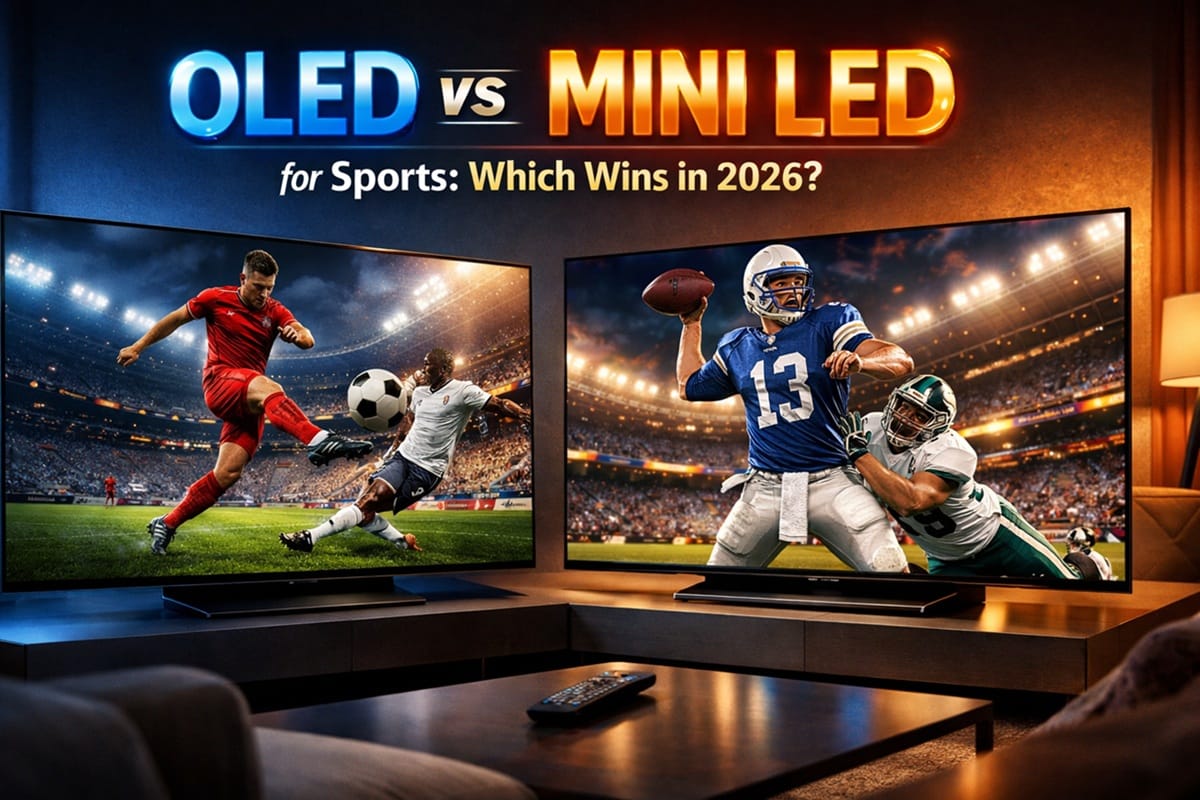
OLED vs Mini LED for Sports: Which TV Handles Fast Action Better?
Last updated: June 2026 / 🕒 9 min read
Disclosure: As an Amazon Associate I earn from qualifying purchases. This article contains affiliate links — we may earn a small commission if you buy through them, at no extra cost to you.
You’re mid-pan on a fast break, or a striker is breaking into open space, and the picture goes soft for a half-second — right when it matters most. Maybe it’s a hockey puck that turns into a smear during a power play, or a Formula 1 car that blurs into the background as the camera tracks it down the straight. That blur, or its opposite problem of a flat, washed-out image in a sun-filled living room, is the actual decision most sports fans are weighing before this season, not a spec sheet.
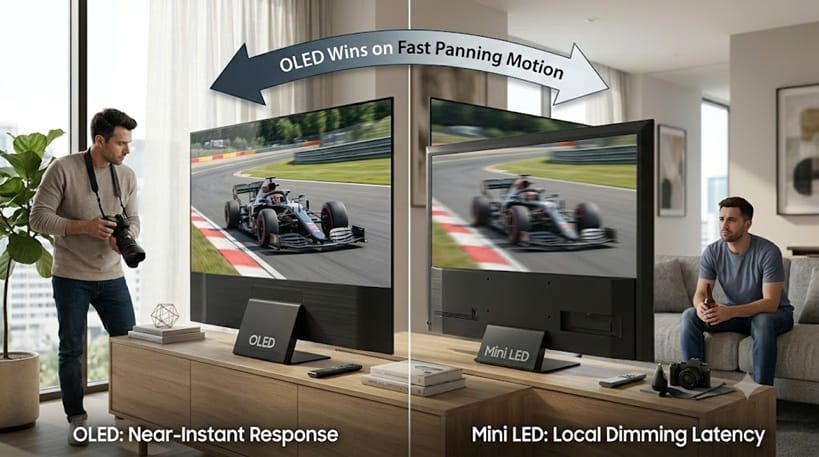
Here’s the short answer: OLED wins for sports, mainly because of how fast it reacts to motion — but it’s a qualified win, not a universal one.
This piece is narrowly focused on sports and fast live broadcast. For the full side-by-side across every use case, our OLED vs Mini LED compared guide goes deeper into movies, gaming, and everyday TV.
Table of Contents
Ready to act on that verdict? See our picks for best OLED TVs for sports →.
How OLED and Mini LED Actually Differ for Sports
What Is OLED?
OLED panels light each pixel individually, so motion, black levels, and off-angle viewing all trace back to that one structural fact. For the full plain-English breakdown, see what OLED TV technology is.
That self-emissive design is also why OLED’s published specifications list pixel response in fractions of a millisecond — a number we’ll unpack below. LG’s OLED TV lineup page covers how that plays out across its current models.
What Is Mini LED?
Mini LED is still an LCD panel at its core — it just swaps a few large backlight zones for thousands of tiny LEDs grouped into far more dimming zones than older LED TVs used. The Samsung 65QN70H is a workable example of how that backlight approach behaves in real use; see our Samsung 65QN70H review for specifics.
Because the light source sits behind the panel rather than inside each pixel, Mini LED can push far more raw brightness. Samsung’s own buying guide walks through how its Neo QLED Mini LED lineup uses that backlight architecture.
The Key Structural Difference
Every dimension below — motion, brightness, contrast, even burn-in — traces back to this one split: OLED controls light at the pixel, Mini LED controls light at the backlight zone. Keep that distinction in mind as we get into sports specifically.
Motion Handling for Sports: Does OLED Really Beat Mini LED?
This dimension decides whether a fast break, a slap shot, or a Formula 1 pass looks crisp or smeared — and it’s the one casual buyers underrate the most. A scoreboard ticker scrolling across the bottom of the screen is also a useful real-world test, since a slow panel will visibly trail or judder behind the text.
According to RTINGS’ motion-blur and response-time testing, OLED panels respond in well under a millisecond, while Mini LED — being LCD-based — typically lands in the low single-digit milliseconds even on well-tuned panels, and a high refresh rate with VRR narrows that gap without fully closing it. Check RTINGS’ motion-blur and response-time testing directly for current measured numbers on any specific model you’re considering.
Brightness for Daytime and Bright-Room Sports Viewing
Sports get watched in rooms OLED was never built for: sun through the blinds at a 1pm kickoff, a sports bar with windows, a kitchen TV catching afternoon glare. Brightness also affects how readable on-screen graphics like scores, down-and-distance, or lap timers stay once ambient light fights back.
Mini LED’s backlight architecture gives it a real edge here — published 2026 specifications routinely put flagship Mini LED peak brightness well above current OLED panels, and that headroom is what cuts through ambient light instead of looking washed out. Modern OLED anti-glare coatings have closed part of that gap in moderately lit rooms, and OLED still holds a wider viewing-angle advantage for couches off to the side, but in a properly sun-bright space, Mini LED’s brightness ceiling is still the more dependable pick.
Picture Quality and Contrast During Live Broadcasts
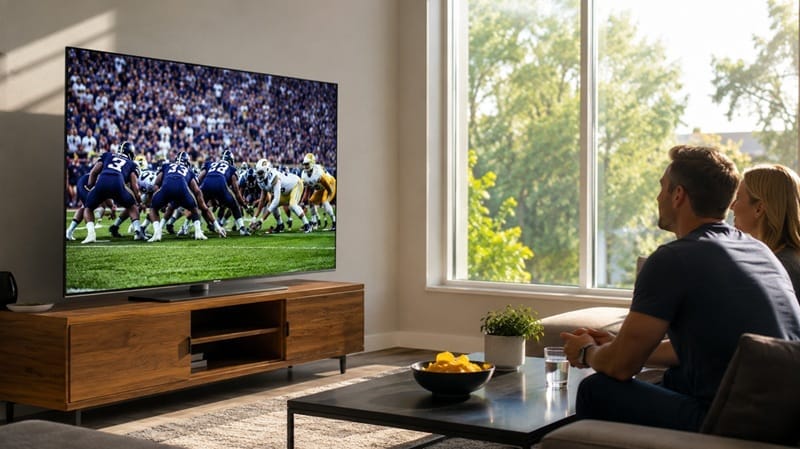
Stadium lighting at night, ice glare, grass shadow detail, jersey colors under floodlights — sports broadcasts put a lot of contrast range on screen at once. A night game also tends to mix deep shadow in the stands with intensely bright floodlights, which is exactly the kind of high-contrast scene that separates the two technologies.
OLED’s per-pixel control means it can place a fully black pixel directly next to a bright one with no halo, which matters when stadium lights or a scoreboard sit against a dark night sky — a structural advantage Mini LED’s zone-based backlight can’t fully match. Mini LED’s local dimming has improved meaningfully, but bright elements against dark backgrounds, exactly what night games produce, can still show a faint glow or blooming around the edges.
Price and Value for a Sports-First Living Room
A lot of sports buyers want one thing above all: the biggest, brightest screen for game day their budget allows. That’s a different priority than a movie-first buyer chasing the absolute best black levels in a dark room.
At larger screen sizes, Mini LED generally delivers more brightness and size per dollar, based on publicly available pricing patterns across both categories — it’s simply a cheaper technology to scale up. Mid-size OLED has gotten meaningfully more affordable too, narrowing that gap at 55–65 inches, so the price story shifts depending on the size you’re shopping for and how much screen real estate game day actually demands in your space.
Burn-In Risk: What Happens to a Static Scoreboard?
A scorebug or ticker that sits in the same spot for a three-hour broadcast, multiplied across a full season, is exactly the kind of static content that worries OLED owners. The same concern applies to a channel logo, a persistent score bug, or a fantasy-stats overlay left up for an entire Sunday of football.
Modern OLED panels include pixel-shifting and brightness-limiting features specifically to manage this, and the real-world risk is lower than it once was, but it isn’t zero — we cover this in detail in whether OLED burn-in still matters in 2026. Mini LED has no equivalent risk, since its LCD layer doesn’t retain images the way organic OLED pixels can, which is a genuine advantage for households that leave a static scoreboard up for hours every day.
OLED vs Mini LED for Sports by Viewing Scenario
Putting all five dimensions together, here’s how the winner shifts depending on how and where you actually watch.
Which Should You Buy?
For most buyers watching sports in a normal living room with curtains or evening games, OLED is the better pick — the motion and contrast advantages show up on screen more often than the brightness gap does.
If your priority is a sun-drenched room, a sports bar, or any space where the TV competes with daylight most of the day, Mini LED is the more practical choice — brightness wins more often than motion clarity in that environment.
If your priority is zero burn-in risk because a scoreboard or ticker stays up for hours every single day, Mini LED removes that worry entirely, even though OLED’s modern mitigations keep the real-world risk fairly low either way.
📍 Still narrowing down a screen size or model? See the full best OLED TVs of 2026 roundup for picks across every budget and room type.
OLED vs Mini LED for Sports: Common Questions
Is OLED Better Than Mini LED for Watching Football or Soccer?
Yes, for most rooms — OLED’s faster pixel response keeps fast breaks and quick passes from blurring, and its contrast makes night games and stadium lighting look sharper. The exception is a sun-bright room, where Mini LED’s brightness advantage matters more than motion clarity.
Is OLED Worth the Switch From Mini LED for a Sports-Focused TV?
Yes, if most of your sports viewing happens in the evening or in a room with some light control — OLED’s motion and contrast advantages are noticeable enough to justify the switch. RTINGS’ Mini LED vs. OLED comparison is a good place to check current measured differences for specific models you’re considering.
Will My OLED TV Burn In From Watching Sports Every Day?
Unlikely with normal viewing — modern OLED panels include pixel-shifting and brightness-limiting features built specifically to manage static graphics like scorebugs. The risk rises in extreme cases, such as the same channel logo and ticker at high brightness for many hours every single day with no breaks, which is the scenario where Mini LED’s zero-risk advantage becomes meaningful.
Will Mini LED Ever Close the Motion Clarity Gap With OLED?
Unlikely to fully close it — Mini LED has narrowed the gap with higher refresh rates and better backlight control, but the underlying LCD layer, not just the refresh rate, is what limits response time. OLED’s self-emissive pixels have a structural head start here that improved backlights can’t fully erase. For a deeper look at what’s actually happening at the pixel level — and why refresh rate alone doesn’t tell the full story — see our guide to OLED motion and response time explained.

iYaiii
Editor, GearPulse360
iYaiii is the editor and founder of GearPulse360, specializing in TV reviews and consumer electronics. He researches every recommendation before publishing.
✅ Based on spec analysis and LG’s and Samsung’s official data plus RTINGS — last verified June 2026