Sony OLED vs Samsung OLED: Which QD-OLED TV Is Worth Your Money?
Last updated: June 2026 / 🕒 9 min read
Disclosure: As an Amazon Associate I earn from qualifying purchases. This article contains affiliate links — we may earn a small commission if you buy through them, at no extra cost to you.
You’ve already ruled out WOLED and Mini LED — you’ve settled on QD-OLED, and that narrows the real decision down to two brands: Sony and Samsung. (If you haven’t made that panel-type call yet, our QD-OLED vs WOLED compared breakdown is the better starting point.) The catch is that the comparison isn’t as clean as “Sony vs Samsung” usually sounds, because the two QD-OLED panels involved share more history than most shoppers realize.
For most buyers, Samsung’s new S95H is the stronger pick — it runs a newer QD-OLED panel generation, a higher refresh-rate ceiling, and broader gaming-format support. The exception is Sony’s BRAVIA 8 II, which still wins on Dolby Vision support, built-in screen sound, and PlayStation 5 integration, making it the better Sony OLED vs Samsung OLED pick for home theater and console-first households.
This comparison sticks to each brand’s current QD-OLED flagship specifically. If you’re weighing Sony’s panel tech against LG instead of Samsung, our Sony OLED vs LG OLED compared breakdown covers that matchup in the same format.
Table of Contents
Ready to act on that verdict? See our picks for our Samsung OLED roundup →.
How Sony BRAVIA 8 II and Samsung S95H Actually Differ
What Is Sony BRAVIA 8 II?
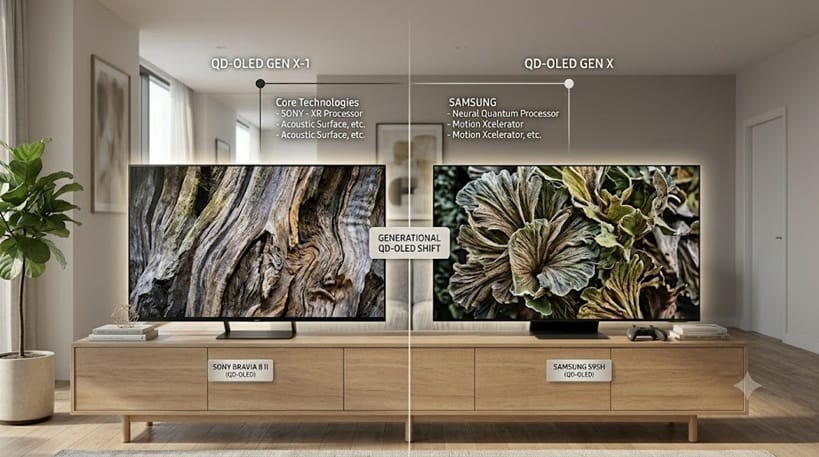
The BRAVIA 8 II is Sony’s only current QD-OLED TV, sitting above the standard WOLED Bravia 8 in the lineup. It pairs a Samsung Display-sourced QD-OLED panel with Sony’s own XR processing, Acoustic Surface Audio+ screen speaker, and deep PlayStation 5 picture integration. We cover it in more depth in our full Sony BRAVIA 8 II review.
What Is Samsung S95H?
The Samsung S95H is the brand’s new flagship for 2026, replacing the S95F. It introduces a new FloatLayer design that mounts flush to a wall, a brighter QD-OLED panel, and Samsung’s Ultimate Gaming Pack with Motion Xcelerator 165Hz, NVIDIA G-Sync compatibility, and AMD FreeSync Premium Pro.
The Key Structural Difference
This is where the “Sony vs Samsung” framing gets interesting: Sony’s BRAVIA 8 II uses the same QD-OLED panel generation and supplier that powered Samsung’s own 2025 S95F. If you want the fuller breakdown of what QD-OLED is and how the technology actually works, that’s a useful detour before this comparison. The S95H moves to Samsung’s newer 2026 panel, so this isn’t a fresh-panel-vs-fresh-panel matchup — it’s last year’s QD-OLED generation against this year’s, wearing two different brand names.
Picture Quality: How Sony OLED and Samsung OLED Compare
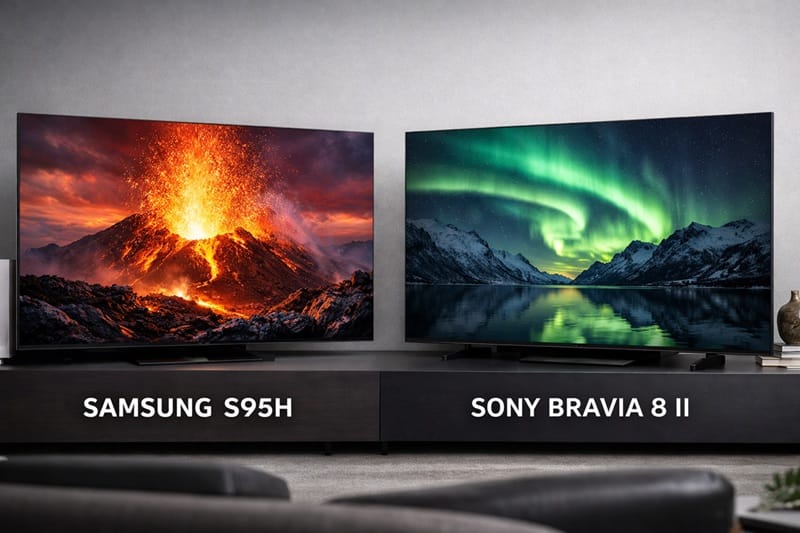
Both TVs deliver the deep blacks and wide color volume that define QD-OLED, and side by side most viewers would call them close. The newer panel generation in the S95H gives Samsung a slight edge in highlight detail and tone mapping at higher brightness levels, based on Samsung’s official spec sheet and RTINGS’ published testing of both models.
Sony’s advantage shows up elsewhere: its XR processing has a strong reputation for natural motion handling and accurate out-of-the-box color, which is part of why the BRAVIA 8 II remains a favorite for film-accurate viewing rather than maximum punch.
Calibration: Accuracy vs. Impact
Where this matters in practice is calibration effort. Sony’s out-of-the-box picture modes tend to need less adjustment to look reference-accurate, while Samsung’s S95H leans toward a punchier default look that some viewers prefer straight out of the box and others choose to dial back in settings. Neither approach is objectively wrong — it comes down to whether you want a TV tuned for accuracy or for impact by default.
HDR Brightness: Sony BRAVIA 8 II vs Samsung S95H
Brightness is the dimension where the panel-generation gap matters most. Samsung markets the S95H as meaningfully brighter than its own S95F predecessor, and because the BRAVIA 8 II shares that earlier panel generation, the practical gap between the two 2026 flagships favors Samsung noticeably in HDR highlights.
That extra headroom matters most in rooms with some ambient light, where a brighter panel keeps highlights from looking flat. For a closer look at how Sony’s panel performs in independent lab testing, see RTINGS’ Sony BRAVIA 8 II review.
Gaming Performance & Refresh Rate
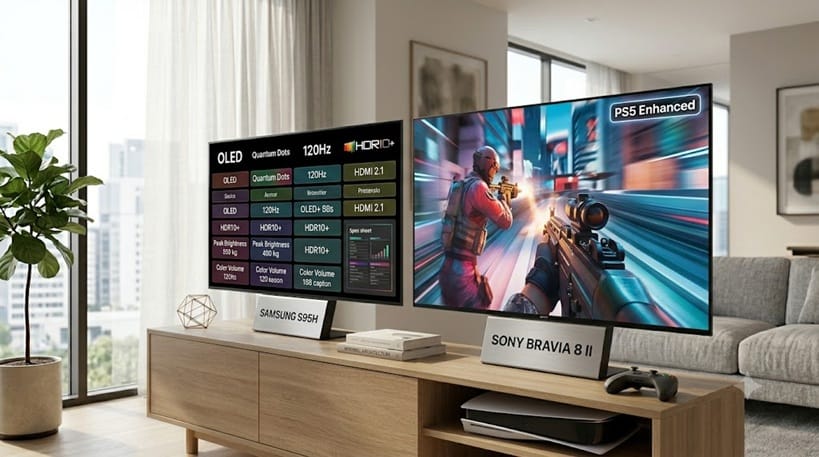
This dimension isn’t close. The S95H supports a 165Hz refresh rate with both NVIDIA G-Sync compatibility and AMD FreeSync Premium Pro, giving PC and console gamers flexibility regardless of which graphics ecosystem they’re on. The BRAVIA 8 II tops out at 120Hz.
PS5 Households and Input Lag
Sony claws some of that back for one specific audience: PlayStation 5 owners get exclusive Auto HDR Tone Mapping and game-menu integration that Samsung’s TV simply can’t replicate, since those features are built around Sony’s own console.
Input lag is excellent on both sets in their respective game modes, so the practical gap comes down to motion smoothness and adaptive sync rather than responsiveness. PC gamers with high-refresh graphics cards will notice the S95H’s higher ceiling most; console-only households running at 120Hz won’t feel the difference nearly as much.
Built-In Sound & Smart Platform
With panels this close in price tier, the experience outside the picture itself becomes a real differentiator. Sony and Samsung take noticeably different approaches to both sound and software, and which one suits you depends on how you actually use the TV day to day.
Audio: Screen Speaker vs Traditional Setup
Sony’s Acoustic Surface Audio+ turns the screen itself into a speaker, using actuators behind the panel so dialogue tracks visually with the actor on screen. It’s a genuine differentiator for buyers who don’t plan to add a soundbar. Samsung’s S95H relies on a more conventional speaker array, though it supports Q-Symphony for buyers who do pair it with a compatible soundbar.
Smart Platform: Google TV vs Tizen
The BRAVIA 8 II runs Google TV with Chromecast and Google Assistant built in. The S95H runs Samsung’s Tizen OS with SmartThings integration and the new Samsung Art Store for displaying artwork when the TV isn’t in use — a feature tied directly to its wall-mounted FloatLayer design.
Price & Value: Is Sony OLED or Samsung OLED the Smarter Buy?
Samsung manufactures its own QD-OLED panels, while Sony licenses its panel from Samsung Display — a structural cost difference that typically shows up at checkout. Combined with the S95H’s newer panel and stronger gaming spec sheet, Samsung’s flagship is the better value case for most shoppers comparing Sony OLED vs Samsung OLED pricing at the same screen size.
Sony’s premium is easier to justify if Dolby Vision and built-in sound quality matter more to you than raw spec-sheet numbers. For a deeper look at whether that premium holds up, see are Sony OLED TVs worth it.
Sony OLED vs Samsung OLED by Use Case
Which Should You Buy?
For most buyers, the Samsung S95H is the easier recommendation. It runs a newer QD-OLED panel, offers a meaningfully higher refresh-rate ceiling, and supports both major VRR formats — and Samsung’s direct control over its own panel supply tends to translate into a stronger price-to-spec ratio.
If your priority is movie night over spreadsheet specs, the Sony BRAVIA 8 II earns its premium — Dolby Vision support and Acoustic Surface Audio+ give it a home-theater feel that Samsung’s more gaming-and-brightness-focused S95H doesn’t try to match. That holds especially true if you’re a PlayStation 5 owner who wants Sony’s console-tuned picture modes and don’t mind trading some refresh-rate headroom for that integration. For the full lineup of Sony’s current OLED options, check our Sony OLED roundup.
📍 Still deciding between brands before you commit to QD-OLED specifically? See the full picture in our OLED TV roundup.
Sony OLED vs Samsung OLED: Common Questions
Is Samsung OLED better than Sony OLED for gaming?
Yes, for most gamers. The Samsung S95H’s 165Hz refresh rate and dual VRR format support (NVIDIA G-Sync and AMD FreeSync Premium Pro) outpace the Sony BRAVIA 8 II’s 120Hz ceiling. PS5 owners get some of that back through Sony’s console-specific picture features, but the raw refresh-rate advantage sits with Samsung.
Is Sony OLED worth the premium over Samsung OLED?
It depends on what you watch most. If movies and Dolby Vision content are your priority, Sony’s processing and built-in sound make the premium defensible. If you mostly game or watch in a brighter room, Samsung’s newer panel and higher refresh rate deliver more for the money. RTINGS’ independent testing of the Samsung S95H is a good next stop if you want the full spec breakdown.
Do Sony and Samsung QD-OLED TVs have the same burn-in risk?
Both use QD-OLED panels with similar pixel structures, so the underlying burn-in risk is comparable between the two. Samsung’s S95H adds updated panel-protection features specifically because Art Mode encourages leaving static images on screen longer, which is a use case Sony’s BRAVIA 8 II isn’t designed around.
Will Samsung’s brightness advantage hold up against Sony next year?
Possibly not. Sony hasn’t released a new QD-OLED panel generation in 2026, but its TV lineup typically refreshes on a roughly annual cycle, and the brand has historically closed brightness gaps quickly once it adopts a newer panel. Treat this year’s advantage as current, not permanent.
Does Sony or Samsung make the better OLED TV overall?
Neither brand wins across the board, which is the whole point of this comparison. Samsung currently leads on raw panel specs and gaming features; Sony leads on processing refinement, built-in sound, and console integration. The better brand depends on which of those you’d actually use.

iYaiii
Editor, GearPulse360
iYaiii is the editor and founder of GearPulse360, specializing in TV reviews and consumer electronics. He researches every recommendation before publishing.
✅ Based on spec analysis and Samsung’s official data, Sony’s published specifications, plus RTINGS — last verified June 2026.