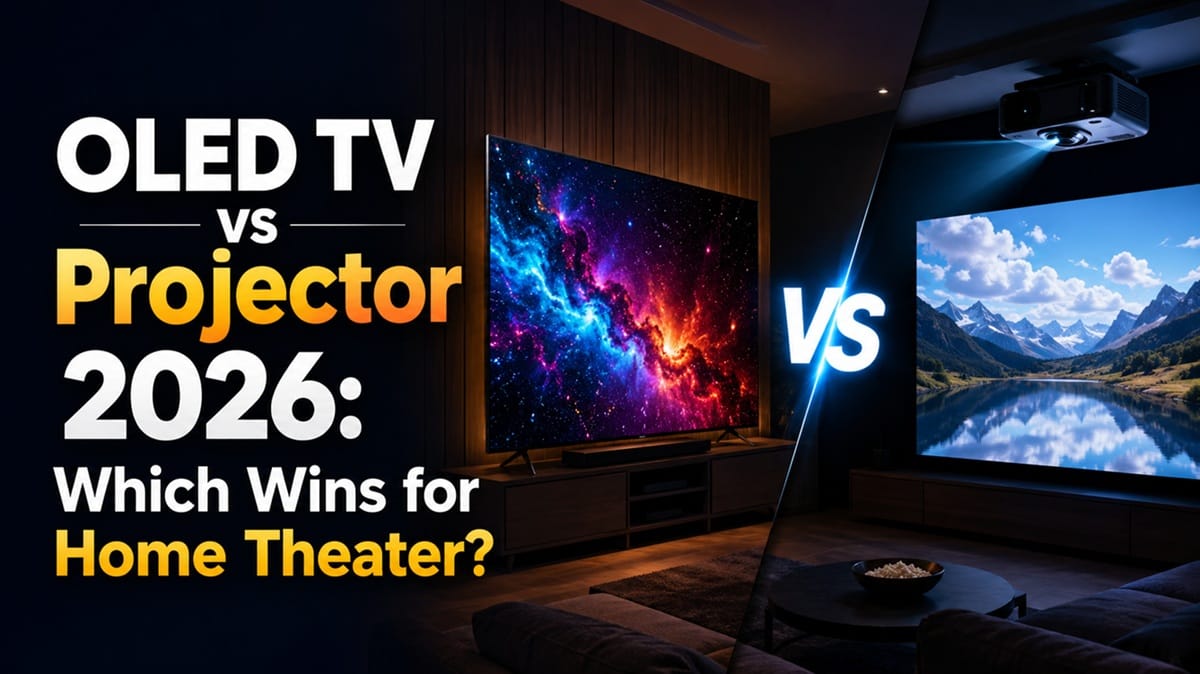
OLED TV vs Projector: Which Should You Choose for Home Theater?
Last updated: July 2026 | 🕒 9 min read
Disclosure: As an Amazon Associate I earn from qualifying purchases. This article contains affiliate links — we may earn a small commission if you buy through them, at no extra cost to you.
You’re standing in the room where the new setup is going. Maybe it’s a spare bedroom you’re converting into a dedicated theater, or maybe it’s just the living room wall where the old TV used to hang. Either way, you’ve narrowed it down to two very different paths: a big-screen OLED TV, or a home theater projector.
For most people upgrading a living room or a mixed-use space, an OLED TV is the better choice — it works in any lighting, needs zero setup, and delivers a sharper, more consistent picture day to day. A projector earns its place when you’re building a dedicated, light-controlled room and want the biggest possible screen for your money.
If you’re also weighing OLED against QLED for a room that gets a lot of daylight, we’ve covered that separately in our OLED vs QLED for bright rooms comparison — this article assumes you’ve already settled on OLED as your TV panel type and are now deciding between that and projection altogether.
Table of Contents
Ready to act on that verdict? See our full picks for best OLED TVs for home theater.
How OLED TVs and Projectors Actually Differ
What Is an OLED TV?
An OLED TV is self-emissive — every pixel produces its own light and can switch off completely, which is why OLED delivers true black levels and near-infinite contrast. If you want the deeper mechanics of how OLED panels differ from each other, our QD-OLED vs WOLED comparison breaks that down separately.
What Is a Home Theater Projector?
A projector doesn’t emit its own image — it beams light onto a separate reflective screen or wall. Picture quality depends heavily on that surface, on how dark you can get the room, and on the throw distance between the projector and the screen.
The Key Structural Difference
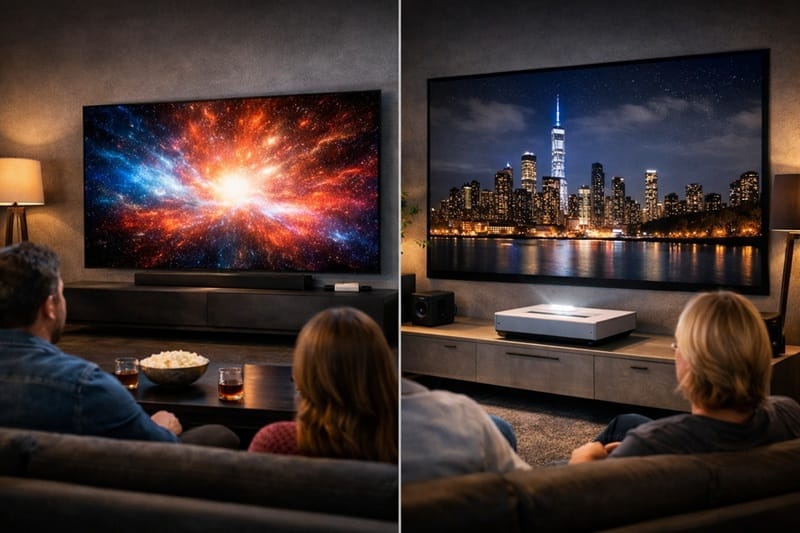
This is the part that decides everything else in this comparison: an OLED TV’s picture is fixed and self-contained, so it performs consistently regardless of your room. A projector’s picture is reconstructed by bouncing light off a surface, so its performance is only as good as the room you put it in.
Picture Quality & Contrast: Which Wins?
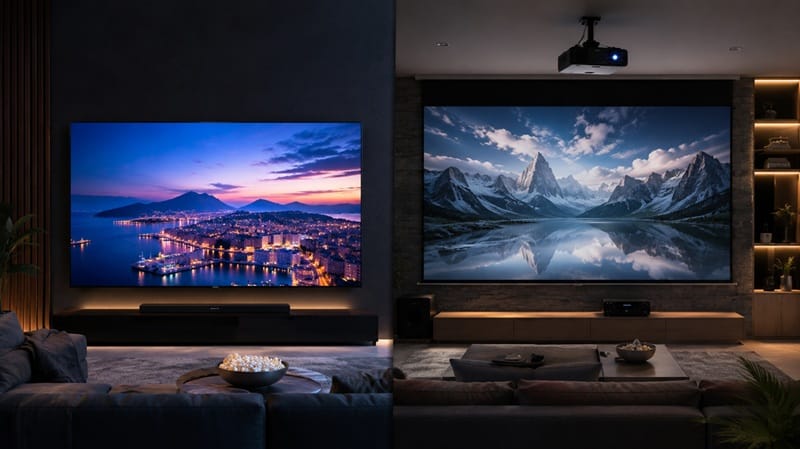
OLED wins this dimension clearly. Because each pixel emits and dims independently, black levels sit at effectively zero next to bright highlights in the same frame — something no projector, no matter how good its native contrast, can fully match once ambient light is added to the room.
Projectors have closed some of that gap. Higher-end laser models now advertise contrast ratios in the hundreds-of-thousands-to-one range, and in a fully dark, well-treated room that can look genuinely excellent. But that contrast figure assumes ideal conditions — a single stray light source or an off-white wall can wash it out fast.
Brightness & Ambient Light: Which Wins?
This is where the units themselves cause confusion. TVs report brightness in nits — a measure of light per square meter of the panel itself. Projectors report brightness in ANSI or ISO lumens — a measure of total light output, before it ever hits a screen. The two aren’t directly interchangeable, and marketing numbers on either side can be misleading, which is something independent projector testing has documented in detail.
A 2026 flagship OLED, based on manufacturer specifications, can push into the thousands of nits in small highlight areas — enough to hold up against daytime living-room light. A home theater projector in the 2,000–3,500 ANSI/ISO lumen range needs a dim-to-dark room to look its best, and an ambient-light-rejecting screen helps but doesn’t fully solve the problem in a bright space.
Screen Size & Room Fit: Which Wins?
Past 100 Inches
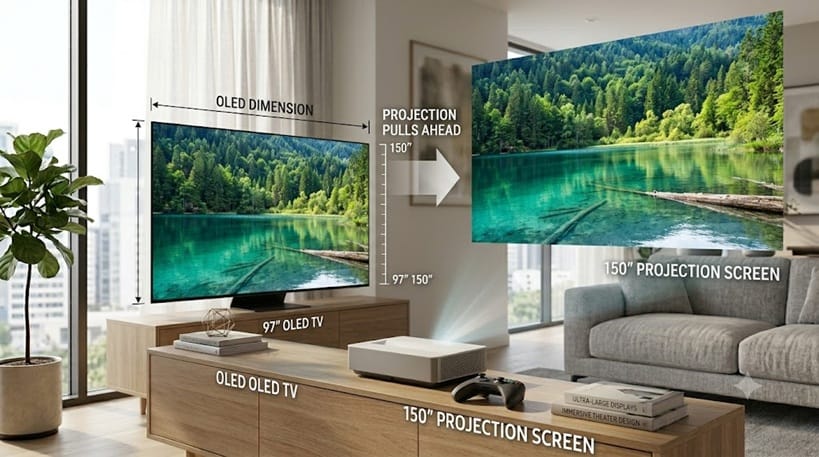
Projectors win outright once you’re past roughly the 100-inch mark. An ultra-short-throw laser projector can fill a wall with a 120–130-inch image from inches away, while a comparably sized OLED panel is a specialty, high-cost purchase.
Under 100 Inches
Below that size, the calculation flips. Large-screen OLEDs in the 65–83-inch range are now widely available and far simpler to live with — no throw-distance planning, no screen purchase, and no worrying about a stray lamp washing out the image.
Room Shape Matters Too
A long, narrow room can make a long-throw projector setup awkward, while an ultra-short-throw model solves that by sitting inches from the wall it projects onto. An OLED, by contrast, only needs enough wall or stand space for the panel itself — there’s no throw geometry to plan around at all.
Gaming Performance: Which Wins?
Input Lag & Refresh Rate
OLED is the clear winner for gaming. Flagship 2026 OLED TVs support variable refresh rates well past 120Hz, near-instant pixel response, and input lag low enough that competitive and fast-action titles feel responsive.
Most home theater projectors, based on independent testing data, run higher input lag and cap out at lower refresh rates in their 4K modes, since they’re built around picture size and cinema use rather than reaction time. Some gaming-focused projectors close part of that gap, but they’re a different product category from the home-theater UST models compared here.
Screen Size Can Work Against You
There’s also the matter of screen size working against you in fast-paced content. A 120-inch image amplifies motion across a much wider field of view, which some gamers find disorienting during quick camera pans — a non-issue on a fixed-size OLED panel viewed from a normal seating distance.
Price & Value at Large Screen Sizes: Which Wins?
Per inch of screen real estate, projectors are the value play. A UST laser projector paired with a basic screen or even a treated wall can deliver a 120-inch-plus image for meaningfully less than an equivalent-size OLED panel would cost — if an equivalent-size OLED panel exists at all.
At the sizes most living rooms actually use — 55 to 77 inches — the math favors OLED. You’re not paying for a screen, mounting hardware, or light control, and the picture doesn’t degrade if you forget to close the blinds.
OLED TV vs Projector by Use Case
OLED TV vs Projector: Spec Comparison
Which Should You Buy?
Buy This If…
For most buyers, the OLED TV is the right call. It looks right in whatever light your room has, it doesn’t ask you to plan a screen purchase or a throw distance, and if gaming is part of your routine, it’s not close.
Skip This If…
If your priority is building a dedicated theater room — walls treated, light controlled, a screen mounted and ready — the projector’s 120-inch-plus image at a fraction of what an equivalent-size OLED would cost becomes the stronger argument.
If your priority is a big screen without giving up daytime usability, an ultra-short-throw laser projector paired with an ambient-light-rejecting screen narrows the gap, though it won’t fully close it in a genuinely bright room.
There’s also a middle path if you’d rather not deal with throw distance or light control at all: LG’s QNED lineup now stretches to 115 inches. Our LG 115QNED92B review looks at whether that jump to a genuinely massive Mini LED panel gets you closer to projector-scale presence while staying in TV territory.
Not sure which OLED size or model fits your space either way? Our full home theater buying guide walks through picks by room type and budget tier.
📍 Still narrowing down which OLED TV fits your room? See our full picks and buying advice in our OLED TV roundup.
Also consider: LG OLED65C6 — if you don’t need the full 77-inch, Tandem-panel brightness boost, the standard 65-inch C6 delivers the same OLED fundamentals at a friendlier size for smaller rooms.
OLED TV vs Projector: Common Questions
Is a projector better than an OLED TV for a home theater room?
For a dedicated, light-controlled room, a projector can deliver a more cinematic-feeling, much larger image than most OLED TVs can match. For a room that also gets used in daylight, an OLED TV holds up better and needs no light management.
Is it worth paying more for a big-screen OLED instead of a projector?
If your room isn’t fully dark and light-controlled, yes — an OLED’s self-emissive picture doesn’t rely on room conditions the way a projected image does. Independent projector testing consistently shows even strong home theater projectors need real light discipline to perform at their best.
Does OLED burn-in happen faster than a projector wears out?
Both have long-term wear considerations, just different ones. Modern OLED panels include pixel-refresh and brightness-limiting safeguards that make burn-in unlikely under normal, varied viewing. Laser light sources in projectors are rated for tens of thousands of hours, but static content and improper ventilation can still shorten a lamp’s or laser’s effective life.
Will next-gen projectors close the brightness gap with OLED?
Laser projector brightness has climbed steadily, and that trend looks set to continue. Even so, a projected image still depends on the screen and room around it, while an OLED panel’s brightness is fixed and consistent — a structural difference that’s unlikely to fully disappear. If you’re weighing this specifically for a dark viewing space, our best OLED TVs for dark rooms guide covers that angle in more depth.
Is Samsung’s projector better than LG’s or Sony’s projectors?
Each brand takes a different approach — Samsung’s Premiere line leans into ultra-short-throw convenience and smart-TV-style features, while other brands split between long-throw and UST designs with their own brightness and audio trade-offs. The right pick depends more on your room’s throw distance and layout than on brand alone.

iYaiii
Editor, GearPulse360
iYaiii is the editor and founder of GearPulse360, specializing in TV reviews and consumer electronics. He researches every recommendation before publishing.
✅ Based on spec analysis and LG’s and Samsung’s official data plus RTINGS — last verified July 2026