Samsung OLED TV Buying Guide 2026: Which Model Is Right for You?
Last updated: June 2026 / 🕒 8 min read
Disclosure: As an Amazon Associate I earn from qualifying purchases. This article contains affiliate links — we may earn a small commission if you buy through them, at no extra cost to you.
Three Samsung OLED TVs are sitting on a showroom floor, and by the second spec sheet the model names already start to blur together. S85H, S90H, S95H — close enough in name that it’s easy to assume the differences are mostly cosmetic.
They aren’t. Based on Samsung’s official 2026 lineup specifications and RTINGS testing data, the three series split apart in ways that actually change what you’re paying for, starting with something most shoppers don’t expect: they don’t all use the same screen technology.
This Samsung OLED buying guide breaks down what changes between the S85H, S90H, and S95H — panel type, available sizes, and the handful of features worth paying extra for. For the technical background on how Samsung’s premium panel works, our explainer on what QD-OLED is covers the basics before you get into model-picking.
Table of Contents
The Short Answer: Samsung’s 2026 OLED Lineup at a Glance
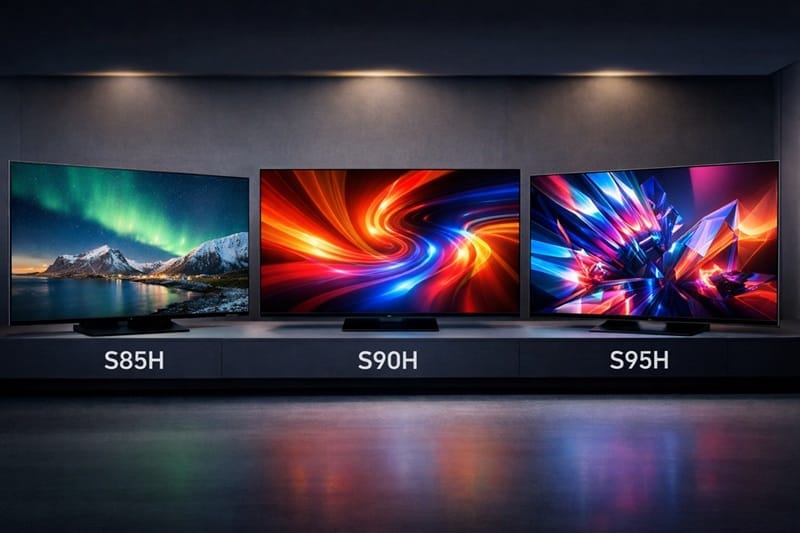
Samsung’s 2026 OLED TVs split into three series: the budget-focused S85H, the mid-range S90H, and the flagship S95H. The biggest surprise is panel technology — the S85H and S90H now use WOLED panels at every size, while QD-OLED is reserved for the S95H, and even then only at 55″, 65″, and 77″ (the 83″ S95H is WOLED too). Screen size availability and access to Samsung’s Glare Free coating are the next two things worth checking before you settle on a series.
Why This Samsung OLED Buying Guide Starts With the Panel
Panel Technology: Where the Names Get Confusing
For years, “Samsung OLED” has been shorthand for QD-OLED, Samsung’s quantum-dot panel technology. That assumption held for the 2025 S85F, S90F, and S95F series, where most sizes used Samsung’s own QD-OLED panel.
2026 breaks that pattern in a bigger way than it first appears. The S90H switches entirely to a WOLED panel, and so does the S85H — Samsung’s quantum-dot panel is now exclusive to the S95H, and only at three of its four sizes. It’s the single most important fact in this Samsung OLED buying guide, because QD-OLED, the technology “Samsung OLED” used to mean by default, is now mostly absent below the flagship tier.
According to Samsung’s own 2026 OLED announcement, the new lineup spans three series across class sizes from 42″ to 83″, with each series built around a distinct panel and feature set rather than a single shared technology scaled up or down.
Design and Feature Differences
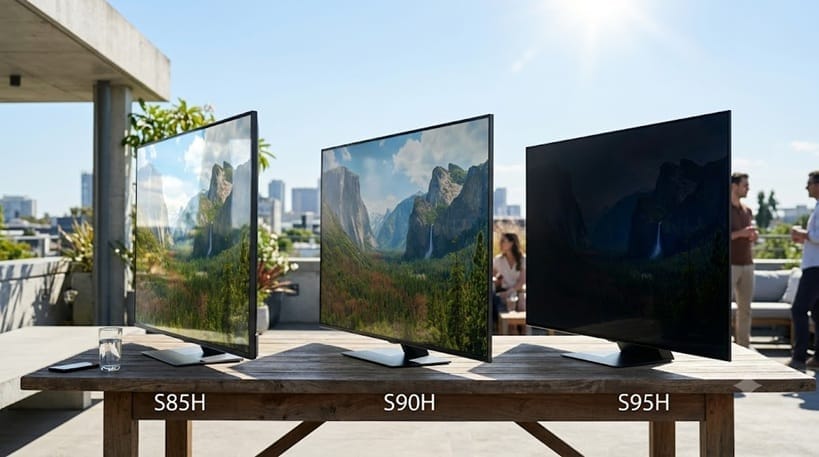
Samsung’s Glare Free screen coating is available on the S90H and S95H, but not on the S85H. If you watch TV in a bright room during the day, that’s a bigger practical difference than panel type for a lot of households. How much it actually helps — and where it still falls short against direct window light — is its own question; our breakdown of Samsung OLED anti-glare bright-room performance gets into that in more detail than fits here.
The S95H also carries a distinct design identity this year. It uses a new metal-frame “FloatLayer” build that doubles as a flush wall mount, and it’s the first Samsung OLED to support Art Mode and the Samsung Art Store — features borrowed from Samsung’s Frame TV lineup rather than its traditional OLED line. Object Tracking Sound, Samsung’s spatial audio feature, runs in its fuller form on the S95H and a lighter version on the S90H and S85H.
Why This Matters Once You’re Actually Comparing Models
Processing and Gaming Considerations
The S90H and S95H both run Samsung’s newer NQ4 AI Gen3 processor, while the S85H uses the older Gen2 chip. That affects upscaling and HDR tone-mapping more than it affects gaming responsiveness, since all three series support VRR and high refresh rates at their respective tiers.
If you’ve already narrowed your choice down to the S90H or S95H specifically, our Samsung S90H vs S95H compared piece goes deeper on where that smaller gap actually shows up in daily use.
Sizes Each Series Actually Comes In
Size availability doesn’t scale evenly across the lineup, and it’s worth checking before you assume your preferred size exists in every series. The S90H is the only series offered at 42″, though the S90H and S85H both come in a 48″ size for smaller rooms or bedrooms. The S95H starts at 55″ with no smaller option. All three series top out at 83″ — there’s no 85″ model anywhere in Samsung’s 2026 OLED lineup, so screen size alone won’t separate the lineup once you’re past the smallest sizes.
None of this happens in isolation from the rest of the market, either. If you’re still weighing Samsung against other brands entirely, our best OLED TVs of 2026 roundup ranks the strongest picks across LG, Samsung, and Sony by use case and budget.
Price and Size Tiers Across the Lineup
Samsung prices the three series in a clear step pattern, even before you account for size. The S85H sits at the entry tier — the smallest price gap between its own sizes, and no Glare Free screen to pay for. The S90H costs noticeably more than the S85H even at matching screen sizes, and that jump buys you the Glare Free coating and the newer Gen3 processor.
The S95H sits well above the S90H at every matching size. That premium goes toward the QD-OLED panel (at the 55″, 65″, and 77″ sizes), the FloatLayer design, and Art Store access rather than a dramatically different picture-quality ceiling. Worth knowing before you assume the most expensive option is automatically the best fit for your room and budget.
What This Means for You in Practice
Who Should Pay Attention to This
This Samsung OLED buying guide is most useful if you’ve already decided you want a Samsung OLED but are stuck choosing between two or three specific models. It’s also worth a careful read if you assumed every Samsung OLED uses the same quantum-dot panel, since that’s no longer true for the S85H or the S90H.
For a full ranked breakdown of every size and trim across all three series, our Samsung OLED roundup is the natural next stop.
Who Doesn’t Need to Worry About This
If you’ve already settled on one specific model and size and just need to confirm availability or specs, the lineup-wide comparison here matters less. The panel-type distinction is the one thing worth double-checking either way, especially if the S90H is your pick.
FAQs: Samsung OLED Buying Guide 2026
What’s the most important thing to know before using this Samsung OLED buying guide?
The single most important fact is that Samsung’s 2026 lineup doesn’t share one panel type — the S85H and S90H use WOLED at every size, while QD-OLED is now exclusive to the S95H. RTINGS’ testing of the S95H supports its position as the lineup’s QD-OLED flagship at the 55″, 65″, and 77″ sizes (the 83″ S95H is WOLED), sitting above the S90H — a useful anchor point if the model names are still blurring together.
Is the Samsung S90H a QD-OLED TV?
No. For 2026, the S90H uses a WOLED panel across every size. The S85H also moved to WOLED this year, so QD-OLED is now exclusive to the S95H — and even there, only at the 55″, 65″, and 77″ sizes; the 83″ S95H is WOLED too. This is a bigger shift than 2025, when the S90F used QD-OLED at those same three sizes.
Which Samsung OLED size should I buy for a typical living room?
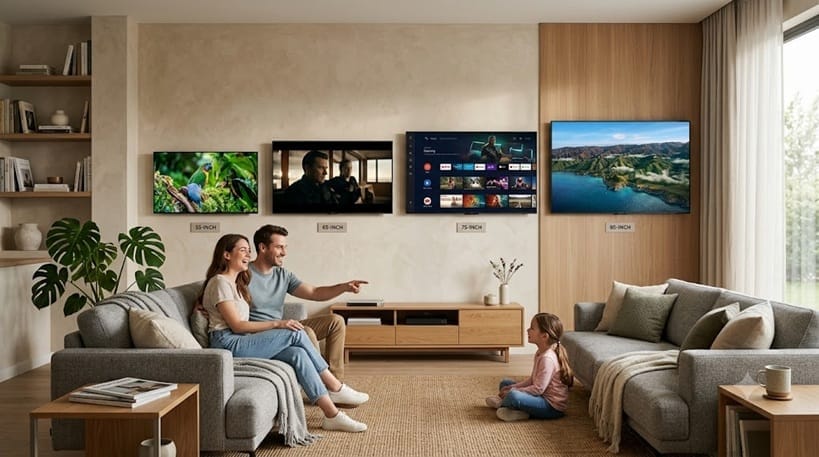
Most living rooms land comfortably in the 55″–65″ range, where all three series overlap and size isn’t a deciding factor. Smaller spaces should look at the S90H if you need 42″, or either the S90H or S85H at 48″.
Are Samsung OLED TVs worth the extra cost over Samsung’s QLED models?
For most buyers prioritizing contrast and black levels, yes, but the answer depends on viewing habits and room lighting. Our deeper breakdown on are Samsung OLED TVs worth it walks through the value case in more detail than fits here.
Will Samsung add more sizes to the S95H lineup later in 2026?
Samsung hasn’t announced additional S95H sizes as of this guide’s last update. If that changes, this Samsung OLED buying guide will be updated to reflect any new class sizes Samsung adds.
What if I need to return or file a warranty claim on a Samsung OLED?
Return windows are set by the retailer, not Samsung, and they run on a separate clock from Samsung’s manufacturer warranty. Our warranty claim return window guide walks through how those timelines typically work, so it’s worth a read before your return window quietly closes.

iYaiii
Editor, GearPulse360
iYaiii is the editor and founder of GearPulse360, specializing in TV reviews and consumer electronics. He researches every recommendation before publishing.
✅ Based on spec analysis and Samsung’s official and RTINGS data — last verified June 2026