What Is WOLED? LG’s White OLED Technology Explained
Last updated: June 2026 / 🕒 8 min read
Disclosure: As an Amazon Associate I earn from qualifying purchases. This article contains affiliate links — we may earn a small commission if you buy through them, at no extra cost to you.
Stand in front of two similarly priced 65-inch OLED TVs from different brands under bright showroom lighting, and you’ll sometimes notice one looks noticeably punchier while the other looks a little washed out — even though the box on both says “OLED.”
That difference usually comes down to which of two underlying panel designs is doing the work. You’ve probably seen “WOLED” attached to LG and almost every other OLED TV brand, and “QD-OLED” attached mostly to Samsung, and you want to know what’s actually different before you spend real money. We cross-referenced LG’s own OLED technology pages and LG Display’s newest panel-branding announcement against RTINGS’ independent panel testing to sort out what’s real and what’s just marketing language.
WOLED isn’t some outdated also-ran — it’s the panel design behind the large majority of OLED TVs sold today. This guide covers how WOLED actually works, how it compares to what QD-OLED is, and why LG just gave its newest version a new name. If you want the foundational mechanism first — why removing the backlight entirely is what makes any OLED panel work — our broader guide on how OLED TVs work covers that before this guide narrows in on WOLED specifically.
Table of Contents
The Short Answer: What WOLED Actually Means
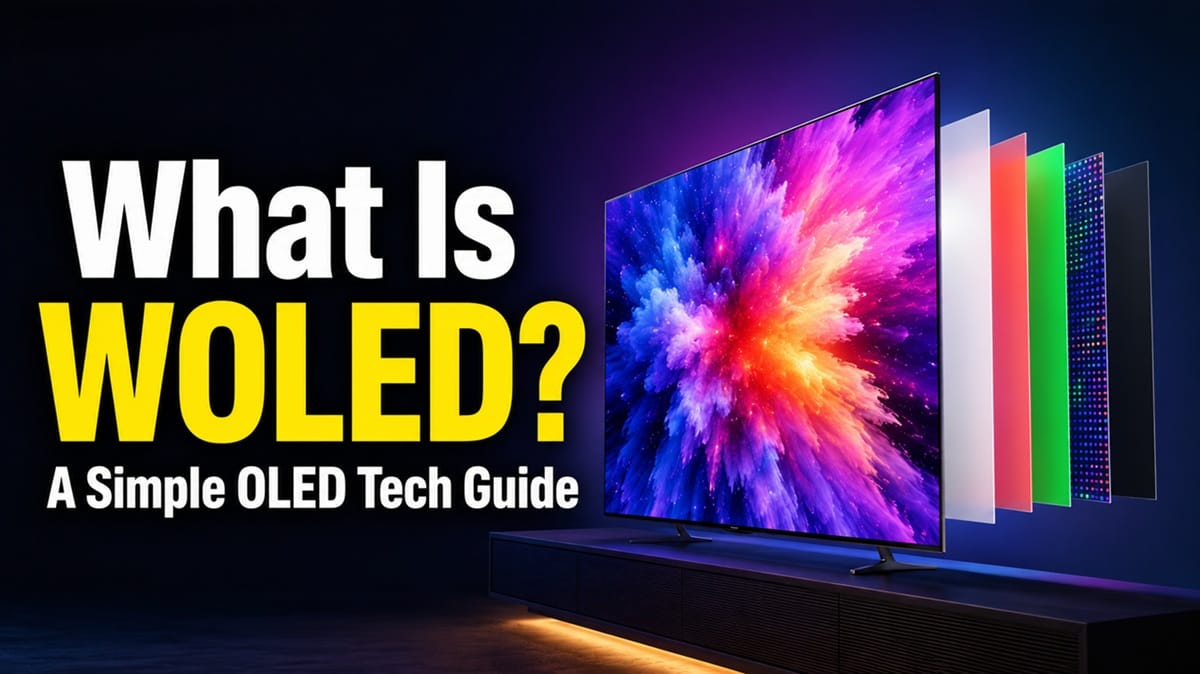
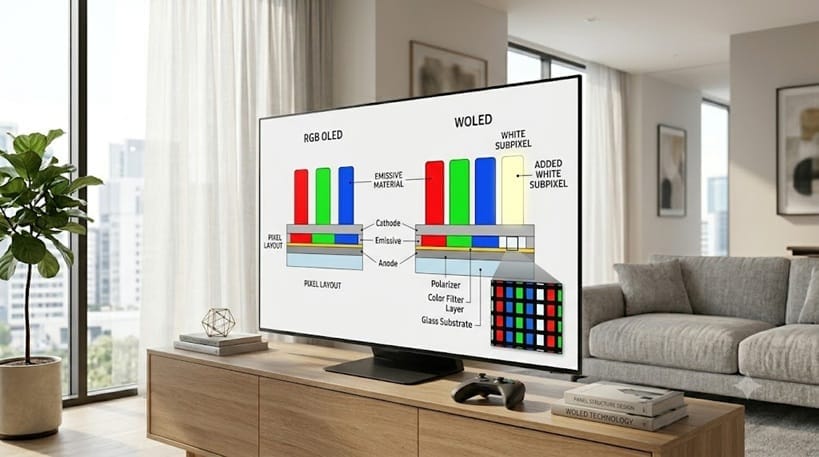
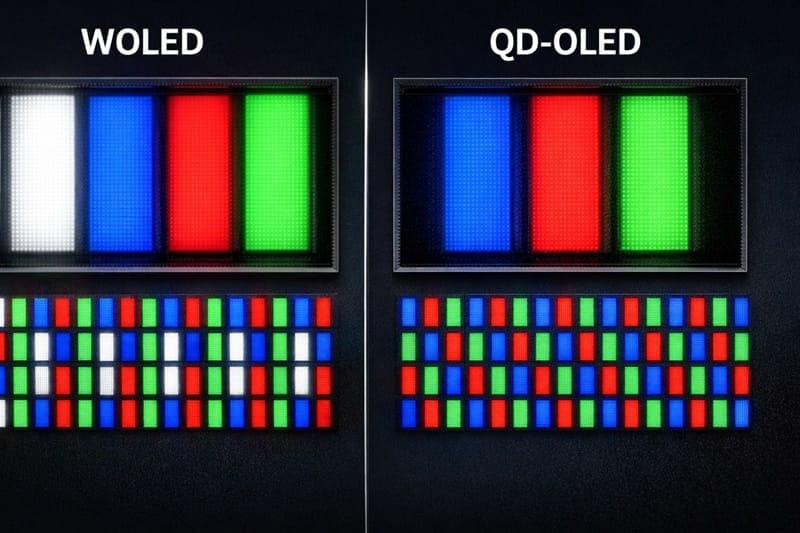
WOLED stands for White OLED — it’s LG Display’s OLED panel design that adds a dedicated white-emitting subpixel alongside the standard red, green, and blue ones, then uses color filters to shape that light into the colors you see on screen. It’s the panel found in most OLED TVs on the market today, including LG, Sony, Panasonic, and Philips models — Samsung’s QD-OLED is the main exception. As of late 2025, LG Display renamed its large-panel version “Tandem WOLED,” though the underlying white-subpixel mechanism hasn’t changed.
How WOLED Actually Works: The White Subpixel Explained
Why LG Added a Fourth Subpixel
Every OLED pixel needs to produce red, green, and blue light to build a full-color image, and each of those colored subpixels has a brightness ceiling on its own. WOLED panels add a fourth, white-emitting subpixel that boosts the panel’s overall light output — a bit like adding a master volume knob on top of three separate instrument channels, so overall brightness goes up without each individual color subpixel having to work harder.
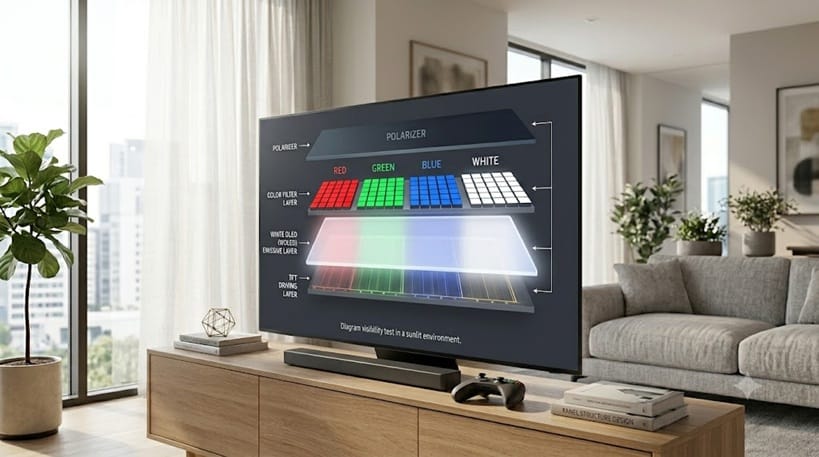
To get from that white light to an actual red, green, or blue pixel on screen, WOLED panels pass the light through color filters that subtract out everything except the wavelength they need. According to LG Display’s own technology overview, this stacked-layer approach is also what lets newer WOLED generations push brightness and lifespan further than earlier versions.
The Tradeoff: Color Filters and Color Volume
Color filters work by blocking light, not adding it — so some of the brightness gained from the white subpixel gets lost again on its way through the filter for each color. That’s the core engineering tradeoff WOLED has always had to manage: more raw brightness from the white subpixel, balanced against some loss of color-specific light on the way out.
Why WOLED Matters in 2026: The Tandem WOLED Rebrand
What LG Display Actually Renamed
Ahead of CES 2026, LG Display renamed its large-panel OLED technology — the kind used in TVs and PC monitors — “Tandem WOLED.” It’s the same white-subpixel mechanism described above; LG Display says the “Tandem” part refers to a stacked emission-layer structure designed to improve brightness, lifespan, and power efficiency. The move sits in the same competitive lane as our QD-OLED vs WOLED comparison, since LG Display frames it partly as an answer to Samsung’s QD-OLED gains.
Does the New Name Mean a New TV?
Not automatically. A brand name change doesn’t mean every model in a given year’s lineup uses the newest panel structure — entry-level and mid-tier sets often carry an older generation a season or two longer than the flagship. LG, Sony, and Panasonic all source WOLED panels from LG Display, but each brand decides separately which models in its own lineup get the newest panel generation in a given year. If panel generation matters to your decision, it’s worth checking the specific model rather than assuming from the brand name alone.
If you’re already weighing specific models against each other, our best OLED TVs in 2026 roundup ranks the top picks across brands by use case and budget.
Is WOLED Worse Than QD-OLED? The Honest Tradeoffs
The Real Differences
QD-OLED skips the white subpixel and color filters entirely. According to Samsung’s own OLED TV technology overview, it starts from a blue OLED layer and uses a quantum-dot layer to convert that light into red and green, which tends to deliver wider color volume since nothing’s being filtered out afterward. WOLED’s brightness comes from that extra white subpixel instead, which historically gave it an edge in raw light output, even if some of that light gets trimmed back down by the color filters.
There’s a second, less talked-about tradeoff around ambient light. Because QD-OLED panels skip a polarizer layer that WOLED panels use, they can be more prone to raising the apparent black level under bright ambient lighting — meaning blacks can look a touch greyer in a bright room. WOLED tends to hold darker blacks under those same bright-room conditions, even though QD-OLED often pulls ahead on color saturation in a controlled, dark room.
Manufacturer brightness claims for both panel types tend to run ahead of what independent reviewers actually measure on shipping TVs, so it’s worth treating headline nit figures from either camp as a ceiling rather than a guarantee. The practical gap between WOLED and QD-OLED has narrowed each generation, but it hasn’t disappeared — and the panel that “wins” still depends heavily on your room’s lighting and what kind of content you watch most.
What This Means for You in Practice
Which Panel Fits Your Room?
Who Should Pay Attention to This
If you’re comparing an LG, Sony, or Panasonic OLED against a Samsung set and wondering whether “WOLED” means you’re settling for an older technology, this is the distinction to understand before you decide. It’s also worth a look if you’re shopping our LG OLED roundup and want to know what’s actually changed under LG’s new Tandem WOLED branding.
Who Doesn’t Need to Worry
If you’ve already decided you want the most saturated color volume for a fully darkened home theater and you’re set on a QD-OLED model, the WOLED-vs-QD-OLED debate doesn’t change your decision — you’ve already optimized for the thing QD-OLED does best.
FAQs: What Is WOLED
What is WOLED in a TV?
WOLED is LG Display’s white-subpixel OLED panel design, used in the majority of non-Samsung OLED TVs. According to RTINGS’ WOLED vs. QD-OLED breakdown, the core difference from QD-OLED comes down to how each panel generates its red, green, and blue light.
Is WOLED older or worse than QD-OLED?
No — WOLED isn’t an outdated technology, it’s a different engineering approach with its own strengths. It tends to hold darker blacks in bright rooms, while QD-OLED tends to edge ahead on color volume in a dark room.
Does Tandem WOLED mean my TV has a brand new panel?
Not necessarily. Tandem WOLED is LG Display’s new name for its large-panel OLED technology, but not every model released under that branding uses the newest generation of the panel — it’s worth checking the specific model’s spec sheet rather than assuming from the name.
Which OLED panel type should I actually buy?
It depends on your room and viewing habits more than the panel name itself. We’re working on a deeper breakdown of every current OLED panel type — WOLED, QD-OLED, and the in-between variants — for shoppers who want to compare all of them side by side.
Will Tandem WOLED close the brightness gap with QD-OLED in 2026?
It’s moving in that direction, but the gap hasn’t fully closed. LG Display has published ambitious brightness targets for its newest panel generation, though real-world measurements from independent reviewers have historically landed below manufacturer claims for both WOLED and QD-OLED — so it’s worth waiting for independent test results on specific 2026 models rather than going by spec-sheet numbers alone.

iYaiii
Editor, GearPulse360
iYaiii is the editor and founder of GearPulse360, specializing in TV reviews and consumer electronics. He researches every recommendation before publishing.
✅ Based on spec analysis and LG’s official and RTINGS data — last verified June 2026