Is QD-OLED the Future of TV? What the Trend Actually Shows in 2026
Last updated: July 2026 / 🕒 8 min read
Disclosure: As an Amazon Associate I earn from qualifying purchases. This article contains affiliate links — we may earn a small commission if you buy through them, at no extra cost to you.
Every CES for the last three years has opened with the same headline: QD-OLED is brighter, more colorful, and gaining ground. That’s a real trend, not marketing spin — but it’s easy to walk away thinking WOLED is being phased out entirely, and that’s not what’s actually happening.
If you’re shopping for a TV right now, the “is QD-OLED the future” question usually comes from a more practical place: you don’t want to buy into a panel technology that’s about to become a dead end. That’s a fair worry, and based on manufacturer roadmap announcements and independent testing data, the honest answer is more nuanced than either camp’s marketing suggests.
This article looks at where QD-OLED is actually pulling ahead, where WOLED is closing the gap instead of losing it, and what that means for a TV you’ll be living with for years. If you haven’t read our breakdown of what QD-OLED is yet, that’s a useful starting point before diving into the trend data below.
Table of Contents
The Short Answer: Is QD-OLED Really the Future of TV?
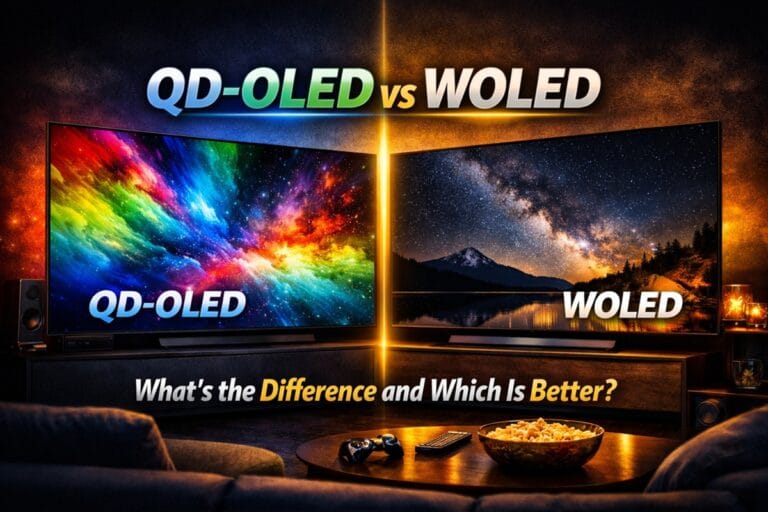
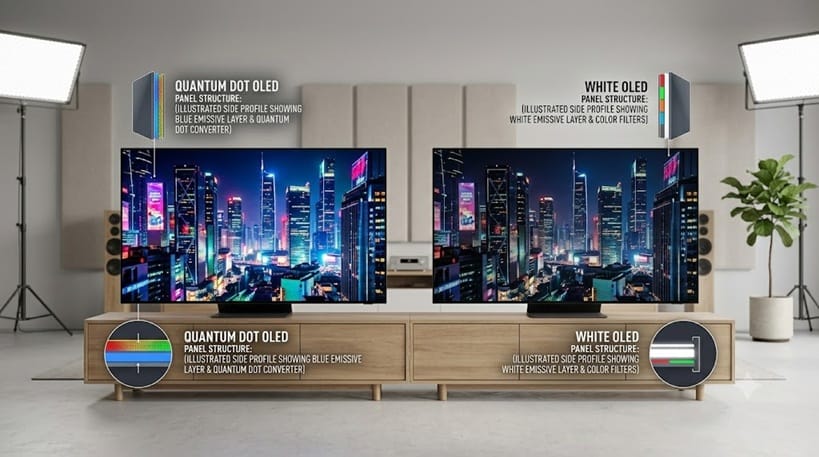
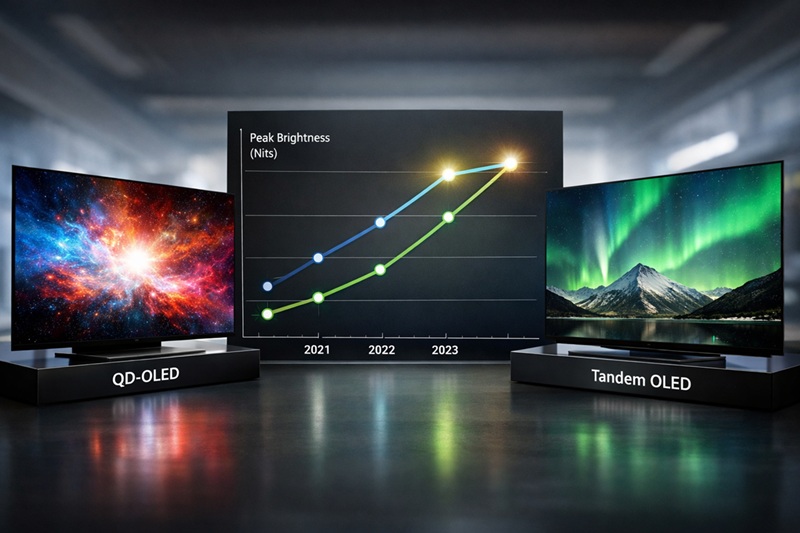
QD-OLED is growing faster than WOLED in market share and is currently setting the pace on brightness and color volume, but it isn’t replacing WOLED outright. Both panel types are advancing in parallel, and LG Display’s Tandem OLED architecture has closed much of the gap that used to make QD-OLED the clear brightness leader. “The future” is better described as two competing OLED paths, not one winner.
Why QD-OLED Is Gaining Ground
Panel Shipments and Brand Adoption Are Both Climbing
Samsung Display remains the sole supplier of QD-OLED TV panels, and it now sells them to both Samsung and Sony. That two-brand footprint alone marks a shift from QD-OLED’s early years, when Samsung was the only company using the technology in a shipping TV. Broader OLED panel adoption across TVs, monitors, and laptops has been climbing industry-wide, and QD-OLED has ridden that wave.
The Brightness and Color Story Keeps Improving
At CES 2026, Samsung Display previewed a 2026 QD-OLED TV panel rated for up to 4,500 nits of peak brightness, up from the prior generation’s 4,000-nit claim, built on newly optimized organic materials. Samsung Display frames this as a color-volume advantage as much as a brightness one, since QD-OLED reaches peak luminance by combining full brightness across all three RGB components rather than adding a white subpixel. Manufacturer figures like these are lab-condition claims rather than what a calibrated TV will hit on your wall, so treat them as a roadmap signal, not a guaranteed spec, per Samsung Display’s CES 2026 announcement.
The Case Against Calling It “The” Future
WOLED Isn’t Standing Still — Tandem OLED Changes the Math
LG Display’s answer to QD-OLED’s brightness lead has been Tandem OLED — a stacked-layer structure that generates light across multiple organic layers instead of one. The current Primary RGB Tandem architecture appears in flagship models like the LG G6, and LG Display’s own CES 2026 announcement claims its next iteration, Primary RGB Tandem 2.0, targets peak brightness up to 4,500 nits with a reflectance rate as low as 0.3%. That’s the same headline number QD-OLED is chasing, from the opposite side of the panel-type debate.
If you want the full technical breakdown of how WOLED, QD-OLED, and their sub-variants differ, our OLED panel types explained guide covers that in depth. For the manufacturer’s own framing of Tandem OLED, see LG Display’s CES 2026 press release.
Price and Availability Still Favor WOLED
WOLED panels are used by far more TV brands — LG, Sony, Philips, Panasonic, Hisense, and others all buy from LG Display — while QD-OLED is still limited to Samsung and Sony, and only in specific size tiers. That wider manufacturing base keeps entry-level and mid-range OLED options built on WOLED, which matters if budget is a bigger factor for you than chasing the newest panel spec.
Whichever panel type you lean toward, the underlying question is the same one buyers ask about OLED generally. If you’re already close to a buying decision, our best OLED TVs in 2026 roundup ranks every top pick by use case and budget.
What Could Actually Decide the Winner
Two things are more likely to shape OLED’s direction than this year’s nit count. The first is cost: QD-OLED’s smaller manufacturing base has kept it a premium-tier technology, and whether that changes depends on Samsung Display scaling production, not on any single spec bump. The second is long-term reliability — QD-OLED is younger technology with a shorter public track record than WOLED, so claims about longevity are still being tested in the field rather than proven over a decade of ownership like WOLED’s.
There’s also a wildcard neither Samsung Display nor LG Display controls directly: Chinese panel makers are investing heavily in their own OLED and QD-OLED-style production. If that capacity comes online at scale, it could reshape pricing and availability for both existing panel types faster than either company’s own roadmap.
It’s also worth watching where each technology is gaining traction outside TVs. QD-OLED has picked up real momentum in the premium gaming monitor space, where Samsung Display now supplies panels to multiple monitor brands. That kind of cross-category demand helps justify further investment in QD-OLED manufacturing, which is one of the more concrete signs that the technology has staying power beyond marketing claims.
What This Means for You in Practice
Who Should Pay Attention to This
If you’re shopping in the flagship tier and color volume or peak brightness are top priorities, the QD-OLED versus Tandem WOLED decision is worth weighing carefully, since the gap between them keeps shrinking year over year. Our QD-OLED vs WOLED compared guide walks through that side-by-side if you’re choosing between two specific models right now.
Who Doesn’t Need to Worry About This
If you’re buying in the mid-range or budget tier, this debate barely touches you yet — most sets at that price point are WOLED regardless of which technology is “winning” at the high end. Panel-type marketing moves faster than what actually reaches affordable shelves.
FAQs: Is QD-OLED the Future of TV
Is QD-OLED the future of TV, or just one direction it’s heading?
It’s one of two directions, not a replacement for WOLED. According to RTINGS’ ongoing OLED testing, both QD-OLED and Tandem WOLED sets place among the best-performing OLED TVs each year, which reflects two technologies improving in parallel rather than one overtaking the other.
Is WOLED being phased out in favor of QD-OLED?
No — WOLED remains the more widely manufactured panel type, used by far more TV brands than QD-OLED. LG Display’s continued investment in Tandem OLED shows the opposite of a phase-out; it’s a direct competitive response.
Will QD-OLED TVs get cheaper over time?
Pricing depends mainly on how much Samsung Display expands QD-OLED production capacity, since it’s currently the only manufacturer. Wider manufacturing, or new entrants, would likely bring prices down faster than any single generational upgrade.
Does panel type matter more than picture processing when choosing a TV?
Not on its own — processing, brightness tuning, and screen coating often affect real-world picture quality as much as the base panel technology does. Two TVs built on the same panel type can still look noticeably different once you compare a Samsung and a Sony implementation.
What could change the QD-OLED vs WOLED picture in the next few years?
New panel architectures already in development, alongside expanding manufacturing capacity from multiple companies, could shift the balance well before either current panel type is considered outdated. Our next-generation OLED panels breakdown covers what’s coming after QD-OLED in more detail as those technologies mature.

iYaiii
Editor, GearPulse360
iYaiii is the editor and founder of GearPulse360, specializing in TV reviews and consumer electronics. He researches every recommendation before publishing.
✅ Based on spec analysis and Samsung Display’s and LG Display’s official data plus RTINGS — last verified July 2026