Samsung OLED Warranty Denied: Why Claims Get Rejected and What Actually Helps
Last updated: July 2026
🕒 9 min read
GearPulse360 participates in the Amazon Associates Program. This particular article contains no affiliate links; other content on our site may.
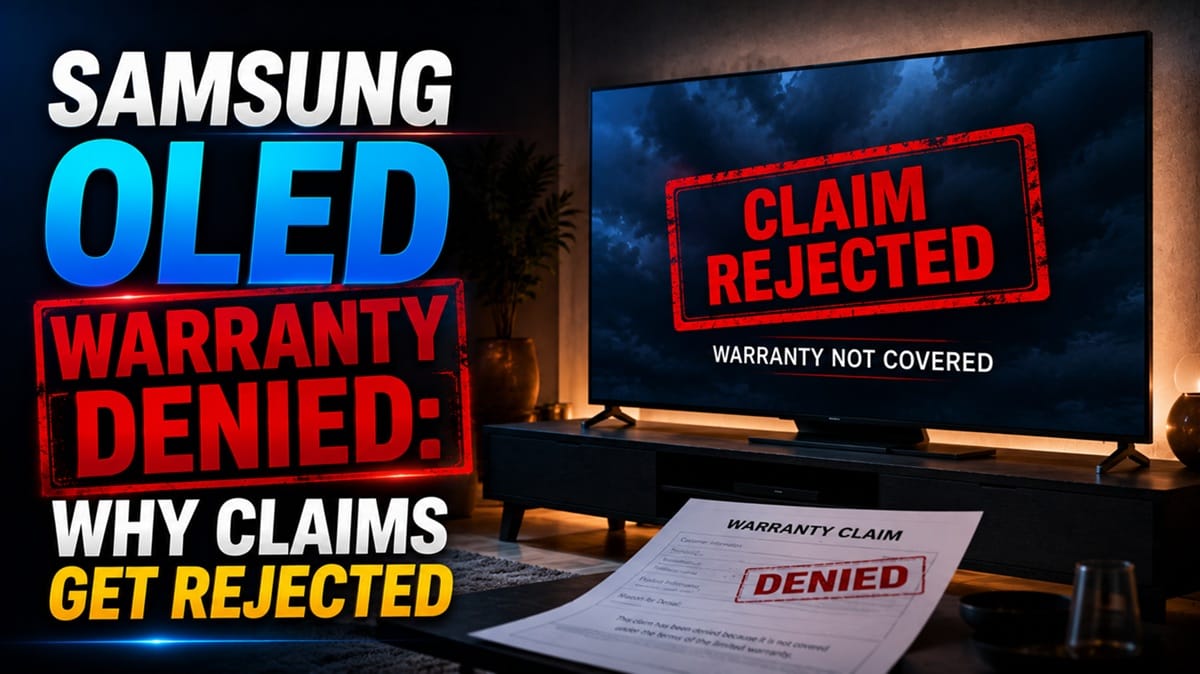
Two Samsung OLED owners file nearly identical claims — same symptom, same model year, same general timeline — and one gets a free repair while the other gets a denial letter. That split outcome isn’t random. It comes down to a handful of conditions buried in Samsung’s warranty terms, and a samsung oled warranty denied result usually traces back to one of them rather than an arbitrary decision on Samsung’s part.
If you’re reading this because a claim just got rejected, or because you’re trying to understand what you’d actually be covered for before buying, that’s a fair thing to want clarity on — Samsung’s published terms use fairly generic appliance-warranty language that doesn’t spell out how it applies to OLED-specific issues like uniformity or burn-in.
Below, we break down the specific exclusions and conditions that most often turn a legitimate-feeling issue into a denied claim, walk through what Samsung’s own warranty terms actually say, and cover what recourse looks like once a claim has already been rejected. If you’re still weighing whether the ownership experience is worth it at all given quality-control chatter like this, our breakdown of whether Samsung OLED TVs are worth it covers that bigger picture.
Table of Contents
The Short Answer
Samsung most commonly denies OLED TV warranty claims for a short list of reasons: damage classified as accidental or cosmetic rather than a manufacturing defect, screen burn-in (which Samsung’s standard limited warranty explicitly excludes), problems traced to third-party installation or unauthorized repair work, and claims filed outside the 12-month coverage window or without valid proof of purchase. Most denials fall into one of these categories rather than being a judgment call on Samsung’s part.
Why Samsung OLED Warranty Denied Claims Happen
Panel Defects vs. Excluded Conditions
Samsung’s standard limited warranty covers defects in materials and workmanship — meaning the panel or component failed on its own, under normal use, through no fault of the owner. What it doesn’t cover is anything Samsung classifies as a condition rather than a defect, and burn-in on OLED panels is the clearest example: it’s a known characteristic of the display technology itself, not a manufacturing flaw, so it sits outside standard coverage the same way it does for LG and Sony OLEDs. RTINGS’ long-running longevity and burn-in testing tracks how this plays out across brands over time, which is useful context if you’re trying to gauge how much of a real-world risk this is for the specific panel generation you own.
Physical Damage and Installation Disputes
The second-biggest category is physical damage — cracked panels, dented corners, or screens that show signs of impact. Samsung’s service technicians are trained to distinguish this from an internal component failure, and once damage is logged as physical rather than a defect, the claim is denied regardless of when it happened relative to the warranty window.
Installation disputes work similarly: if a wall mount was installed by someone other than an authorized installer and the resulting stress caused a panel or connector issue, Samsung can deny coverage for that specific failure — though federal warranty law generally prevents a manufacturer from voiding an entire warranty just because a third party touched the product, so a denial should typically be limited to the affected component rather than the whole TV.
Why Samsung OLED Warranty Denials Feel More Common in 2026
A Larger Installed Base Surfaces More Edge Cases
Samsung’s OLED lineup has expanded considerably since the S90-series launched, and a bigger installed base mechanically produces more total claims — and more denied ones — even if the underlying denial rate hasn’t shifted at all. It’s the same pattern we’ve seen play out with other reliability topics in this lineup, including the S90D power board breaker trip issue, where a larger owner base surfaced a specific failure pattern that was always going to exist at some rate.
Owner-Reported Denial Patterns Are More Visible Online
Denial reasons that used to stay buried in individual support calls now show up in specific, comparable detail across owner forums and community threads. That doesn’t mean Samsung’s terms have gotten stricter — it just means a denial that would have gone unremarked a few years ago is more likely to get discussed and cross-referenced today.

None of this is a reason to write off Samsung’s OLED lineup outright — it’s a reason to go in with clear expectations about what’s covered. Our best OLED TVs of 2026 roundup is a useful starting point if you’re still narrowing down a model and want the current field laid out side by side.
What Actually Determines Approval vs. Denial
Three things matter more than the symptom itself: whether the issue is inside the 12-month standard coverage window, whether you have proof of purchase from an authorized retailer, and how a technician classifies the failure during inspection. The table below breaks down how common scenarios typically shake out.
What This Means for You in Practice
Whether a samsung oled warranty denied outcome is likely for you comes down to which side of these patterns your situation falls on — here’s how to tell in advance.
Who Should Pay Attention to This
If you’re dealing with a mounting-related issue, a Samsung TV screen falling off or coming loose is one of the more common flashpoints for a denial, since installation disputes turn on exactly who mounted the set and how. Registering your TV and keeping your original receipt in one place also matters more than most owners assume, since a missing proof of purchase is an easy, avoidable reason for a claim to get rejected.
Who Doesn’t Need to Worry
If your issue shows up early, under normal household use, with no impact damage and no third-party repair history, the odds are clearly in your favor — Samsung’s standard warranty is built to cover exactly that scenario, and most clear-cut defect claims go through without a fight.
FAQs: Samsung OLED Warranty Denied
Why was my Samsung OLED warranty claim denied?
Most denials come down to the issue being classified as physical damage, an excluded condition like burn-in, or the claim falling outside the 12-month coverage window. Samsung’s official limited warranty terms spell out exactly what’s covered, and checking your specific model’s terms there is the fastest way to confirm which category your denial fell into.
Does Samsung deny warranty claims for burn-in on OLED models?
Yes, in nearly all cases. Screen burn-in is treated as a characteristic of OLED display technology rather than a manufacturing defect, and this exclusion isn’t unique to Samsung — LG and Sony’s OLED warranties carry the same carve-out.
Can I appeal a denied Samsung TV warranty claim?
You can request a second inspection or escalate through Samsung’s customer service line, and it’s worth doing if you believe the technician misclassified the failure. It won’t overturn a denial based on a clearly excluded condition like burn-in, but there’s no downside to asking for a second look if you think the initial classification was wrong.
Is a Samsung OLED still a safe buy given how often claims get denied?
The denial categories covered here apply broadly across OLED brands, not just Samsung, so they shouldn’t be the single deciding factor in a purchase on their own. If you’re comparing how Samsung’s warranty experience stacks up against other brands, our look at LG OLED warranty claim problems covers a lot of the same exclusion categories from the other side of that comparison.
For a specific model example, our Samsung 48S90H review covers what’s actually inside the box before warranty ever becomes a factor.
What’s the single best way to protect yourself against a denied claim?
Register the TV with Samsung and store a digital copy of the receipt the same week you buy it — that one step closes off the most common avoidable denial reason (missing proof of purchase) before it can ever come up. Pair that with using an authorized installer for any wall mount, and you’ve addressed the two exclusion categories that account for most denials that aren’t burn-in related. If you’re still comparing models before you buy, our Samsung OLED roundup is a reasonable next stop for weighing current options against each other.

iYaiii
Editor, GearPulse360
iYaiii is the editor and founder of GearPulse360, specializing in TV reviews and consumer electronics. He researches every recommendation before publishing.
✅ Based on spec analysis and Samsung’s official and RTINGS data — last verified July 2026