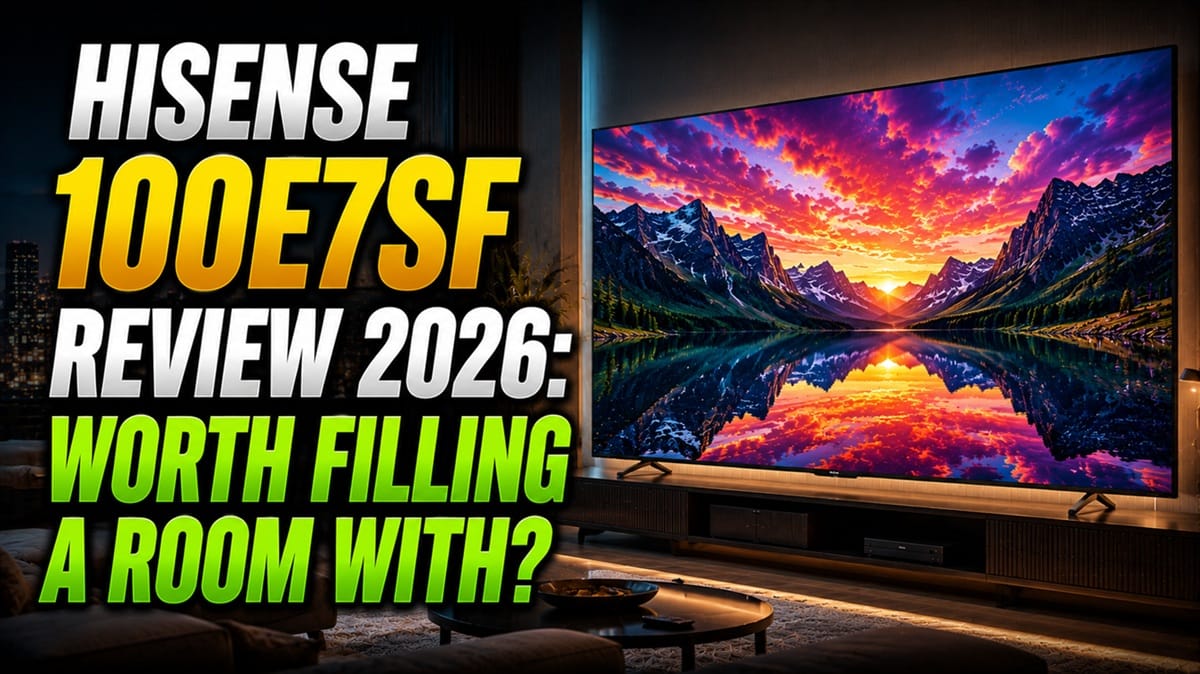
Hisense 100E7SF Review 2026: Is Hisense’s Biggest Hi-QLED Worth Filling a Room With?
Last updated: August 2026
🕒 9 min read
Disclosure: As an Amazon Associate I earn from qualifying purchases. This article contains affiliate links — we may earn a small commission if you buy through them, at no extra cost to you.
A 100-inch screen doesn’t just show a bigger picture — it asks more of the backlight behind it. Local dimming that looks tight and controlled at 55 or 65 inches has roughly 2.4 times more screen area to cover at 100 inches, using whatever zone count the panel actually has. This Hisense 100E7SF review exists to work out whether Hisense’s Hi-QLED Mini-LED still holds its contrast once you stretch it this far, or whether the same technology just gets thinner at scale.
If you’re comparing sizes, you’re probably also weighing the 100E7SF against Hisense’s own siblings — the step-up 100U7SG with its brighter, faster panel, or the cheaper 100U6SF Pro. This review draws on Hisense’s published specifications and how the E7 series has performed at smaller sizes, since Hisense’s own spec sheet stops short of publishing size-specific dimming-zone or brightness figures for the 100-inch panel.
For anyone shopping the wider field, our best 4K TVs of 2026 roundup covers how 100-inch Mini-LED sets like this one stack up against smaller, sharper alternatives. The 100E7SF undercuts most 100-inch competition on price — the trade-offs that come with that gap are what the rest of this review breaks down.
Table of Contents
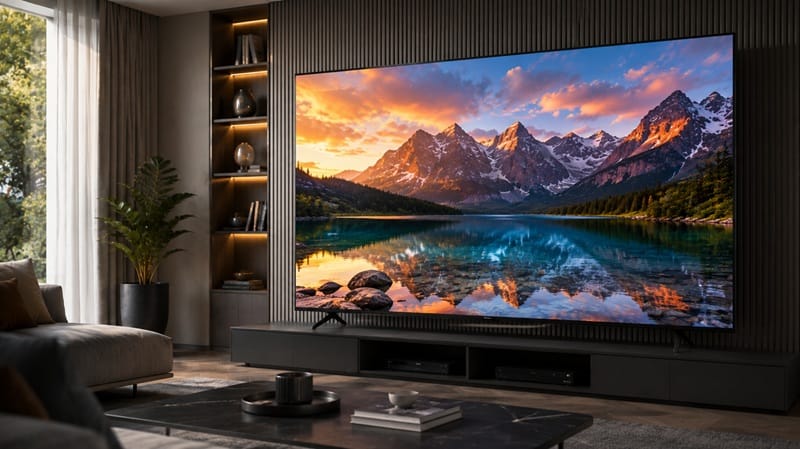
Quick Verdict
At a Glance
★★★★☆★ 7.6 / 10
At a Glance
Picture Quality
Gaming
Audio
Value
👍 Best For: buyers with a dedicated, dim-to-moderately-lit room who want the biggest screen they can get without paying premium-tier prices.
👎 Skip If: you watch mostly in a bright room, or you want best-in-class HDR punch at 100 inches.
One-Line Verdict: A 100-inch Mini-LED priced well below most 100-inch competitors — with an unpublished zone count that keeps it from being a sure thing for reference-level uniformity.
🛒 Check Availability on AmazonProduct Specs at a Glance
Product Specs
Hisense 100E7SF
Hi-QLED Mini-LED (FALD) · Native 144Hz · Fire TV
| 📺 Panel Type | Hi-QLED Mini-LED (FALD) |
| ⚡ Refresh Rate | Native 144Hz |
| 🎨 HDR Formats | Dolby Vision IQ, HDR10+ Adaptive, HDR10, HLG |
| 🔊 Audio | Dolby Atmos |
| 🧠 Processing | AI scene-by-scene picture optimization |
| 📡 Smart Platform | Fire TV with Alexa+ |
Design & Build Quality
Materials & Finish at 100 Inches
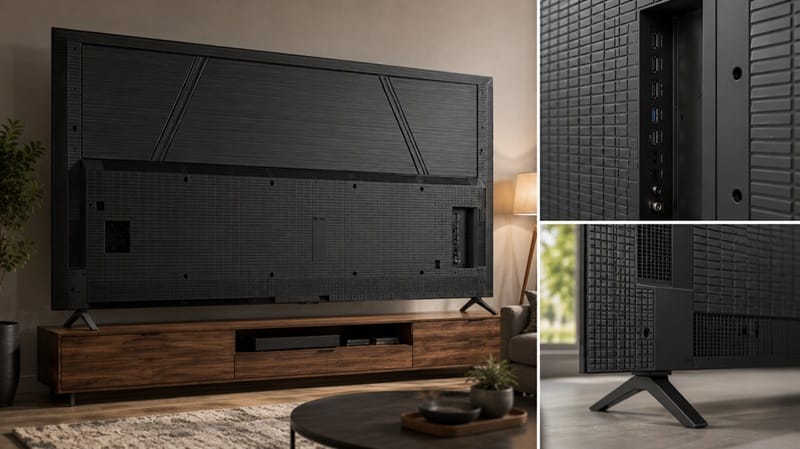
At this size, “design” mostly means logistics: this is a two-person unbox-and-mount job, and Hisense’s spec sheet doesn’t list a tabletop stand configuration for the 100-inch size the way it does for 55- and 65-inch models — plan on wall mounting or a dedicated media console rated for the weight. Based on Hisense’s product materials, the bezel follows the same slim, matte-black design language as the rest of the E7 line, just scaled up.
The panel uses the same Hi-QLED Mini-LED construction Hisense applies across the E7 series — full-array local dimming behind a quantum-dot color layer, described by Hisense as “hundreds of precise light zones.” Hisense hasn’t published an exact zone count for the 100-inch variant, so treat any claim about how tightly those zones control blooming at this size as an estimate rather than a confirmed spec.
Hisense 100E7SF Ports and Connectivity
Hisense’s official Dolby Vision certification carries over to the 100E7SF alongside HDR10+ Adaptive, HDR10, and HLG — a fuller HDR format spread than some rivals bother to support at this price tier. For day-to-day setup, that means most streaming and disc sources will hand off HDR metadata correctly without extra configuration.
Cable management at 100 inches is less forgiving than at smaller sizes simply because runs are longer — a soundbar, streaming box, and console all need clean paths to the back of a panel this wide. Wall-mount installs benefit the most here, since a media console at this scale usually sits further from the screen than the cable lengths of typical accessories.
Performance & Real-World Use
Home Theater and Movie Night
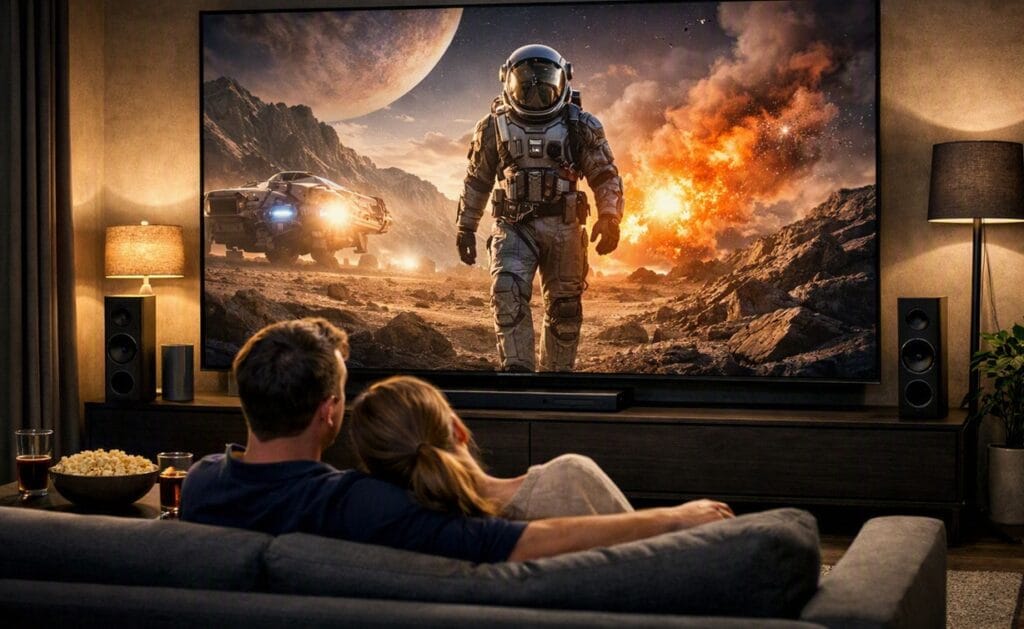
According to Hisense’s official product page, the AI picture engine analyzes content scene by scene and adjusts brightness, contrast, and color automatically — useful for movie night specifically, since manually switching picture modes throughout a two-hour film isn’t realistic. Dolby Vision IQ layers on top of that by reading the room’s ambient light and adjusting the tone curve to match.
Where the zone-count gap noted above tends to show up in practice is high-contrast content — a spaceship against a black sky, movie subtitles on letterboxed bars, a single streetlamp in a night scene. Daylight footage and brightly lit shows are far less likely to expose it, since local dimming only has to work hard when the image mixes very bright and very dark areas in the same frame.
Hisense 100E7SF Gaming Performance at 144Hz
The 100E7SF ships with a native 144Hz panel, which Hisense frames around reduced blur during gameplay and smoother handling of fast camera pans. That number matters more for PC gaming than console: the PS5 and Xbox Series X top out at 120Hz over HDMI 2.1, so a PC is the only source that can actually drive this panel at its full native refresh rate.
For couch-distance console gaming, the panel’s 144Hz ceiling still helps with motion clarity even at 120Hz input, and MEMC interpolation smooths non-native content further. Hisense’s spec sheet doesn’t list a VRR range or game-mode input lag figure for this model, so gamers who care about exact numbers should ask a retailer or check a demo unit before buying rather than assuming parity with the higher-tier U7SG, which runs a faster 165Hz panel.
Sports and Bright-Scene Viewing
HDR10+ Adaptive and Dolby Vision IQ both use ambient-light sensing to recalibrate the image in real time, which should help sports broadcasts — typically shot brighter and more saturated than film content — stay watchable if the room isn’t fully dark. That said, Mini-LED sets in this price bracket generally aren’t built for truly bright rooms; a set with higher peak brightness, like the step-up Hisense 100U7SG, is the better fit if the room gets significant daylight.
Key Features Breakdown
AI Scene-by-Scene Picture Processing
Rather than relying on a single static picture mode, the AI engine reads each scene and adjusts settings automatically — a real help at 100 inches, where a poorly calibrated picture mode is far more noticeable than it would be on a 55-inch set tucked in a bedroom.
MEMC Motion Enhancement
Motion smoothing helps lower-frame-rate content — cable news, older films, some streaming — look less juddery on a screen this size, where motion artifacts tend to be more visible simply because more of your field of view is filled by the panel.
The Good, the Bad, and the Ugly
Pros
- ✅ Properly large screen at a mid-flagship price — 100-inch Mini-LED sets from most competitors cost noticeably more.
- ✅ Full HDR format support — Dolby Vision IQ, HDR10+ Adaptive, HDR10, and HLG cover nearly every source you’re likely to throw at it.
- ✅ Native 144Hz panel — a real refresh-rate advantage over most budget-tier TVs at 100 inches.
Cons
- ❌ Unpublished zone count — Hisense hasn’t confirmed how many local dimming zones the 100-inch panel actually uses, making uniformity claims harder to verify.
- ❌ No confirmed VRR range or detailed game-mode specs — competitive gamers should confirm input lag figures before buying, rather than assuming parity with Hisense’s higher tiers.
The Ugly
This isn’t unique to the 100-inch model, either — Hisense’s own product page follows the same pattern across the E7 series regardless of size: “hundreds of precise light zones” is the only figure given, with no number attached. That’s different from how Hisense documents its step-up U7 series, where listings do cite a specific zone count. What changes at 100 inches is the stakes: the same missing number matters more when it’s covering 2.4 times the screen area of a 65-inch panel.
If uniform blacks in a dark home theater are the top priority, ask a retailer directly about dimming-zone density before buying — the zone count on a 55- or 65-inch E7SF isn’t automatically the same math at 100 inches.
Who Should Buy This — and Who Shouldn’t
Buy the Hisense 100E7SF If…
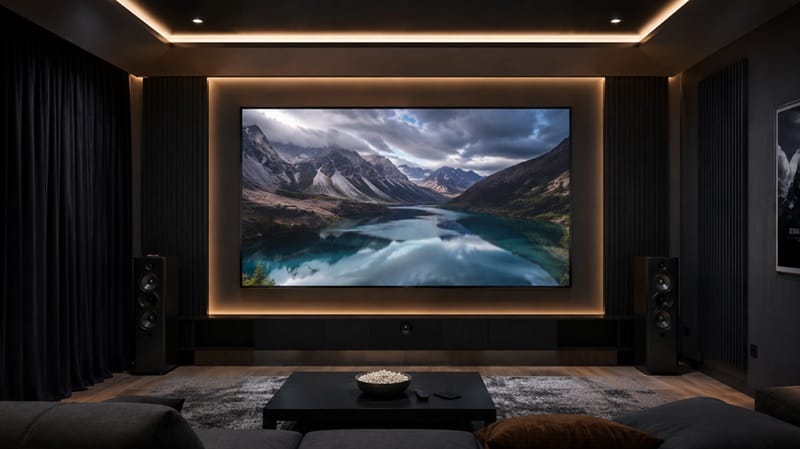
You’ve got a dedicated room — a finished basement, a media room, a home theater setup — where you can control lighting and want the largest screen your budget allows. Think of the 100E7SF less as “a bigger TV” and more as a modest home-theater projector replacement: it trades some of a projector’s setup hassle and bulb maintenance for a brighter, always-ready Mini-LED panel, without the premium most 100-inch sets carry.
It’s also a reasonable pick if you’ve compared it against our OLED vs Mini LED compared breakdown and decided screen size matters more than absolute contrast — OLED simply doesn’t scale to 100 inches at any price most buyers can justify, so Mini-LED is the only realistic route to a screen this large.
For a wider look at value picks across brands and sizes, our Samsung Crystal UHD buying guide covers where budget-tier competitors land by comparison.
Skip This If…
Your room gets meaningful daylight, or peak HDR brightness matters more to you than sheer size — the step-up Hisense 100U7SG is the better fit there, with a faster 165Hz panel and higher published brightness at a higher price. If 100 inches is simply more than your room needs, the smaller E7SF sizes deliver the same picture technology without the installation logistics.
Final Verdict
Is the Hisense 100E7SF Worth Buying?
The 100E7SF earns its price: full HDR format support, a native 144Hz panel, and Hisense’s AI processing add up to a reasonable case for a TV this size at a mid-flagship price. The missing zone-count figure keeps it from being an easy yes for anyone chasing reference-level uniformity — that buyer is better served sizing down to the Hisense 65E7SF review‘s smaller, easier-to-verify panel, or stepping up to the 100U7SG for a documented spec sheet. 🛒 Check Availability on Amazon
Frequently Asked Questions
Is the Hisense 100E7SF a good TV in 2026?
It’s one of the more affordable routes to a 100-inch screen, with full HDR format support and a native 144Hz panel backing that up. It’s a less clear pick if bright-room performance or best-in-class uniformity is the top priority.
How does the 100E7SF compare to Hisense’s other Mini-LED TVs?
Based on RTINGS’ broader testing of Hisense’s Mini-LED lineup, Hisense’s step-up U7 series generally trades a higher price for a faster panel and higher published brightness — a pattern that Hisense’s own spec sheets suggest holds at 100 inches too, though the company hasn’t broken out size-specific numbers to confirm it.
Is the Hisense 100E7SF good for gaming?
Console gaming, yes, though the PS5 and Xbox Series X cap out at 120Hz — it’s PC gamers who get the full benefit of the native 144Hz panel. Hisense hasn’t published VRR range or input-lag numbers for this specific size, so confirm those with a retailer if competitive play is the priority.
Who should avoid the 100E7SF?
Bright-room viewers and buyers chasing best-in-class HDR brightness should look at the step-up 100U7SG instead. Anyone without a room actually suited to a 100-inch screen is usually better served by a smaller E7SF size.
Does the Hisense 100E7SF need professional installation?
Not strictly, but at 100 inches, a two-person wall mount rated for the panel’s weight or a heavy-duty media console is close to a requirement rather than a suggestion.

iYaiii
Editor, GearPulse360
iYaiii is the editor and founder of GearPulse360, specializing in TV reviews and consumer electronics. He researches every recommendation before publishing.
✅ Based on spec analysis and Hisense’s official data — last verified August 2026.