How High Should a TV Be Mounted? Finding the Right Height for Comfortable Viewing
Last updated: August 2026
🕒 7 min read
Disclosure: GearPulse360 is a participant in the Amazon Associates Program. Some pages on this site contain affiliate links, and we may earn a commission from qualifying purchases at no extra cost to you.
You’ve got the mount, the drill, and a stud finder — and now you’re staring at a blank wall trying to figure out exactly where to put the bracket. If you haven’t gotten to that stage yet, our guide on how to mount a TV on a wall covers the mount, the drill, and the stud-finding steps that come before this decision. Every site you check gives a different fixed number: 42 inches, 60 inches, “eye level.” None of them agree, and once the holes are drilled, there’s no undoing a height that turns out to be wrong.
Most people search for how high should a TV be mounted right before they commit to a permanent decision, and the frustration is usually the same: a flat inch measurement online never accounts for the couch, the screen size, or how far back people actually sit. A TV mounted “correctly” by someone else’s living room measurements can still end up too high in yours.
Two things actually decide the right number: seated eye level, not a fixed measurement from the floor, and how screen size and viewing distance shift that baseline in either direction. The common mistakes below explain where fixed-inch advice falls apart in practice — over the fireplace being the biggest one. If you’re weighing a wall mount against just leaving the TV on a stand or console, our look at how thin panel design affects flush wall-mounting is worth a read before you finalize a mounting plan at all. From there, the short answer below gets you the number you need.
Table of Contents
Quick Answer
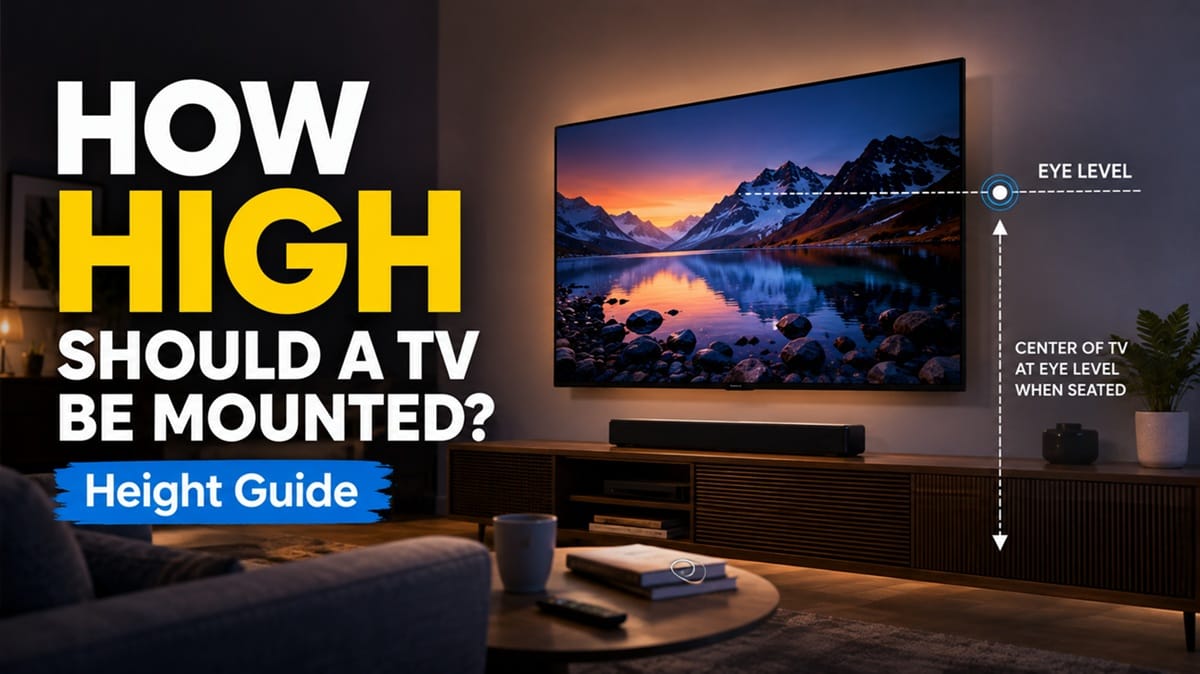
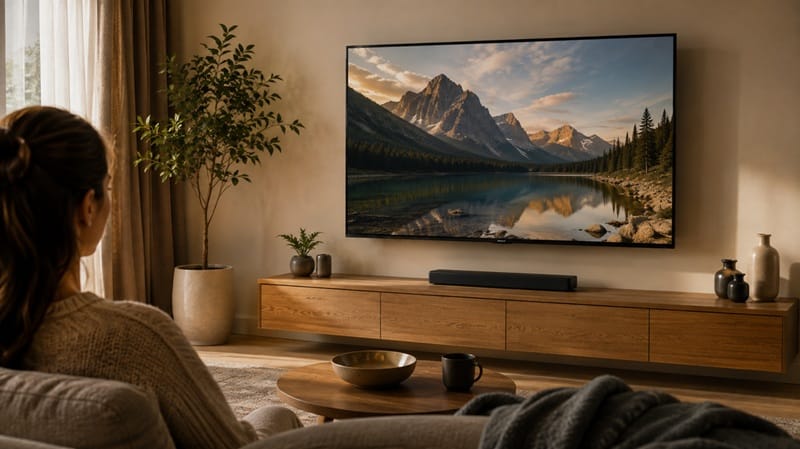
Mount your TV so the center of the screen lines up with your eyes when seated — for most living rooms with a standard sofa, that puts the center around 42–48 inches from the floor, but the exact number shifts with screen size and seating distance.
- Best for: Living rooms and bedrooms with a fixed seating position
- Not ideal for: Rooms where seating changes often (standing, mixed-height furniture)
- Key advantage: Eye-level mounting reduces neck strain and keeps the picture looking its best
- Starting price: Basic fixed wall mounts start in the budget range; full-motion mounts cost more
The Short Answer: How High Should a TV Be Mounted
The center of the screen should sit at eye level for whoever’s watching from the main seat, measured while seated — not standing. For a typical sofa with a seat height around 17–19 inches, that usually lands the screen center somewhere between 42 and 48 inches off the floor, though bigger screens and closer seating distances can push that number in either direction.
Why Eye Level Beats a Fixed Number
The Geometry Behind the Recommendation
A flat inch measurement ignores the two things that actually determine comfort: how big the screen is and how far back you’re sitting. RTINGS’ size-to-distance research lays out why viewing distance and screen size are directly linked — a 77-inch screen at 8 feet needs a different setup than a 55-inch screen at the same distance. That size-distance relationship has a geometric knock-on effect for mounting height: basic viewing-angle geometry means the vertical angle to the screen shifts less per inch of height the farther back you’re sitting, so the farther back you sit relative to screen size, the more forgiving the exact mounting height becomes.
Why Neck Angle Matters More Than People Expect
Mounting too high forces a constant upward tilt of the neck, which is the single biggest complaint behind “my TV is mounted too high” searches. It’s the same reason a laptop propped too high causes neck fatigue during a long call — small angles add up over hours of viewing.
The Mistakes That Show Up Most in 2026 Living Rooms
Two setups account for most of the “mounted too high” regret: TVs placed above a fireplace, and TVs mounted to match furniture that gets replaced later.
The Over-the-Fireplace Problem
Fireplace mantels are almost always taller than the eye-level formula calls for, so a TV centered on the mantel typically sits well above where it should. If the fireplace is the only realistic wall option, a full-motion or tilting mount that angles the screen downward toward the seating area helps offset the extra height — it won’t fully solve the angle problem, but it reduces it.
Mounting to Match Furniture That Won’t Stay
A height chosen around a specific couch or recliner stops working the moment that furniture gets swapped for something with a different seat height. If you’re not planning to keep the same seating setup long-term, it’s worth measuring a couple of realistic seat heights (both current and likely future) and mounting toward the middle of that range rather than the exact current number.
If you’re still comparing panel types before you even get to the mounting stage, our best OLED TVs of 2026 roundup ranks this year’s picks by picture quality, screen size, and recommended viewing distance for each — worth a look if the mounting height math above has you reconsidering what size screen actually fits the wall.
Why There’s No Single “Standard” Height for Every Room
The eye-level formula only works once you know your actual seat height and screen size — and screen size is where a lot of the fixed-number advice online falls apart, since a 42-inch and an 85-inch TV centered on the same wall spot look completely different in practice — matching your actual screen dimensions to the wall matters as much as the height math itself. If you’re not sure how wide or tall your specific model actually is, our reference on what are the dimensions of a TV breaks down exact width, height, and weight for every common screen size.
A reasonable bedroom-mounting variant also comes up often enough that it’s worth covering directly, since bedroom seating (usually a bed, not a sofa) changes the eye-level math — covered in the FAQ below.
What This Means for You in Practice
Buy This If…
You’re mounting fresh — new TV, new wall, or a full remodel — and want the eye-level formula applied correctly the first time instead of guessing and living with a bad angle. It’s also worth doing properly if you’re in a small space or apartment, where a poorly placed TV is harder to compensate for with seating changes.
Renters weighing whether they can even mount a TV in a rental in the first place should sort that out before drilling anything — our guide on whether you can mount a TV in an apartment walks through lease restrictions and what to check first. If you’re also sizing the TV itself for a smaller room, our best OLED TVs for small spaces guide covers picks suited to apartments and bedrooms specifically.
Skip This If…
Your TV is staying on a stand or console rather than going on the wall at all — the eye-level principle still applies loosely, but you don’t need to calculate a drilling height if nothing’s being mounted. The same goes for rooms where seating position changes constantly (a home gym, a kitchen), where no single height will stay “correct” for long.
FAQs: TV Mounting Height
How high should a TV be mounted in a bedroom?
Bedroom mounting height depends on whether you’re watching from a bed or a chair — from a bed, the eye level is much lower than a seated sofa position, so the same living-room formula would sit the screen too high. A useful starting point is to sit or recline in your usual watching position and measure straight across to where your eyes land, since the viewing-angle testing RTINGS publishes shows picture quality degrades faster the further you view a screen from off-angle, which matters more in a bedroom’s shorter viewing distances.
Is it bad to mount a TV too high?
Yes, in that it forces a constant upward neck tilt during viewing, which is the most common complaint behind “TV mounted too high” regret. It’s not a safety issue, just a comfort one, and it’s usually fixable after the fact with a tilting mount that angles the screen down toward the seating area.
Does TV size change the ideal mounting height?
Yes — a larger screen centered at the same eye-level point extends further both above and below that center, so the top and bottom edges land in different spots than a smaller screen would at the identical height. The eye-level rule for the center of the screen stays consistent regardless of size; it’s the edges that shift.
Should I mount my TV above the fireplace?
You can, but it usually means the screen sits above the ideal eye-level height, since most mantels are taller than the formula calls for. A tilting or full-motion mount that angles the screen downward toward the seating area is the most common fix if the fireplace wall is your only option.
Do I need a stud finder to get the height right?
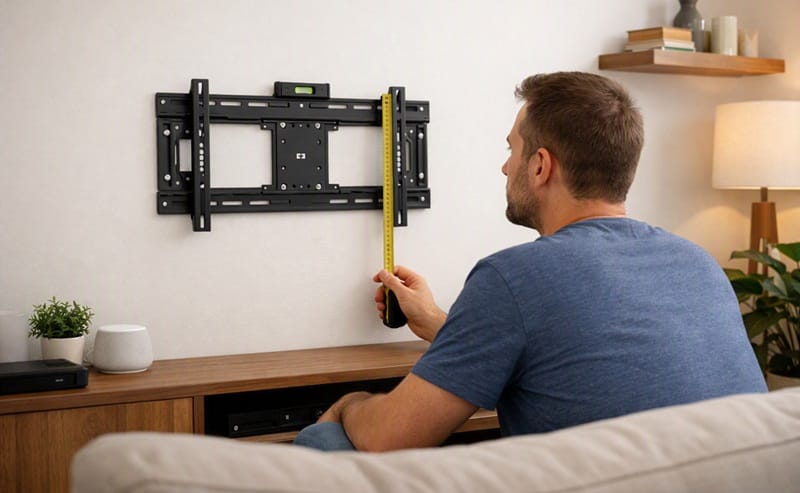
A stud finder helps you confirm where you can actually anchor the mount, but it doesn’t change the height calculation itself — that’s based on seated eye level, not stud placement. If your ideal eye-level height doesn’t line up with a stud, that’s a separate mounting-hardware question rather than a reason to change the target height. Our guide on how to install a TV wall mount walks through that separate mounting-hardware question in full, including what to do when the stud position and your target height don’t line up.

iYaiii
Editor, GearPulse360
iYaiii is the editor and founder of GearPulse360, specializing in TV reviews and consumer electronics. He researches every recommendation before publishing.
✅ Based on spec analysis and RTINGS data — last verified August 2026