Best OLED TVs for Bright Rooms in 2026: Top Picks That Handle Ambient Light
Disclosure: As an Amazon Associate I earn from qualifying purchases. This article contains affiliate links — we may earn a small commission if you buy through them, at no extra cost to you.
Last updated: June 2026
The biggest knock against OLED has always been brightness — the assumption being that you need blackout curtains just to enjoy one. That reputation was fair five years ago. It’s not anymore. The best OLED TVs for bright rooms in 2026 hit brightness levels that would have seemed impossible from an OLED panel just two generations back, and a couple of them come with anti-glare coatings that actively fight reflections instead of just softening them.
That said, not every OLED handles ambient light equally well. Panel type, screen coating, and how the TV manages brightness in sustained scenes all vary significantly between models — and choosing the wrong one for a sun-facing living room is an easy and expensive mistake. If you’re shopping specifically for sports, the calculus shifts slightly — motion clarity and glare handling both matter, and our guide to the best OLED TVs for sports covers that angle in detail. This guide focuses on the specific specs that actually matter when the curtains are open.
Table of Contents
↻ Prices change frequently — click through for current pricing.
✓ Scores reflect our independent assessment, not Amazon customer reviews.
Best Overall OLED TV for Bright Rooms: Samsung S95H
The S95H earns the top spot here for two reasons that compound each other. First, its peak brightness in a 10% HDR window ranks among the highest ever measured for an OLED panel, making it the brightest OLED currently available. Second, its third-generation Glare Free coating doesn’t just diffuse reflections like a standard matte finish; it actively prevents mirror-like glare while preserving color accuracy, which most matte coatings sacrifice.
In practice, that combination means you can watch HDR content in a room with afternoon sunlight coming through the windows and still see specular highlights pop the way they’re supposed to. Three years ago, that combination simply didn’t exist in any OLED panel.
One thing worth flagging: the S95H drops the One Connect Box that Samsung flagship TVs have shipped with for years. All ports are built into the panel itself now, which some buyers will prefer for cleaner cable runs. If your furniture is centered under a wall mount, that’s fine. If you’re routing cables across the room to a media unit, plan accordingly.
Gaming performance is also strong here — 4K/144Hz over HDMI 2.1, VRR, and native G-Sync compatibility are all present. For a TV that’s primarily bought for its bright-room credentials, the gaming spec sheet is a pleasant bonus rather than an afterthought.
Best Value QD-OLED for Bright Rooms: Samsung S90H
The S90H uses the same QD-OLED panel technology as the S95H and hits comparable peak brightness numbers. Where it steps down is the screen coating: no Glare Free finish here, so if your room gets direct sunlight on the screen itself, you’ll notice more reflection than you would on the flagship. In a room with controlled lighting or indirect natural light, that difference largely disappears.
For buyers who sit in a well-lit room but aren’t dealing with windows that beam directly at the TV, the S90H is the sharper value. You’re getting the core brightness advantage of QD-OLED without paying for the premium coating and chassis refinements that define the S95H.
The panel’s color volume is also worth calling out here. QD-OLED’s quantum dot layer produces some of the most saturated, accurate colors at high brightness of any TV technology available — which means HDR content looks genuinely different in a bright room compared to a standard WOLED panel trying to do the same thing. Skin tones under bright outdoor scenes, in particular, hold their detail in a way that impresses even viewers who aren’t paying close attention to picture quality.
Best WOLED Pick for Bright Rooms: LG G5
LG’s G5 uses a Tandem OLED structure — essentially two OLED layers stacked on top of each other — which gives it a meaningful brightness jump over the standard WOLED panels found in the C5. It’s not quite at QD-OLED levels of peak luminance, but it’s close enough that in most real-world bright rooms, the difference is far less dramatic than the spec sheets might suggest.
Where the G5 has a genuine advantage over Samsung’s lineup is Dolby Vision support. If you consume a lot of streaming content on Netflix, Disney+, or Apple TV+, Dolby Vision’s dynamic tone mapping adds a visible layer of precision to HDR delivery that HDR10+ simply doesn’t match frame-for-frame. For a bright-room TV that’s mostly used for streaming, that’s a real consideration.
The Gallery Series design is also legitimately flat against the wall — wall-mounted, it looks like a piece of hardware that was designed for that position rather than propped there. If you’re installing this TV in a living room where aesthetics matter as much as picture quality, the G5’s build gives you something the Samsung lineup doesn’t quite match.
That said, if your room gets very direct, harsh sunlight, the Samsung QD-OLED options above will handle it more comfortably. The G5 is the pick when your lighting situation is manageable and you want the full LG ecosystem — including webOS, Magic Remote, and native Dolby Vision — as part of the package.
Best Sony OLED for Bright Rooms: Sony Bravia 8 II
The Bravia 8 II is the Sony pick here, and the main reason to choose it over either Samsung QD-OLED comes down to picture processing. Sony’s Cognitive Processor XR handles tone mapping, upscaling, and Dolby Vision rendering in a way that produces a more natural, film-like image out of the box — without the slight oversaturation that Samsung’s processing tends toward in default modes.
That matters because ambient light is unforgiving with color accuracy. Watch a nature documentary on an over-saturated TV in a bright room — grass goes neon, skin tones orange. The Bravia 8 II’s processing avoids that. Colors read as accurate whether the sun is up or down, which is exactly what you want from a living-room TV that doubles as your primary streaming screen.
The trade-off compared to the Samsung options is the refresh rate. The Bravia 8 II tops out at 120Hz and has only two HDMI 2.1 ports, which is worth noting if you’re planning to use this as a gaming TV for a PS5 and another console simultaneously. For movie and streaming-focused buyers, it’s not a factor. For serious gamers, the Samsung S95H or S90H are stronger choices.
Also Consider
Samsung S95H — if gaming performance or maximum brightness in direct sunlight is your priority over Sony’s picture processing.
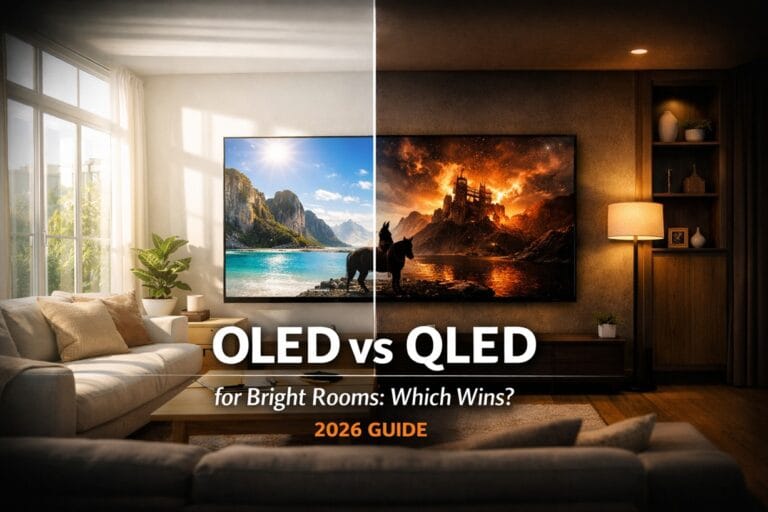
Deciding between OLED and QLED for your bright room? Our full OLED vs QLED comparison goes deeper on how both technologies stack up when ambient light is a factor — including specific scenarios where QLED still has an edge.
What to Look For in a Bright-Room OLED TV
Peak Brightness — and Why the Window Size Matters
Manufacturers quote peak brightness numbers in different ways, and not all of them are equally useful. The figure that matters most for bright-room viewing is peak brightness in a 10% window — that’s the spec that reflects how bright the TV gets during the small, intense highlights that appear in HDR content (a sunlit window in a scene, a stadium floodlight, a chrome surface). This is where OLED has made the most dramatic progress in recent generations.
Full-screen sustained brightness is a separate number, and it’s always lower. This is where OLED’s Automatic Brightness Limiter (ABL) comes into play — OLEDs reduce brightness when large portions of the screen are lit simultaneously, to protect the panel from overheating. In a very bright room watching content with large bright scenes (think: sports in a stadium), this ABL behavior is more noticeable. QD-OLED panels generally handle this better than standard WOLED, which is one reason the Samsung picks dominate this list.
If sports is your main use case rather than bright-room viewing broadly, our full OLED vs Mini LED for sports comparison walks through how each panel type handles that fast-motion, high-brightness combination in more depth.
Screen Coating — Gloss vs Matte vs Glare Free
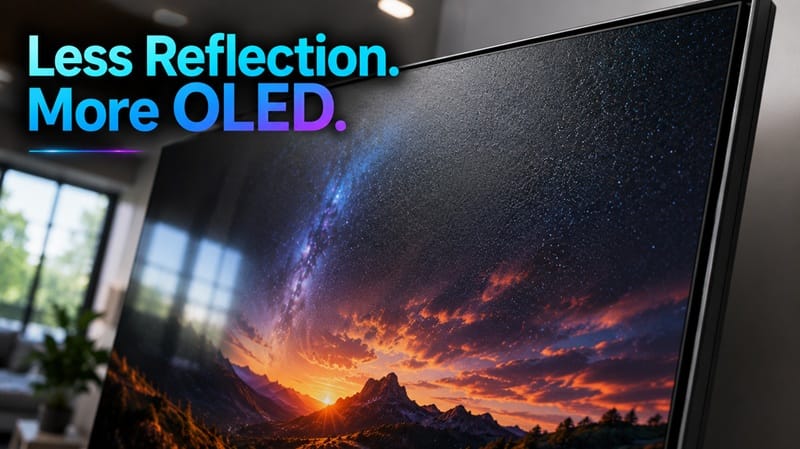
This is arguably the most underrated spec for bright-room buyers. A glossy screen will reflect everything behind you with crystal clarity — which is beautiful in a dark room and distracting in a light one. A standard matte coating reduces reflections but also softens the image slightly and can make dark areas look grayish.
Samsung’s Glare Free coating (exclusive to the S95 tier) is in a different category. It uses a micro-textured surface that scatters reflections without the image-softening penalty of traditional matte finishes. Put it next to an LG C5 under the same store lighting and the difference is obvious within seconds — the C5’s semi-gloss surface picks up the ceiling lights like a mirror, while the S95H’s surface just doesn’t. For the most demanding bright-room environments, it’s the coating to look for. You can compare how different panel technologies approach this in our OLED vs Mini LED comparison.
QD-OLED vs WOLED Tandem for Bright Rooms
These are the two main OLED panel architectures you’ll encounter in 2026, and they approach brightness differently. QD-OLED (Samsung and Sony’s panels) uses a blue OLED emitter with a quantum dot layer to produce red, green, and blue subpixels — the result is higher color volume at high brightness, which is why QD-OLED TVs tend to look more vivid in bright conditions rather than washed out.
WOLED Tandem (LG’s G-series) stacks two OLED layers on top of each other, doubling the light output compared to a single-layer WOLED. The G5 is significantly brighter than the C5 as a result. It doesn’t produce the same color saturation at peak brightness as QD-OLED, but for most living rooms it’s now genuinely competitive — and it supports Dolby Vision, which QD-OLED Samsung panels don’t.
For a deeper technical breakdown of how these two architectures differ, our QD-OLED vs WOLED comparison covers the full picture beyond the bright-room context.
Ambient Light Detection and Auto-Dimming Behavior
Most modern OLED TVs include an Ambient Light Detection sensor that adjusts brightness and tone mapping based on the room’s light level. LG’s implementation is generally the most conservative — it adjusts gradually and rarely draws attention to itself. Samsung’s ALD can be more reactive on high-APL content. If you’re particular about consistent brightness, turning it off entirely and locking a picture mode is the cleaner approach on any brand.
Refresh Rate and HDMI 2.1 — Relevant If You Game
For movie and streaming viewers, 60Hz is technically all you need from a content delivery standpoint, and every TV on this list exceeds that. For gaming, the calculus changes. The Samsung S95H and S90H both support 4K/144Hz over HDMI 2.1 and include four HDMI 2.1 ports — which means you can connect a PS5, Xbox Series X, and a soundbar simultaneously without adapters or splitters. The Sony Bravia 8 II has a 120Hz panel and two HDMI 2.1 ports, which works fine for a single-console setup. The LG G5 is also 144Hz with four HDMI 2.1 ports. Its game optimizer auto-switches to low-latency mode when it detects a console signal — no digging through menus required.
Is OLED Actually Good for Bright Rooms?
The honest answer is: it depends on the model, and it depends on what you mean by “bright room.” If your living room gets direct afternoon sun streaming straight at the TV screen, a top-tier Mini LED TV — think Samsung QN90F or similar — may still edge out even the S95H in pure reflective resistance and sustained full-screen brightness. OLEDs are no longer weak in bright rooms, but Mini LED still holds a measurable peak brightness advantage overall. If price is the bigger factor than panel type for you, our LG 75NU850B review looks at how a large, budget-friendly LED screen handles that same direct-light scenario for a fraction of what any TV on this list costs.
That said, the question isn’t just about brightness numbers. It’s about the total picture experience. OLED’s perfect black levels mean that even in a bright room, dark scenes retain their depth in a way no LCD panel can match — because there’s no backlight bleeding around those blacks. During a film that cuts between dark interiors and bright outdoor sequences, OLED handles both extremes better than any competing technology, even if the bright scenes aren’t as blinding as a Mini LED can achieve.
Where OLED still makes sense for a bright room is the scenario most buyers actually face: a well-lit living room with windows but not direct sun on the screen, combined with evening or night viewing that benefits from deep contrast. For that environment — which describes the majority of living rooms — the S95H or S90H are excellent choices. The trade-off vs Mini LED in pure bright-room performance has narrowed to a point where most viewers won’t feel the difference in daily use.
If you’re still weighing your options between OLED and the latest panel technologies, our piece on whether OLED is worth it in 2026 addresses exactly this trade-off with more nuance than the spec sheets provide.
And if you want the full picture on what OLED gets right and where it still falls short, our breakdown of OLED TV pros and cons covers every side of the decision — not just bright-room performance.
How We Picked These TVs
These picks are based on spec analysis cross-referenced against third-party measurement data from RTINGS, supplemented by manufacturer specs and independent testing reports published in 2026. For bright-room evaluation specifically, we weighted peak brightness (10% window), screen coating quality, and ABL behavior under high-APL content more heavily than overall picture scores.
This article is updated when new measurement data becomes available or when significant price or availability changes occur. Our recommendations are editorially independent — affiliate links help fund the site, but they don’t influence which TVs make the list.
📍 Shopping across all budgets and use cases? Our full roundup covers the best OLED TVs of 2026 at every price point — not just bright rooms.
Bright-Room OLED TV FAQs
Which Are the Best OLED TVs for Bright Rooms in 2026?
The Samsung S95H is the strongest pick for most bright-room buyers — it combines the highest peak brightness of any OLED currently available with a third-generation Glare Free coating that reduces reflections without degrading image quality. For buyers who want similar panel technology at a lower price, the Samsung S90H is the next best option, with the understanding that it lacks the Glare Free screen finish.
Are OLED TVs worth it if I have a lot of windows?
It depends on whether light is hitting the screen directly. In a room with indirect natural light or controlled blinds, modern QD-OLED and Tandem WOLED panels handle ambient light well enough that most viewers won’t feel they’re compromising. If sunlight streams directly onto your screen for hours at a time, a premium Mini LED TV may still be the more practical choice — though the gap has narrowed substantially since 2023.
Does OLED brightness suffer in bright rooms due to ABL?
Automatic Brightness Limiting (ABL) is a real characteristic of OLED panels — brightness does reduce on large bright scenes to protect the panel. In practice, this is most noticeable during extended sports watching with large white or light-colored areas filling the screen. QD-OLED panels, including both Samsung picks on this list, handle sustained brightness more gracefully than older WOLED panels. For detailed brightness measurement methodology, RTINGS’ bright room TV testing covers this comprehensively.
Should I choose OLED or QLED for a bright room?
For most living room setups with indirect natural light, the best OLEDs now compete directly with premium QLEDs in bright-room performance — while retaining OLED’s contrast and black level advantages in darker scenes.
What’s the difference between QD-OLED and WOLED for bright rooms?
QD-OLED panels (Samsung S95H, S90H, Sony Bravia 8 II) generally produce higher peak brightness and better color saturation at high luminance, which is why they lead on this list for bright-room use. WOLED Tandem panels like the LG G5 have closed the gap significantly with stacked panel architecture, and the G5 adds Dolby Vision support that Samsung’s panels don’t offer. For the most demanding bright-room environments, QD-OLED holds a measurable edge. For a more controlled living room, either technology works well.

iYaiii
Editor, GearPulse360
iYaiii is the editor and founder of GearPulse360, specializing in TV reviews and consumer electronics. He researches every recommendation before publishing.
✅ Based on spec analysis and RTINGS data — last verified June 2026