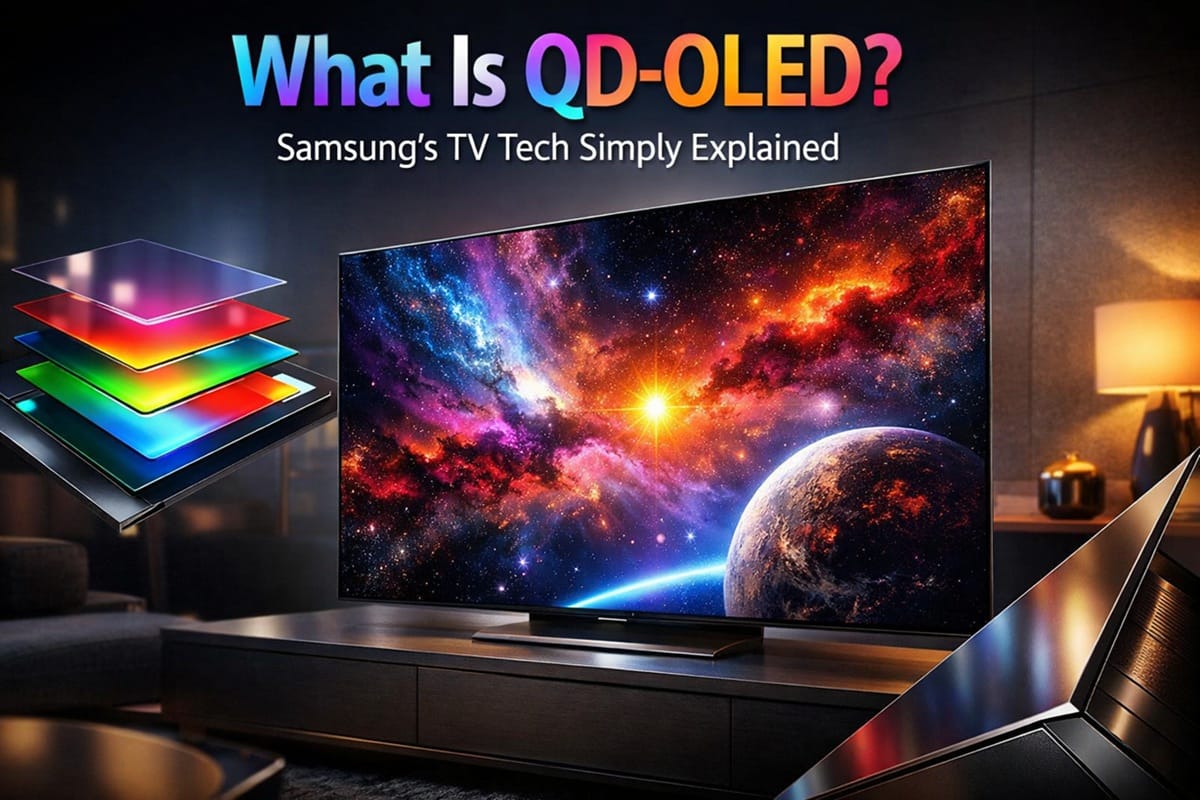
What Is QD-OLED? Samsung’s Display Technology Explained Simply
Last updated: June 2026
Disclosure: As an Amazon Associate I earn from qualifying purchases. This article contains affiliate links — we may earn a small commission if you buy through them, at no extra cost to you.
You’re looking at a Samsung or Sony TV listing and the spec sheet says “QD-OLED panel.” Sounds impressive — but what does it actually mean for the picture you’re going to see on your wall?
QD-OLED is essentially Samsung’s attempt to take everything good about OLED — the perfect blacks, the razor-thin pixels — and push the brightness and color further than standard OLED panels can manage. It does this by combining OLED’s self-emissive pixels with a quantum dot layer that converts light into more vivid, more precise colors. The result: an OLED that gets noticeably brighter in highlights and richer in saturated colors, without sacrificing the contrast that made OLED worth buying in the first place.
In this article we’ll break down exactly what QD-OLED is, how the technology works, how it compares to the WOLED panels LG uses, and which TVs you can actually buy with a QD-OLED panel in 2026. If you’re new to OLED in general, our primer on what OLED TV technology is is a good place to start before reading on.
Table of Contents
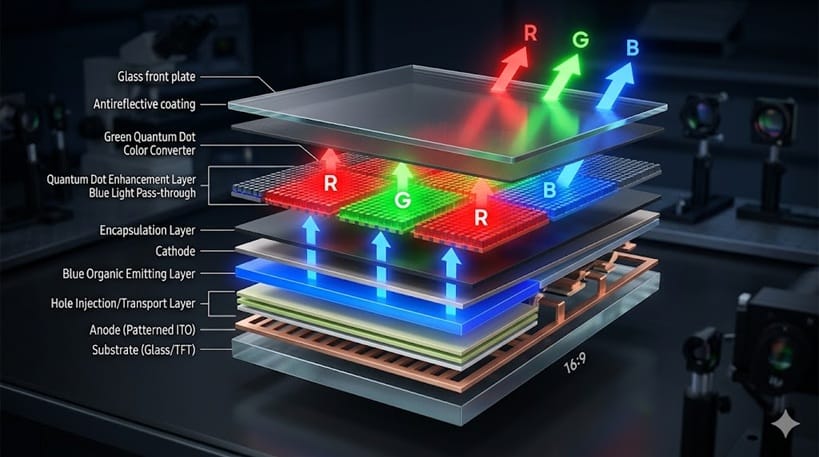
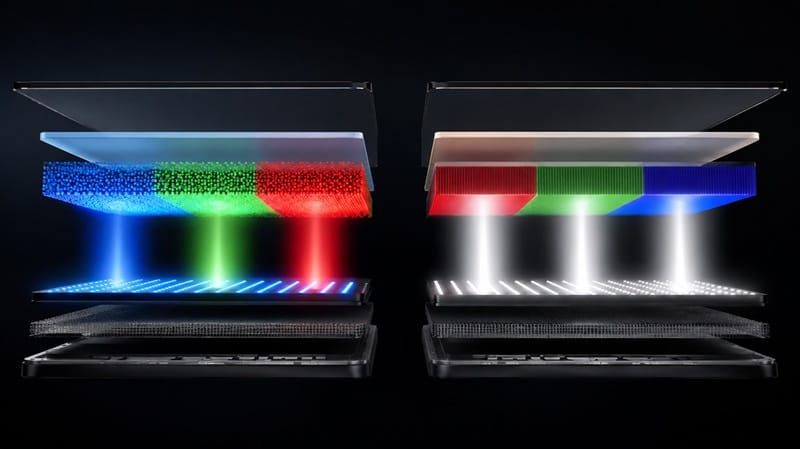
A QD-OLED panel uses blue OLED emitters with a quantum dot layer to produce a wider color gamut and higher brightness than traditional OLED designs.
The Short Answer: What Is QD-OLED?
QD-OLED stands for Quantum Dot OLED. It’s a panel technology developed by Samsung Display that uses a layer of quantum dot particles to convert blue OLED light into a full, vivid color spectrum. The core advantage over standard OLED is higher peak brightness and a wider color volume — particularly in bright highlights and saturated colors. Black levels remain as deep as any other OLED technology.
Think of it this way: a standard WOLED TV might peak at around 800–1,000 nits in a small highlight window. A QD-OLED panel in the same scenario can hit 1,500 nits or above. That gap is what separates a bright HDR highlight from one that actually makes you squint — and it’s the clearest single reason QD-OLED exists.
How QD-OLED Works
The blue OLED emitter and quantum dot layer
A conventional LCD TV uses a white backlight that shines through color filters to produce red, green, and blue sub-pixels. Standard OLED TVs — specifically LG’s WOLED panels — use white OLED emitters with color filters on top. Both approaches involve some light being absorbed and wasted by the filter.
QD-OLED takes a different route. The panel starts with a layer of blue OLED emitters — the entire screen glows blue at the pixel level. That blue light then passes through a quantum dot conversion layer. Quantum dots are nanoscale semiconductor crystals — each one tuned to absorb the panel’s blue light and re-emit it at a specific wavelength. Red dots produce red. Green dots produce green. Blue sub-pixels don’t need converting — the original blue light passes straight through. Three primaries, one blue source, no backlight.
The result is that the panel produces its red, green, and blue sub-pixels through light conversion rather than light filtering. Conversion is more efficient than filtering — less light is lost in the process — which is why QD-OLED panels can achieve higher brightness while retaining the color purity that quantum dots are known for.
Why Samsung — and Sony — use this approach
Samsung Display manufactures QD-OLED panels and supplies them to two TV brands: Samsung Consumer Electronics and Sony. That’s why you’ll find QD-OLED panels in Samsung’s S-series OLED TVs and in Sony’s BRAVIA line. No other TV manufacturers currently use QD-OLED panels in their 2026 consumer TV lineup.
For Samsung, QD-OLED was a strategic way to enter the premium OLED market while differentiating from LG — which holds the dominant position in OLED panel manufacturing. Rather than license LG’s WOLED technology, Samsung developed its own panel architecture from scratch. That said, Samsung’s 2026 OLED TV lineup isn’t entirely QD-OLED anymore: only the flagship S95H uses it. The S90H and S85H switched to WOLED panels for 2026, a notable change from previous generations.
For a closer look at how panel type, pricing, and features stack up across Samsung’s full 2026 range, our Samsung OLED buying guide walks through the S85H, S90H, and S95H side by side.
QD-OLED vs WOLED: The Key Differences
If you’re not sure what WOLED is, it’s the panel technology LG uses in its own TVs — the C-series, G-series, and others. Both QD-OLED and WOLED are OLED technologies, which means both deliver self-emissive pixels, perfect black levels, and near-instant pixel response. The differences lie in how each panel generates color and handles brightness.
Brightness and Color Volume
Brightness: QD-OLED panels tend to achieve higher peak brightness in small highlights — the kind of bright spots you see in HDR content like a lamp in a dark scene or sunlight glinting off water. LG’s latest WOLED panels with MLA (Micro Lens Array) technology have narrowed this gap considerably in 2026, but Samsung’s top-tier QD-OLED panels in peak highlight scenarios still edge ahead in independent testing.
Color volume: QD-OLED produces a wider color gamut, particularly in high-brightness colors. Deep reds and saturated greens at high luminance levels look more vivid on a QD-OLED panel than on most WOLED panels. This is where the quantum dot conversion layer earns its keep — it produces purer primaries than a white OLED + color filter setup.
Where They’re Identical — and Where They Differ
Where the two technologies converge completely is black levels. Both switch their pixels off entirely — there’s no backlight to bleed through — so dark scenes look identical on either panel. The one area where WOLED holds a genuine edge is off-axis viewing: LG’s MLA+ coating keeps brightness and color stable as you move to the side of the screen. QD-OLED panels can shift slightly in color when viewed at sharp angles, though in a typical living room seating arrangement, most people never notice.
That brightness gap isn’t fixed — it narrows a little more with each new panel generation, on both sides. We track that year-over-year shift in our piece on whether QD-OLED is the future of OLED, which looks at how far each side’s 2026 roadmap has actually closed the distance.
For the full comparison between these two panel types, our QD-OLED vs WOLED compared article goes deep on every metric.
Which TVs Use QD-OLED in 2026?
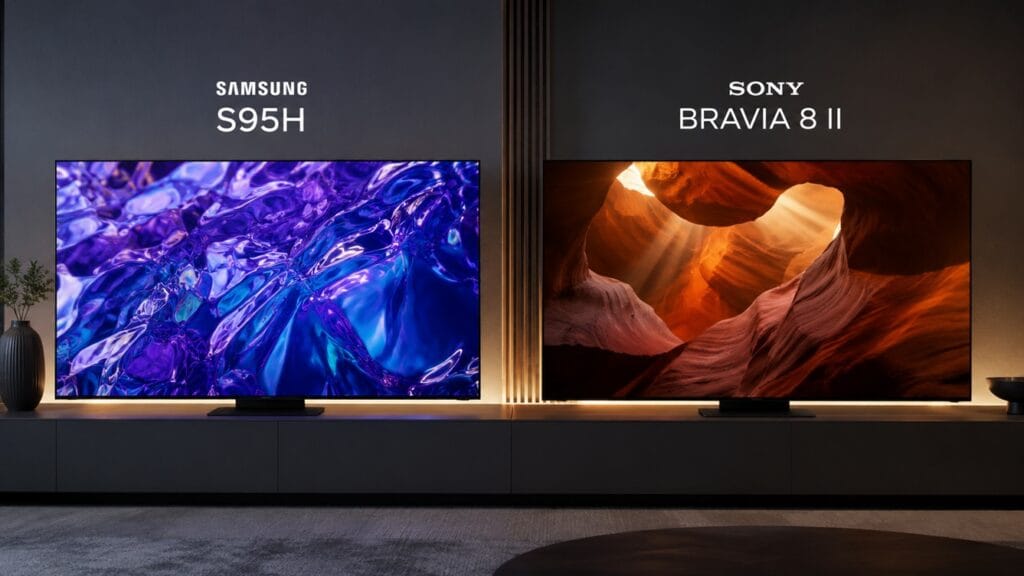
The QD-OLED panel is currently exclusive to Samsung and Sony — but not across their entire OLED lineups. Here’s where you’ll actually find it in 2026:
- Samsung S95H — Samsung’s only QD-OLED model for 2026. Anti-glare coating, the highest peak brightness in the lineup, and premium build. See our Samsung OLED roundup for how it compares to the rest of the range.
- Sony BRAVIA 8 II — Sony’s QD-OLED entry for 2026. Uses the same Samsung Display panel, but Sony’s Cognitive Processor XR handles picture processing differently — with a focus on film-accurate color reproduction and motion handling tuned for cinematic content. Read our full Sony BRAVIA 8 II review for hands-on findings.
Here’s the part that trips up a lot of shoppers: Samsung’s S90H and S85H switched to WOLED panels for 2026, despite model names that previously implied QD-OLED. The S90H still gets Samsung’s Glare Free screen treatment, a 165 Hz refresh rate, and four HDMI 2.1 ports, while the S85H is the entry-level option with a glossy screen and a lower refresh-rate ceiling. So is LG’s entire OLED range — the C6H, G6, and B6 all use WOLED panels too. If you want QD-OLED specifically, the S95H or the BRAVIA 8 II are Samsung and Sony’s only options this year.
What QD-OLED Means for You in Practice
Who will notice the difference
QD-OLED’s advantages are most visible in specific situations. If you watch a lot of HDR content — 4K Blu-rays, Dolby Vision films, HDR gaming — the higher peak brightness and wider color volume make a tangible difference. Bright highlights pop more naturally. Saturated colors in high-brightness scenes look richer. If you also game, the S95H’s fast pixel response and high refresh rate are strong additional reasons to consider QD-OLED specifically — though the WOLED S90H now matches most of that same gaming spec sheet for less money.
Bright-room viewers will also appreciate QD-OLED’s brightness headroom. While OLED panels in general are better suited to controlled lighting than LED TVs, a QD-OLED panel in a moderately lit room performs better than most WOLED panels at the same price point. For more on this use case, see our honest breakdown of OLED pros and cons including the brightness and glare limitations of OLED in general.
Who probably won’t notice
If you mostly watch standard dynamic range (SDR) content — regular cable TV, free-to-air broadcasts, standard streaming at non-HDR quality — the difference between a QD-OLED and a WOLED panel won’t be significant. Both will look excellent compared to a standard LED TV. Both will deliver perfect blacks, smooth motion, and great color. The advantages of what QD-OLED is become most apparent in HDR, and if HDR content isn’t a priority for you, a WOLED TV from LG can offer comparable picture quality — sometimes at a lower price.
QD-OLED vs WOLED: which is right for you?
📍 Ready to shop OLED TVs? See every top-rated QD-OLED and WOLED TV ranked by picture quality, gaming performance, and value in our full 2026 guide. See our best OLED TVs of 2026 → roundup.
FAQs: What Is QD-OLED?
Is QD-OLED better than regular OLED?
In terms of peak brightness and color volume, yes — QD-OLED panels generally outperform standard WOLED panels, particularly in HDR highlight performance and saturated color reproduction at high brightness levels. However, “better” depends on your use case. Independent testing at RTINGS consistently shows QD-OLED leading in color gamut coverage, while WOLED panels with MLA technology compete closely on viewing angles and overall brightness. For most buyers, both are excellent — the gap is real but not dramatic in everyday viewing.
Does LG make QD-OLED TVs?
No. LG manufactures and uses WOLED panels in all its OLED TVs. QD-OLED panels are made exclusively by Samsung Display and used only in Samsung and Sony televisions. The two technologies are competing approaches to OLED — neither brand uses the other’s panel type.
What’s the difference between QD-OLED and QLED?
Despite the similar name, QLED and QD-OLED are very different. QLED is Samsung’s marketing term for a standard LCD TV that uses a quantum dot enhancement film to improve color — it still relies on a conventional LED backlight and does not have self-emissive pixels. QD-OLED is a true self-emissive panel where every pixel generates its own light and can switch off completely for perfect blacks. QLED cannot match OLED for contrast ratio. QD-OLED is OLED with quantum dot enhancement — QLED is not OLED at all.
Which Samsung TV should I buy if I want QD-OLED?
Only the Samsung S95H uses a QD-OLED panel in Samsung’s 2026 lineup. The S90H and S85H switched to WOLED panels for 2026, despite model names that previously implied QD-OLED across the range. If QD-OLED specifically matters to you, the S95H is currently Samsung’s only option. See our Samsung OLED roundup for a full comparison of all three models, including how the WOLED S90H stacks up against the QD-OLED S95H in practice.
Is QD-OLED good for gaming?
QD-OLED is an excellent gaming panel. Samsung’s S95H supports up to 165 Hz native refresh rate, four HDMI 2.1 ports (for multi-console setups), very low input lag around 1ms, and features like G-Sync Compatible and FreeSync Premium Pro. The WOLED S90H now shares most of that same gaming spec sheet, so you don’t have to pay the QD-OLED premium for top-tier gaming performance. The Sony BRAVIA 8 II is also strong for gaming, though it prioritizes film processing over raw gaming features.

iYaiii
Editor, GearPulse360
iYaiii is the editor and founder of GearPulse360, specializing in TV reviews and consumer electronics. He tests and researches every recommendation before publishing.
✅ Based on spec analysis and Samsung’s official data plus RTINGS — last verified June 2026