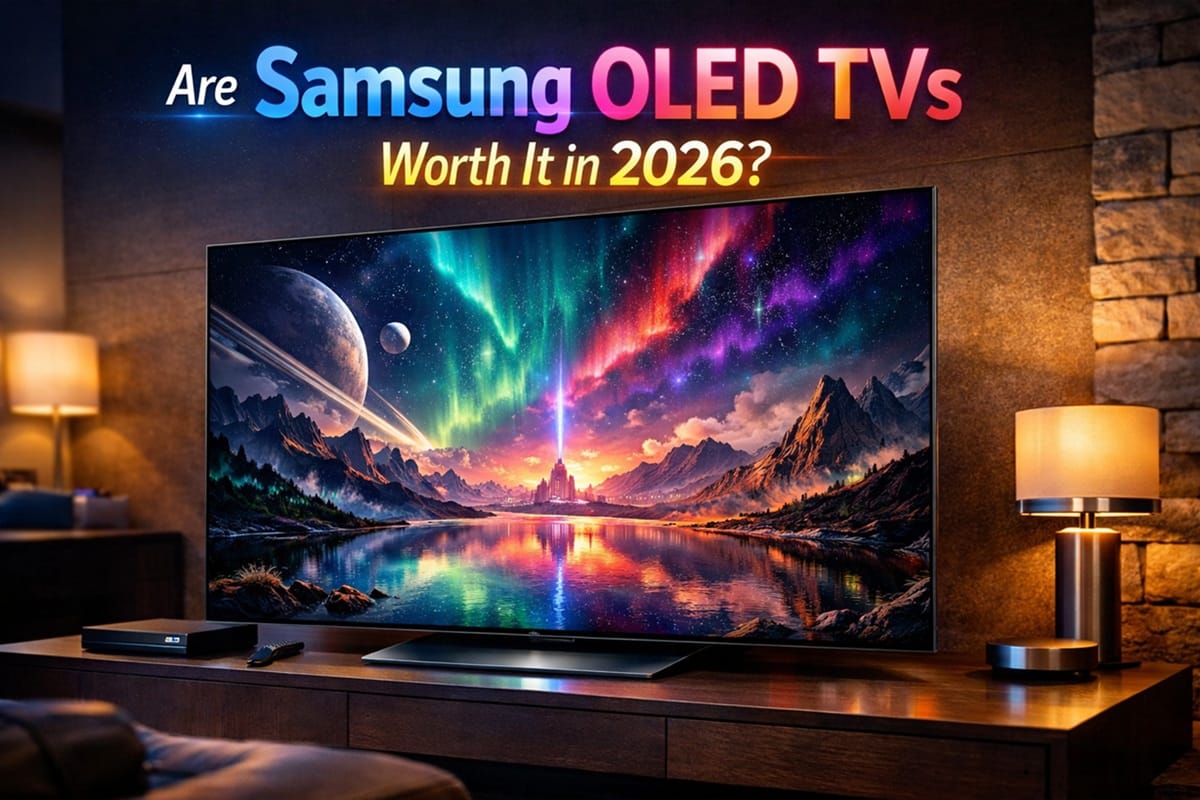
Are Samsung OLED TVs Worth It? QD-OLED Value Honestly Assessed
Disclosure: As an Amazon Associate I earn from qualifying purchases. This article contains affiliate links — we may earn a small commission if you buy through them, at no extra cost to you.
Qualified Yes — but it depends which advantage you actually want
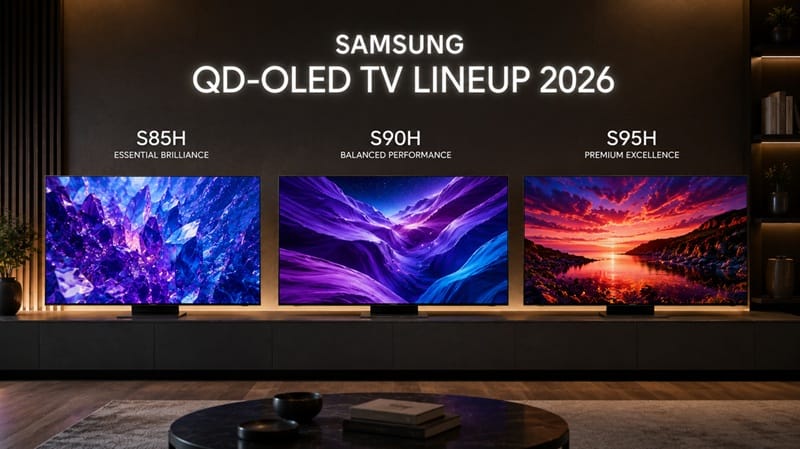
Samsung splits its two real advantages across the lineup: the S95H gets both QD-OLED’s richer HDR color and the Glare-Free coating, the S90H gets Glare-Free plus a faster 144Hz panel but runs a standard WOLED panel for color, and the S85H keeps QD-OLED color but drops Glare-Free and caps at 120Hz. There’s no single tier that’s the obvious answer for every buyer — it depends whether color or glare/speed matters more to you.
Samsung sells three OLED TVs in 2026 — the S85H, S90H, and S95H — and the answer to “are Samsung OLED TVs worth it” is not the same for all three. They don’t all share the same panel: the S85H and S95H use Samsung’s QD-OLED panel, while the S90H actually switched to a WOLED-based panel this year. Each tier trades a different set of advantages, and picking the right one means knowing which trade-off matches how you watch.
Most buyers searching this question are standing at a fork in the road: Samsung OLED vs LG’s C-series at a similar price, or Samsung’s QLED lineup at a lower one. This article gives you a direct answer for each scenario — no hedging, no generic praise of OLED technology.
Already convinced Samsung is the brand and just deciding which model? We cover that below. Still comparing Samsung against LG head to head? Our LG OLED vs Samsung OLED comparison covers every major spec and use case.
Table of Contents
The Short Answer: Are Samsung OLED TVs Worth It?
At the S95H: yes, clearly — it’s the only tier with both of Samsung’s real advantages. At the S90H: yes, but for different reasons than you’d expect — its edge over LG is Glare-Free and a faster 144Hz panel, not color, since the S90H runs a WOLED panel this year. At the S85H: closer than people assume, since it keeps the QD-OLED color advantage but loses Glare-Free and caps at 120Hz, which is why the LG C6H still wins on overall value at that price. Which tier you’re looking at changes the answer completely.
What You’re Actually Paying Extra For
Samsung’s mid and flagship QD-OLED models have two advantages that show up in real-world use — not just in spec comparisons. A third feature is worth knowing about even if it’s parity rather than a lead.
HDR Color That’s Measurably Richer Than LG WOLED
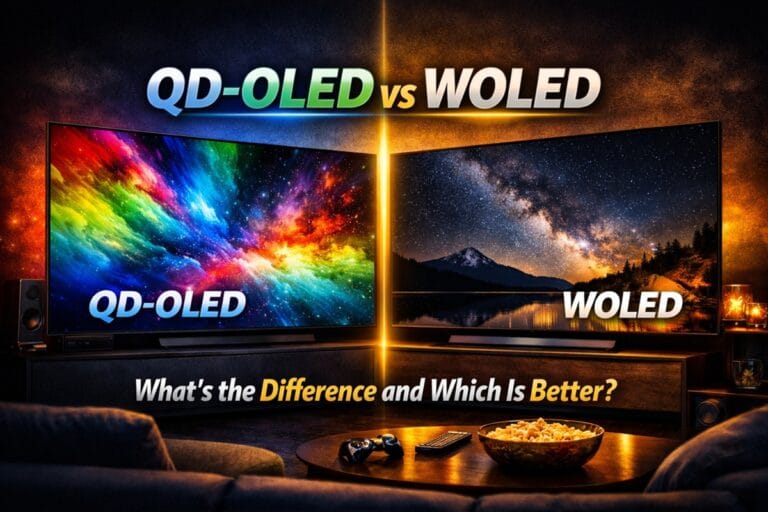
QD-OLED adds a quantum dot conversion layer between the blue OLED emitters and the screen surface. That layer converts a portion of the blue light into green and red, producing a wider color gamut at higher brightness than standard WOLED can achieve. In practice, this means sunset scenes look more orange, deep space scenes render more saturated blues, and skin tones in HDR hold more depth.
Based on independent lab measurements of QD-OLED vs WOLED panels, the color volume gap in HDR is substantial — not a marginal difference. Whether you notice it depends on what you watch: HDR10+ films and high-end gaming content show it most clearly, while standard streaming at SDR or low-bitrate 4K closes the gap considerably. For the full panel-level explanation, our QD-OLED vs WOLED comparison breaks down exactly where each technology wins.
A Glare-Free Coating That No Other OLED Brand Offers
The S90H and S95H ship with Samsung’s Glare-Free treatment — a diffusion layer that scatters incoming light rather than reflecting it as a focused image. The result is that a bright window behind you turns into a soft glow instead of a sharp mirror reflection. Black levels stay deep. The image stays readable.
This is not the same as the matte anti-glare coatings on most LCD TVs, which reduce reflections by adding haze to the image. Samsung’s approach preserves sharpness and contrast while cutting reflections. LG’s WOLED panels use a standard semi-glossy surface that reflects windows and ceiling fixtures clearly. If you watch TV in a room with meaningful ambient light during the day, this coating is the single biggest functional difference between the two brands. See our guide to the best OLED TVs for bright rooms for a broader look at how different panels handle ambient light.
144Hz Native Refresh on the S90H and S95H
The S90H and S95H run a 144Hz native panel — not interpolated, not motion-smoothed to simulate 144Hz. For gaming, this means the TV displays up to 144 frames per second from a compatible PC without any processing artifacts. Both models also include four HDMI 2.1 ports at full 48 Gbps bandwidth, so a PS5, Xbox Series X, and gaming PC can all run simultaneously at 4K/120Hz without a switcher.
LG’s C-series also offers four full-bandwidth HDMI 2.1 ports, so the port spec is parity. The 144Hz native panel is where Samsung pulls ahead for PC gaming specifically — LG’s C6H caps at 120Hz native. Worth noting: the S85H runs 120Hz, not 144Hz, so this advantage applies only to the two higher tiers. If gaming performance across PS5, Xbox, and PC is your main concern rather than refresh rate on paper alone, our best OLED TVs for gaming roundup ranks Samsung against LG and Sony on exactly that basis.
Where Samsung OLED Doesn’t Justify the Extra Cost
The S85H is a tougher call than it first looks. It keeps Samsung’s QD-OLED panel — the same color science as the flagship S95H — but Samsung removed the Glare-Free coating and dropped the native refresh rate to 120Hz. What’s left is a TV with genuinely good color but none of the features that make the step-up tiers worth their premium. At the 65-inch size, the LG C6H typically lands within $100–150 of the S85H and includes Dolby Vision IQ, a more mature picture mode calibration ecosystem, and independent review scores that consistently rank it above the S85H. Unless HDR color volume specifically is what you’re chasing, there’s little reason to pick the S85H over the LG C6H at comparable pricing.
Dedicated dark home theater rooms. In a room with blackout curtains and no ambient light, Samsung’s Glare-Free coating does nothing — there’s no glare to reduce. QD-OLED’s brightness advantage also matters less because you’re not fighting ambient light. Both WOLED and QD-OLED produce identical true black levels. In this environment, LG’s G-series WOLED matches or slightly edges the Samsung S95H on calibrated peak brightness, and typically costs less at the 65-inch size. The dark room buyer has less reason to choose Samsung.
Casual viewers in dim rooms who don’t game. If you watch Netflix and streaming in a moderately lit room without much direct glare, and you’re not gaming, Samsung’s two core advantages don’t apply to your use case. The color richness edge over LG WOLED is real, but Sony’s BRAVIA 8 II competes directly on that front with stronger cinema-tuned processing — and the Sony often lands at a comparable price. For this buyer, Samsung isn’t the wrong choice, but it’s not the obvious right one either.
Buyers stretching a tight budget to reach Samsung OLED. If the S85H is at the very top of your budget and you’d be better served by the LG C6H with $100–200 to spare, spend it on a longer HDMI cable or a calibration service. The LG C6H will serve most viewers better than the S85H in everyday use — not because Samsung’s panel technology is inferior (the S85H does keep QD-OLED’s color advantage), but because it loses the Glare-Free coating and faster refresh that make the step-up tiers worth their premium.
Samsung S90H vs LG C6H: What You Actually Notice
In a dark room, the two TVs look remarkably similar to most viewers. Both produce perfect black levels and clean, fast motion. Put them side by side on a dark Dolby Vision scene and the average viewer won’t pick a clear winner from picture quality alone — both are working from the same general OLED panel category here, not different ones.
Switch to a room with natural light coming in from a window behind or beside you. Now the difference is immediate. The S90H’s anti-glare surface shows a diffused, low-contrast glow where the window reflects. The LG C6H shows a sharp, bright reflection of that same window. The Samsung image stays watchable. The LG becomes visually cluttered. This isn’t a subtle spec difference — it’s something you notice on day one and every day after.
The S85H comparison is a different conversation. Compared to the LG C6H, the S85H wins on HDR color richness and loses on Dolby Vision IQ processing, calibration flexibility, and peak brightness consistency. RTINGS publishes full calibration data for the S90H and the S95H if you want to run your own numbers — and our Samsung S90H vs S95H comparison covers whether the step up to the flagship is worth the additional outlay.
Our Verdict: Are Samsung OLED TVs Worth It in 2026?
Buy the S90H if your room has ambient light during the day or you game with multiple consoles or a PC at 144Hz — but don’t buy it expecting richer HDR color than LG, since it runs a WOLED panel this year. Buy the S95H if you want both of Samsung’s real advantages in one TV. Buy the S85H if HDR color richness specifically is what you’re after and you can live without Glare-Free and the faster refresh.
For most buyers on a tighter budget, the LG C6H is still the stronger overall pick over the S85H. If you want Samsung’s full advantage set without the flagship price, the S95H is the only tier that delivers it — the S90H is well-rounded, but color isn’t where it wins.
The right model for your situation is in our Samsung OLED roundup →
Which Samsung OLED Tier Is Right for You?
📍 Pillar guide: Compare every top OLED TV in 2026 LG, Samsung, Sony — all three brands across every price tier and use case, ranked and compared in one place. See Best OLED TVs 2026 →.
Samsung OLED TVs — Common Questions
Are Samsung OLED TVs worth it over Samsung QLED?
Yes — and the difference is more noticeable than most Samsung QLED owners expect. If you’re coming from a QN85B or QN90B Neo QLED, the jump to the S90H means true infinite contrast on every dark scene, not just very-high contrast. The halos around bright objects on a dark background — a persistent limitation of Mini LED local dimming — disappear entirely on QD-OLED. HDR color is also richer on the QD-OLED panel. It’s a clear upgrade for anyone who watches in a moderately lit room or cares about HDR picture quality.
What’s the real-world difference between Samsung QD-OLED and LG WOLED?
In a dark room they look very close — both deliver perfect black levels, both handle fast motion well, and the color difference in SDR content is hard to see without a side-by-side. The gap opens up in two places: ambient light, where Samsung’s anti-glare surface is a practical advantage that LG doesn’t offer, and HDR saturation, where QD-OLED’s color volume lead becomes visible on the right content. RTINGS publishes detailed lab data for the S90H if you want to run the numbers yourself.
Does Samsung OLED burn-in faster than LG OLED?
No — there’s no evidence that QD-OLED burns in faster than WOLED under typical home use conditions. Samsung includes pixel shift, logo detection, and automatic screen saver activation across the S-series lineup. Burn-in from mixed home use — streaming, gaming, sports — takes years to develop on either panel type. The meaningful risk applies to a specific viewer: someone who leaves a static gaming HUD, news ticker, or stock chart displayed for four or more hours per day without enabling any of the built-in mitigation tools. For a full look at how OLED burn-in actually develops and what the mitigations do, see our guide on whether OLED burn-in still matters in 2026. Burn-in isn’t the only panel quirk to know about, either — a smaller number of previous-generation S90D units have shown S90D banding, a distinct issue unrelated to burn-in that’s worth checking for on that specific model.
Which brand makes the best OLED TV for the money right now?
LG wins on value per dollar, particularly at the C-series tier where the C6H is one of the best-performing TVs at its price in any category. Samsung wins for bright rooms and PC gaming. Sony wins for cinema-tuned processing and PS5 integration. The right answer depends on how you watch and where. Our full OLED TV roundup covers all three brands — and if you’re still deciding whether OLED is the right technology at all, our take on whether OLED is worth it in 2026 starts from the beginning.
Will Samsung OLED prices drop later in 2026?
Prices typically ease toward Q4, though exact timing and depth vary by year — we can’t promise a specific number. Samsung tends to hold new model pricing firm for roughly the first two quarters after launch, then discounts more as the holiday window approaches. The September–November period has historically been where OLED prices across all three brands see their biggest movement. If your purchase isn’t time-sensitive, late Q4 is a reasonable point to start watching.

iYaiii
Editor, GearPulse360
iYaiii is the editor and founder of GearPulse360, specializing in TV reviews and consumer electronics. He researches every recommendation before publishing.
✓ Based on spec analysis and RTINGS data — last verified June 2026