Sony OLED Buying Guide: Bravia 8, XR8B, and Bravia 8 II Explained
Last updated: June 2026 / 🕒 7 min read
Disclosure: As an Amazon Associate I earn from qualifying purchases. This article contains affiliate links — we may earn a small commission if you buy through them, at no extra cost to you.
Pull up two Sony OLED listings on Amazon right now, and you might see two completely different names — and two completely different prices — for what looks like the exact same television. One says “Sony BRAVIA 8.” The other says “Sony BRAVIA XR8B.” The specs look nearly identical. The price tag does not.
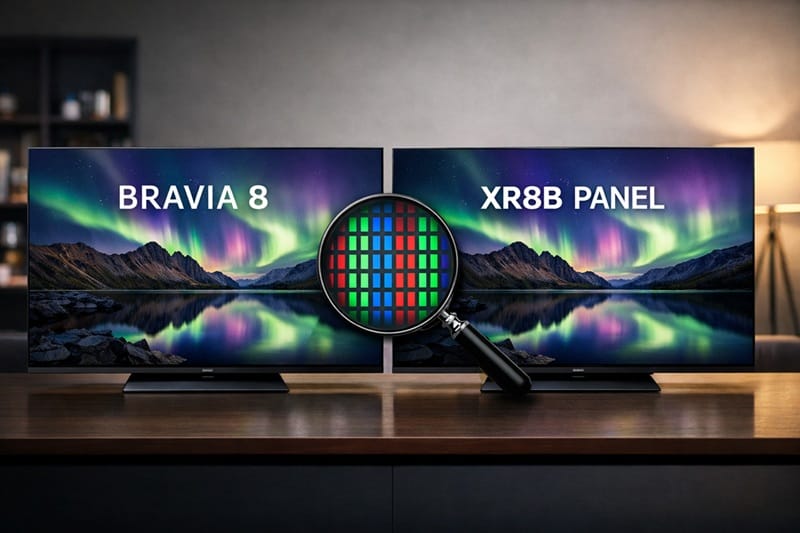
If you’re trying to figure out whether XR8B is some kind of step-up flagship panel — maybe even Sony’s QD-OLED tier — you’re not alone, and it’s an easy mistake to make. Based on RTINGS lab measurements and Sony’s own published specifications, here’s what the panel hardware behind each name actually is: BRAVIA XR8B is not QD-OLED. It uses the same LG Display WOLED panel as the standard Bravia 8, with no panel-level upgrade between the two. Only the Bravia 8 II actually steps up to Sony’s QD-OLED panel.
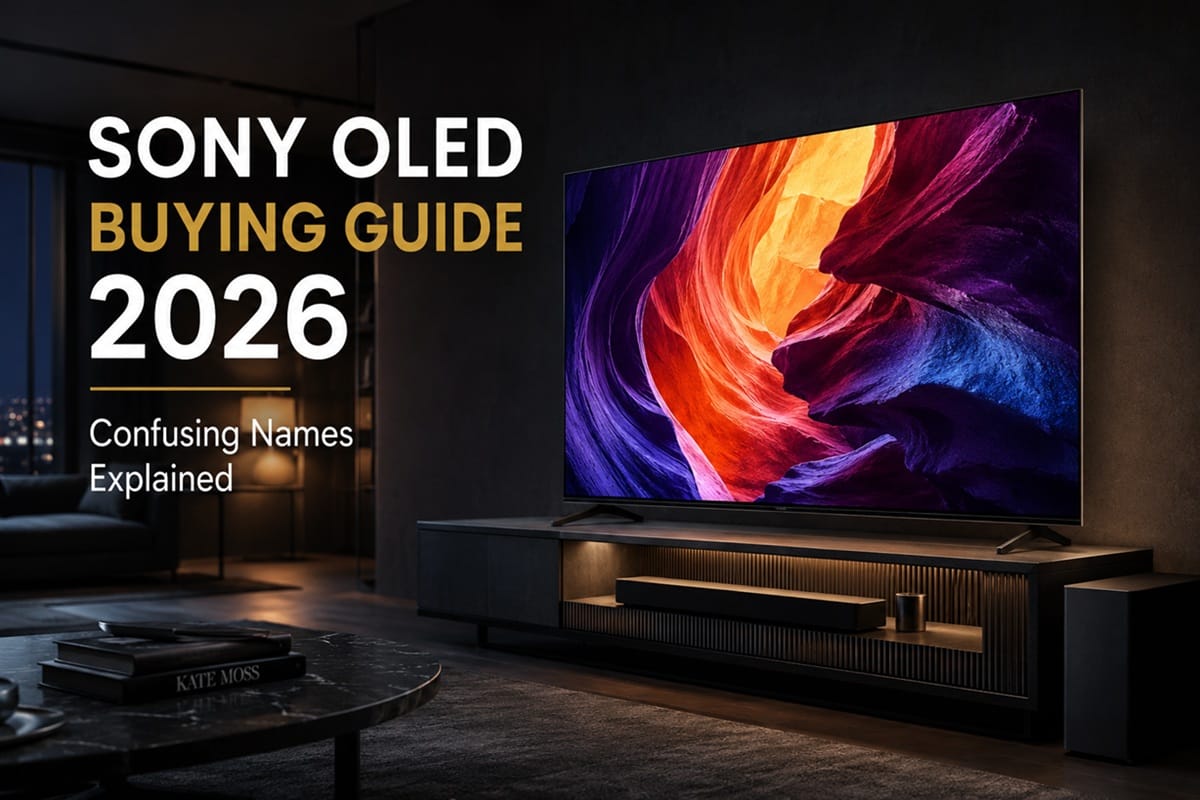
This Sony OLED buying guide breaks down what separates all three names, where the real upgrade actually sits, and how to use that to decide which one is worth your money. If you want the broader mechanics first, our explainer on what OLED TV technology is covers how self-lit pixels work in general before we get model-specific here. Let’s start with the short version, then unpack why the naming got this confusing in the first place.
Table of Contents
The Short Answer
Sony’s current OLED lineup looks like three models, but it’s really two panel types wearing three different name tags. The standard Bravia 8 and the BRAVIA XR8B use the same LG Display WOLED panel — XR8B is simply a different retailer or regional SKU name for the same TV, not a separate product tier. The Bravia 8 II is the actual upgrade: it switches to Sony’s own QD-OLED panel, with meaningfully higher peak brightness and wider color volume. The real question isn’t “which of three TVs” — it’s “WOLED or QD-OLED, and is the price difference worth it for how you watch.”
What’s Actually Different — Bravia 8, XR8B, and Bravia 8 II
Why “XR8B” Isn’t a Separate Model
The confusion starts at the SKU level. “BRAVIA XR8B” isn’t a name Sony promotes in its own marketing materials — it’s the model code that shows up on listings for the standard Bravia 8, depending on region and retailer. Strip away the code and you’re looking at the same core hardware: an LG Display WOLED panel and Sony’s Cognitive Processor XR. Some listings may differ slightly on bundled software features or included promotional content, but the panel and core picture processing are identical.
That matters because some listings price “XR8B” units differently than ones explicitly labeled “Bravia 8” — which can make it look like you’re comparing two tiers of TV, when you’re actually comparing the same WOLED panel at two different prices from two different sellers.
What Actually Changes With the Bravia 8 II
The Bravia 8 II is where Sony’s lineup actually splits in two. It replaces the WOLED panel with Sony’s third-generation QD-OLED panel — the same general panel family used in the well-regarded A95L, evolved further. That’s not a marketing refresh; it’s a different display technology with a different brightness ceiling and a different approach to color.
Which Sony OLED Panel Fits Your Use Case?
Why This Naming Confusion Actually Matters
If you keep landing on conflicting answers about whether XR8B is QD-OLED, you’re running into a real, documented naming overlap — not a knowledge gap on your end. An independent RTINGS measurement of the standard Bravia 8 is consistent with the WOLED panel signature carried across XR8B-labeled listings.
This kind of dual-naming isn’t unique to Sony, but it’s particularly easy to misread here because “8 II” sounds like a refresh of the “8,” not a jump into an entirely different panel family.
Once you know which panel you actually want, the harder part is deciding if it’s the right TV for your room and budget. If you’re already close to a buying decision, our best OLED TVs in 2026 roundup ranks every top pick by use case and budget.
The Brightness Gap Between Sony’s Two OLED Panels
The clearest real-world difference between the two panel types shows up in peak brightness. Independent measurements put the Bravia 8 II at roughly 1,900+ nits in a 5% HDR window, and Sony itself states that’s roughly 50% brighter than the standard WOLED-based Bravia 8 panel.
What Causes the Brightness Gap
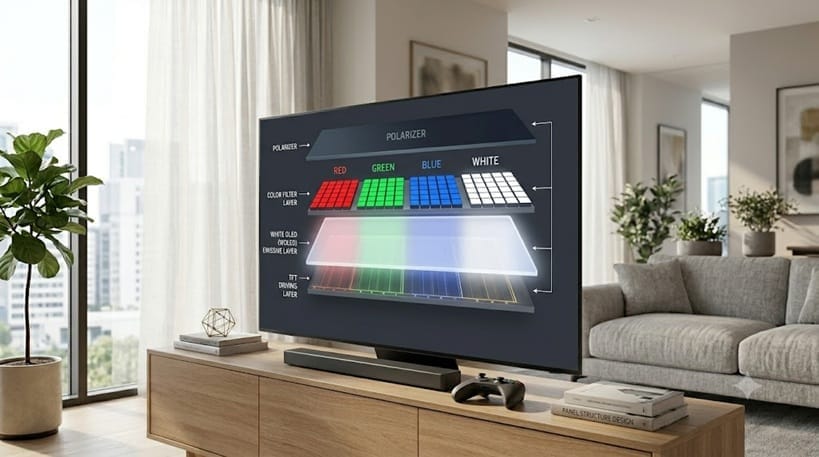
That gap comes down to how each panel type produces light. WOLED panels — used in the Bravia 8 and XR8B-labeled units — rely on a white subpixel layer with color filters. QD-OLED panels — used in the Bravia 8 II — use quantum dots to convert light more directly, which is part of why they can push brighter highlights without sacrificing color saturation. For the deeper mechanics of how these two approaches differ across the wider industry, not just within Sony’s own lineup, our QD-OLED vs WOLED comparison breaks it down panel-by-panel.
In practical terms, the brightness gap matters most in HDR highlights and brighter rooms. In a fully dark home theater, the difference narrows considerably.
What This Means for Your Decision
Who Should Pay Attention to This
If you watch mostly in a brighter living room, care about HDR highlight punch, or you’re cross-shopping Sony against other brands’ QD-OLED-class sets, the Bravia 8 II’s panel jump is the one that actually changes your experience — not the XR8B naming. It’s worth seeing how Sony’s QD-OLED stacks up against the competition directly; our Sony OLED vs LG OLED comparison is a good next stop if brand-level differences matter to you.
If a bright room is pushing you to look outside OLED entirely, Sony’s mini-LED lineup is the other option worth knowing about — and it comes with its own tradeoff. We’ve covered the Sony Bravia 7 reflection problem in detail, since that model skips the anti-reflective coating these OLED panels rely on to stay watchable under bright light.
Who Doesn’t Need to Worry
If you mostly watch in a dim or dark room and don’t need flagship-level peak brightness, the standard Bravia 8 — regardless of whether a listing calls it “XR8B” — already gives you Sony’s processing and WOLED’s deep blacks at a lower price. You’re not missing out on some hidden higher tier by skipping the QD-OLED version.
One thing worth watching for on either panel type: a fixed dot that shows up on the screen within the first few weeks is worth documenting rather than dismissing. Our Sony OLED dead pixels guide covers what actually counts as a defect versus normal manufacturing tolerance, and what Sony does once a claim is confirmed.
Panel type aside, the remote itself is worth a mention too — Sony’s current Google TV models pair over Bluetooth rather than relying purely on line-of-sight, and that pairing is one more thing that can occasionally act up after setup or a software update. Our Sony TV remote control problems guide walks through what usually causes it and how to fix it.
If you already own an older Sony OLED and you’re using this guide to shop for its replacement, it’s worth setting expectations before the new set arrives: a like-for-like room comparison doesn’t always favor the newer TV right away. Different tone-mapping defaults and out-of-box picture modes can make a genuinely better panel look flatter or cooler for the first few days. We walk through why that happens — and how to tell a settings issue from an actual downgrade — in why a new Sony OLED can look worse than an old one.
One more thing worth checking before you buy, if you’re planning to wall-mount whichever model you land on: the screen itself is genuinely thin on both panel types, but the processing board and speaker assembly live in a separate, thicker section near the back — and that’s what actually determines how flush the TV sits and which bracket you need. Our Sony OLED thin panel wall mount design guide covers what to check before ordering a bracket.
FAQs: Sony OLED Panel and Model Questions
Is BRAVIA XR8B the same as BRAVIA 8?
Yes — BRAVIA XR8B and the standard Bravia 8 use the same LG Display WOLED panel and the same core hardware; XR8B is a retailer or regional SKU name, not a separate product tier. Anyone comparing these models can treat the two names as the same TV. An independent RTINGS review of the Bravia 8 II is a useful next read for seeing exactly how the step-up model differs instead.
Is the Sony Bravia 8 II QD-OLED?
Yes. The Bravia 8 II uses Sony’s third-generation QD-OLED panel, part of the same general panel family used in the earlier A95L. It’s the only model in this naming group that uses QD-OLED — the standard Bravia 8 and XR8B-labeled units stay on WOLED.
Is the Bravia 8 II worth the price jump over the standard Bravia 8?
It depends on how you watch. The price difference buys you meaningfully higher peak brightness and wider color volume, which matters most for HDR content in brighter rooms. If most of your viewing happens in a dark home theater setup, the gap narrows and the standard Bravia 8’s WOLED panel may already cover what you need.
Does the panel type affect gaming performance on these Sony OLEDs?
Not significantly. Both panel types support the same core gaming features Sony ships across this lineup, so input lag and refresh-rate behavior stay broadly similar between the WOLED-based Bravia 8 and the QD-OLED Bravia 8 II. The performance gap that does exist shows up in picture quality, not responsiveness.
Will Sony’s OLED model names get less confusing in future years?
There’s no public indication of timing, so we can’t promise the naming gets simpler going forward. What’s reliably true today is that the confusion sorts down to two real questions — which panel type, and which size — and anything else is mostly retailer-specific naming.

iYaiii
Editor, GearPulse360
iYaiii is the editor and founder of GearPulse360, specializing in TV reviews and consumer electronics. He researches every recommendation before publishing.
✅ Based on spec analysis and Sony’s published specifications plus RTINGS data — last verified June 2026