Hisense 55U7SG Review: Worth It at the Smallest Size in the Lineup?
Last updated: August 2026
🕒 9 min read
Disclosure: As an Amazon Associate I earn from qualifying purchases. This article contains affiliate links — we may earn a small commission if you buy through them, at no extra cost to you.
Shrink a Mini-LED panel down to a smaller screen size and the spec sheet usually gives something up first — Hisense makes that trade explicit with the U7SG line, where the 55-inch model ships with roughly half the local-dimming zones and a lower advertised brightness ceiling than the 65-inch and larger sizes.
This Hisense 55U7SG review works through whether that smaller-panel tradeoff actually shows up on screen, and whether it still beats stepping up to the pricier Hisense U8QG or over to a similarly priced TCL 55QM6K.
This size fits buyers furnishing a smaller room who still want the picture quality of Hisense’s step-up sets, rather than settling for entry-level LED. If you’re still weighing panel types before committing to a size, our best 4K TVs of 2026 roundup breaks down how Mini-LED sets like this one compare with OLED at a similar budget.
Table of Contents
Quick Verdict
At a Glance
★★★★★ 8.5 / 10
At a Glance
Picture Quality
Gaming
Audio
Value
👍 Best For: Smaller-room buyers who want flagship-adjacent Mini-LED performance without U8QG-level pricing.
👎 Skip If: You need a wide seating arrangement, watch a lot of fast sports, or want the brightest possible HDR highlights.
One-Line Verdict: The smallest U7SG loses some brightness headroom and dimming precision compared to its bigger siblings, but it’s still one of the better-value Mini-LED sets at this size.
🛒 Check Availability on AmazonProduct Specs at a Glance
Product Specs
Hisense 55U7SG
VA-panel Mini-LED with quantum dot color · 165Hz native refresh · Google TV
| 🔆 Advertised Peak Brightness | Up to 2,000 nits |
| 💡 Local Dimming Zones | 512 zones |
| 🎮 Native Refresh Rate | 165Hz (4K) |
| 🌈 HDR Formats | Dolby Vision, HDR10+, HLG |
| 🔌 HDMI | 4x HDMI 2.1 |
| 📶 Smart Platform | Google TV 14 |
| ✨ Screen Coating | Matte anti-reflective |
Design & Build Quality
Materials & Finish
Based on Hisense’s official support documentation, the 55U7SG carries the same unibody-slim design as the rest of the U7SG line, with a grid-textured rear panel and a center-mounted stand. RTINGS, which tested the 65-inch version, rated build quality as a step up from the prior-generation U75QG — a firmer plastic finish rather than a visible cost-cutting move.
Ports & Connectivity
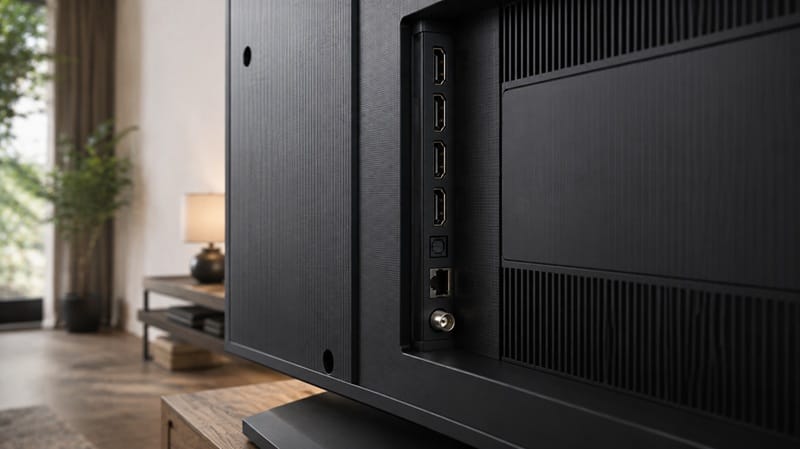
All four HDMI inputs run at full HDMI 2.1 bandwidth, which is uncommon at this price tier — most mid-range competitors limit full-bandwidth HDMI 2.1 to one or two ports and leave the rest at HDMI 2.0. Cable routing runs through channels built into the stand’s feet, and the TV supports both a standard and low-profile stand position depending on how much clearance sits below it.
Performance & Real-World Use
Everyday Streaming and Movie Nights
RTINGS’ lab tests of the U7SG line — run on the 65-inch model — found excellent contrast and deep, uniform blacks, with the local-dimming algorithm controlling haloing around bright highlights well. The 55-inch shares the same VA panel and dimming design, but the spec sheet difference is real: 512 zones against 960 on the 65-inch, and Hisense’s own published specifications list peak brightness at 2,000 nits on the 55-inch versus 3,000 nits on 65-inch and larger models.
Larger zones generally mean less precise control around small bright objects — RTINGS’ own size comparison notes call out the 55-inch as likely to perform somewhat worse on local dimming for exactly this reason, so buyers moving down from a 65-inch U7SG shouldn’t expect an identical dark-room result.
Bright-Room and Daytime Viewing
Glare handling is where this TV earns its keep. RTINGS measured the matte coating as significantly reducing visible reflections, with ambient light having little measurable effect on black levels or color saturation. Since the matte finish carries down to the 55-inch (Hisense drops it only on the 100- and 116-inch models, which ship glossy instead), that’s a bigger real-world difference for a sunlit room than the brightness gap between sizes.
Hisense 55U7SG Gaming Performance
Gaming is where the 55U7SG’s spec sheet does the most work: 165Hz native refresh at 4K, a wide variable refresh rate range, and input lag RTINGS rated as excellent. Both the PS5 and Xbox Series X|S get full 4K/120Hz, VRR, and auto low-latency mode. Hisense’s own spec sheet also lists AMD FreeSync Premium Pro support, though that specific certification hasn’t been independently re-tested at 55 inches.
The tradeoff shows up in response time, which RTINGS clocked as only decent rather than excellent — fast motion, like a panning camera or a fast-moving ball on screen, can look a touch blurrier than on a panel built specifically for competitive gaming.
Key Features Breakdown
Local Dimming and Contrast
The Mini-LED backlight is the main reason this set can trade blows with pricier TVs on paper. RTINGS rated native panel contrast as excellent even before local dimming is factored in — which matters here specifically, since the 55-inch’s larger zones lean more heavily on the panel’s own contrast to keep blacks deep, rather than on dimming precision alone.
Google TV Smart Platform
The 55U7SG runs Google TV 14 on a MediaTek Pentonic 800 processor with 4GB of RAM, and RTINGS reported a smooth interface with no bugs during testing. It does carry ads in the home screen, and Hisense’s opt-out only removes personalization rather than the ads themselves — a “Basic Google TV” setup mode exists to skip ads entirely, but it also disables most smart features.
Buyers who specifically want a Fire TV interface should note Hisense sells a nearly identical model under the U7SF name for that platform.
The Good, the Bad, and the Ugly
Pros
- ✅ Strong contrast and deep blacks — the panel holds up in mixed-content viewing, not just in dark-room test scenes.
- ✅ Excellent glare handling — the matte coating makes this one of the stronger picks for a bright living room.
- ✅ Low input lag and full HDMI 2.1 bandwidth on all four ports — an uncommon pairing at this price.
- ✅ More accurate brightness tracking than the pricier Hisense U8QG — RTINGS found the U7SG holds its picture closer to reference than its own step-up model.
Cons
- ❌ Lower brightness ceiling and fewer dimming zones than the 65-inch and up — the 55-inch is the one size in the line that gives something up.
- ❌ Narrow viewing angle — colors and contrast fade noticeably off-axis.
The Ugly
The dirty screen effect is the flaw worth naming directly instead of glossing over. RTINGS flagged noticeably uneven gray uniformity on the tested unit — most visible in flat, mid-gray content like sports broadcasts and video game HUDs — along with the sides of the panel running darker than the center.
It’s much less noticeable in dark or colorful content, but sports-heavy households shouldn’t assume Mini-LED backlighting on its own fixes uniformity; it doesn’t here.
Who Should Buy This — and Who Shouldn’t
Buy This If…
The 55U7SG makes sense for anyone furnishing a smaller room who still wants picture quality closer to Hisense’s step-up sets than to an entry-level LED TV. It’s a bit like choosing a recipe made in a smaller pan — the ingredients and technique carry over, but the smaller batch has less room to work with, so a couple of results come out slightly different from the full-size version.
Buyers weighing this against the pricier Hisense U8QG, and more broadly against the tradeoffs in our OLED vs Mini LED compared breakdown, should know that RTINGS’ own testing found the U8QG isn’t automatically the better pick: it gets brighter on paper, but most of that extra headroom goes unused in normal content, while the U7SG tracks color and brightness more accurately and handles reflections better.
Anyone still comparing panel types and price brackets before committing can check our Samsung Crystal UHD buying guide for how a QLED-class alternative stacks up at a similar budget.
Skip This If…
If your living room has a wide couch or seating spread well off to the sides, the narrow viewing angle will bother anyone not sitting close to dead-center — a VA panel limitation this TV doesn’t escape. Households that watch a lot of live sports and are sensitive to motion blur or the dirty screen effect may also be happier with a TCL 55QM6K or a similar competitor with tighter uniformity control, even if peak brightness numbers look similar on paper.
Buyers chasing a design-first look over Mini-LED performance should also know Hisense sells a completely different kind of TV under the same roof — our Hisense 50S7SG review covers the smallest CanvasTV model, built for wall art and daytime viewing rather than contrast and dimming zones.
Final Verdict
Is the Hisense 55U7SG Worth Buying?
This Hisense 55U7SG review comes down to one call: the smaller panel gives up real brightness and dimming-zone headroom against its bigger siblings, but nothing here suggests that gap ruins the picture — contrast, glare handling, and gaming responsiveness all carry over from the sizes RTINGS tested directly. Against the pricier Hisense U8QG specifically, it’s arguably the smarter buy rather than the compromise pick.
Anyone with the wall space to go bigger should weigh our Hisense 65U7SG review instead, since the 65-inch model closes the exact brightness and dimming-zone gap flagged above. 🛒 Check Availability on Amazon
Frequently Asked Questions
Does the RTINGS Hisense 55U7SG review reflect the 55-inch model specifically?
Not entirely. RTINGS’ U7SG review was hands-on tested using the 65-inch model, and RTINGS’ own size-comparison notes confirm the 55-inch has smaller dimming zones and a lower advertised peak brightness. Most other measurements — contrast, color accuracy, input lag — are expected to carry over closely across sizes.
Is the Hisense 55U7SG or the Hisense U8QG the better buy?
Most buyers are better served by the U7SG, per RTINGS’ testing. The U8QG gets brighter, but that extra headroom goes unused in most content, while the U7SG offers more accurate brightness tracking and better reflection handling.
Is the 55U7SG good for gaming?
Yes — it supports 165Hz native refresh at 4K, a wide VRR range, and full 4K/120Hz on PS5 and Xbox Series X|S, with input lag RTINGS rated as excellent. Response time is only decent, so very fast motion can look slightly blurred.
Who should avoid the Hisense 55U7SG?
Buyers with a wide seating arrangement will notice the narrow viewing angle, and sports-heavy households sensitive to uniformity issues or motion blur may prefer a different panel.
Is there a Fire TV version of the 55U7SG?
Yes. Hisense sells a near-identical model under the U7SF name that runs Fire TV instead of Google TV; specifications and tuning may differ slightly between the two.

iYaiii
Editor, GearPulse360
iYaiii is the editor and founder of GearPulse360, specializing in TV reviews and consumer electronics. He researches every recommendation before publishing.
✅ Based on Hisense’s official specifications and RTINGS data — last verified August 2026