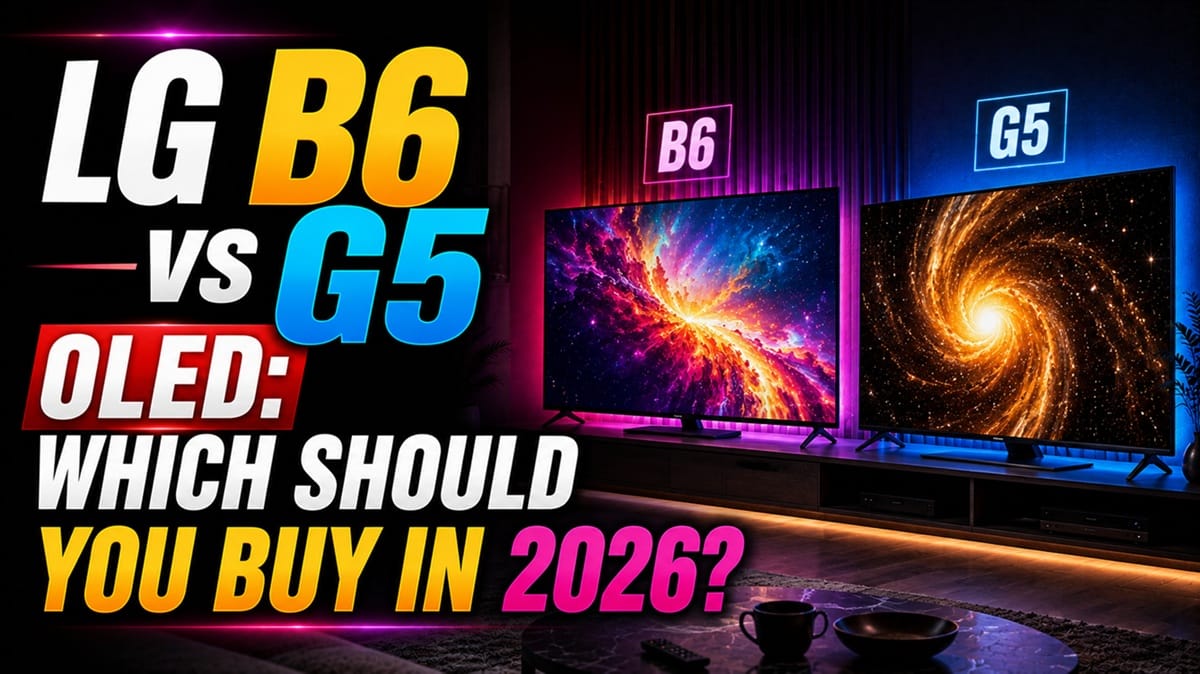
LG B Series vs G Series OLED: Which One Should You Actually Buy?
Last updated: August 2026
🕒 9 min read
Disclosure: As an Amazon Associate I earn from qualifying purchases. This article contains affiliate links — we may earn a small commission if you buy through them, at no extra cost to you.
LG’s B Series and G Series sit at opposite ends of its 2026 OLED lineup, and the price difference between them is steep enough that most buyers assume the G Series must be a completely different TV. In the LG B series vs G series OLED comparison, that’s not really true. Both use OLED panels, so both hit the same true blacks and per-pixel contrast — the gap shows up almost entirely in brightness, refresh rate, and how each TV is built for the wall.
The LG G5 pulls ahead on brightness, gaming headroom, and design. The LG B6 matches its core picture quality in a dark room for a lot less money. Which one makes sense for you comes down to where the TV is going and how bright that room gets.
A note on the models compared here: this is the current LG B6 (2026) against the LG G5, LG’s most recent widely available G-series TV. LG’s 2026 G6 has started shipping, but it isn’t in our verified product database yet — we’ll update this comparison once it is. If you’re weighing LG’s mid-tier options in the meantime, our LG C5 vs G5 comparison covers the step between these two tiers.
Table of Contents
Quick Answer
The LG G5 wins on brightness, gaming headroom, and design; the LG B6 delivers nearly the same OLED contrast for a lower price.
- Best for: LG G5 — bright rooms and high-refresh PC gaming. LG B6 — dark-room value seekers.
- Not ideal for: LG B6 in a sun-facing living room; LG G5 on a tight budget.
- Key advantage: G5’s tandem-panel brightness vs. B6’s price-to-contrast ratio.
- Price gap: B6 typically runs well below the G5 at matching screen sizes.
LG G5 — for brightness, gaming ceiling, and bright-room use. LG B6 — for value in a dedicated dark-room setup.
The G5’s newer panel and higher refresh rate matter most if you’re watching in a well-lit living room or gaming at high frame rates. If the TV lives in a dim room and contrast is what you’re judging picture quality by, the B6 closes most of that gap for a lot less money.
How They Compare
Picture — LG B6
Picture — LG G5
Gaming — LG B6
Gaming — LG G5
Design — LG B6
Design — LG G5
Value — LG B6
Value — LG G5
BUY THE LG G5 IF…
› Your room gets real daylight or bright overhead light
› You’re chasing every frame above 144Hz for PC gaming
› You want the newer tandem-panel design and finish
BUY THE LG B6 IF…
› The TV lives in a dark or dedicated theater room
› Console-only gaming is enough for you
› Getting true OLED contrast for less money matters most
If you’ve already landed on a size, our 65-inch OLED rankings → put both of these next to the rest of the field.
LG B Series vs G Series OLED: How They Actually Differ
What Is the LG B6?
The B6 is LG’s entry point into OLED for 2026, sold in 48-, 65-, 77-, and 83-inch sizes. It runs LG’s Alpha 8 AI Processor 4K Gen3 and uses a standard WOLED panel — the same fundamental panel technology explained in our WOLED vs QD-OLED breakdown, without the extra brightness layers found further up LG’s range. It still supports a 120Hz native refresh rate with VRR up to 144Hz, Dolby Vision, and LG’s UL-verified Perfect Black and Perfect Color certifications.
What Is the LG G5?
The G5 was LG’s 2025 flagship and remains the newest widely stocked G-series model while the 2026 G6 rolls out. It’s the first LG TV to use a Primary RGB Tandem OLED panel, paired with the more powerful Alpha 11 AI Processor Gen 2. It supports a native 165Hz refresh rate, an improved anti-glare coating, and LG’s One Wall Design for a flush wall-mount install.
The Key Structural Difference
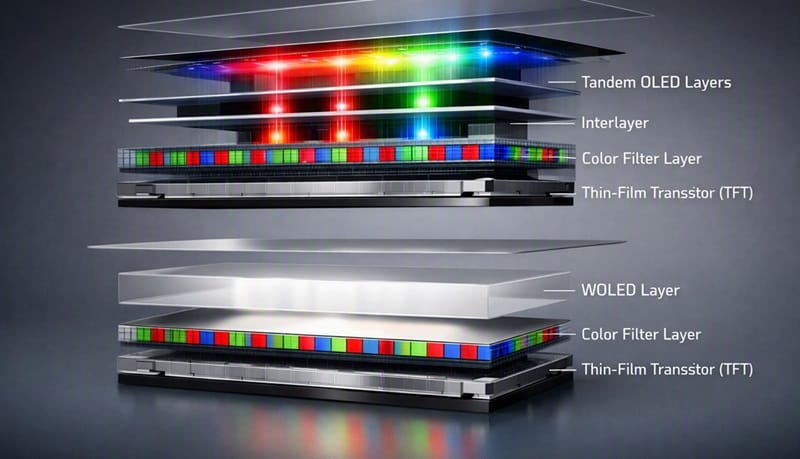
Both TVs are WOLED at their core — neither uses the RGB-stacked QD-OLED tech from Samsung or Sony. The real split is the panel generation: the G5’s tandem four-stack layer boosts brightness well beyond what the B6’s simpler panel structure can reach, especially in HDR highlights and sustained bright scenes.
| Spec | LG B6 | LG G5 |
|---|---|---|
| Panel Type | WOLED | WOLED (Primary RGB Tandem) |
| Processor | Alpha 8 AI Gen3 | Alpha 11 AI Gen2 |
| Native Refresh Rate | 120Hz (VRR up to 144Hz) | 165Hz |
| SDR Peak Brightness (2%) | Not independently tested yet | 574 cd/m² (RTINGS) |
| Design | Standard wall mount | One Wall Design |
| Best For | Dark-room value | Bright rooms, high-refresh gaming |
Picture Quality and Contrast: Who Wins?
Both TVs are self-lit OLEDs, so both hit a near-infinite contrast ratio with true, per-pixel blacks. That’s the one spec neither the price nor the panel generation changes — it’s a function of OLED itself, not of which tier you buy into.
According to RTINGS, the G5 posts a near-infinite native contrast ratio with excellent black uniformity and no blooming around bright highlights, since OLED doesn’t rely on backlight zones at all. Based on manufacturer specifications, the B6 relies on the same pixel-level dimming behavior, so in a dark room watching typical SDR or HDR content, most viewers won’t spot a contrast difference between the two side by side.
Where They Actually Separate
Color and gradient handling in tougher scenes is where the tiers split. The G5’s newer panel and processor combination handles HDR gradients and shadow detail with slightly less banding, based on independent testing data — a difference that shows up in slow, dark cinematic scenes more than in everyday viewing.
Brightness: Who Wins?
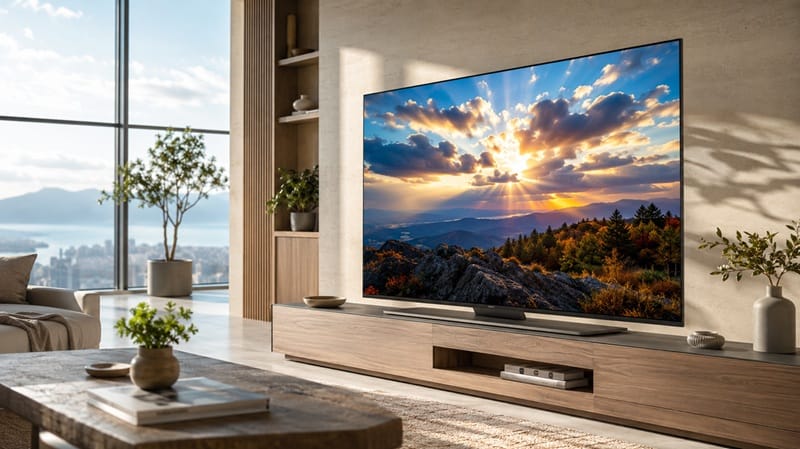
The G5 wins this dimension outright. RTINGS measured it hitting 574 cd/m² in a 2% SDR window and 572 cd/m² sustained across a 10% window — notably bright for an OLED, and enough to fight through glare in a moderately lit room. Its HDR performance goes further still: RTINGS notes it easily displays highlights from content mastered at 600 and 1,000 nits without clipping detail.
The B6’s Alpha 8 processor and standard WOLED panel aren’t built to chase those numbers. Based on manufacturer specifications, it’s still a bright, punchy image by OLED standards, especially in SDR, but LG designed it around a dimmer room rather than a sunlit living room.
Gaming Performance: Who Wins?
Both TVs are solid gaming displays, and the gap here is smaller than the brightness gap. Per LG’s official specifications for the LG OLED65B6GUA, the B6 supports a 120Hz native refresh rate with VRR up to 144Hz, NVIDIA G-Sync and AMD FreeSync Premium compatibility, and 0.1ms pixel response time — everything most console and mid-range PC gaming setups need.
The G5 pushes that ceiling higher, with a native 165Hz refresh rate and, based on independent testing data, input lag as low as roughly 4ms at its maximum refresh rate in Game Optimizer mode. Both TVs support HDMI Forum VRR and Auto Low Latency Mode for PS5 and Xbox Series X|S, so console gamers won’t feel short-changed on either model.
Which One Fits Your Setup
For PC gamers chasing every extra frame above 144Hz, the G5’s headroom is the more future-proof choice. For everyone else, the B6’s feature set already covers what modern console gaming needs.
Price and Value: Who Wins?
The B6 wins this dimension decisively. At matching screen sizes it costs meaningfully less than the G5 while delivering the same core OLED contrast, comparable console gaming features, and Dolby Vision support.
The G5’s price reflects real hardware differences — the tandem panel and Alpha 11 processor are the reason it costs more, not just the G-series badge — but that cost only pays off if you’ll use the extra brightness and refresh headroom regularly. For a secondary room, a bedroom setup, or a first OLED purchase, the B6 gets you the same underlying panel technology for less.
Design and Build: Who Wins?
The G5 uses LG’s One Wall Design, which pulls the electronics into a slim housing so the panel sits nearly flush against the wall once mounted — a look built specifically for a feature-wall installation. It also ships with an improved anti-reflective coating that, per LG’s specifications, is designed to hold up better with lights or windows facing the screen.
The B6 uses a more conventional OLED build, with standard wall-mount hardware and a simpler rear profile. It’s still a slim, well-built TV by any normal standard — it just isn’t styled as a dedicated wall-art centerpiece the way the G5 is. If a flush, gallery-style install matters to you, that’s a real point in the G5’s favor; if the TV is going into an entertainment center or on a stand, the difference matters far less.
LG B Series vs G Series OLED by Use Case
| Use Case | Winner | Why |
|---|---|---|
| Dark-room movie night | Tie | Contrast and black levels are near-identical in low light |
| Bright, sunlit living room | LG G5 | Higher sustained brightness and stronger reflection handling |
| Competitive PC gaming | LG G5 | Native 165Hz vs the B6’s 120Hz native panel (144Hz VRR ceiling) |
| Console-only gaming | Tie | Both cover 4K 120Hz, VRR, and ALLM for PS5 and Xbox |
| Budget-conscious first OLED | LG B6 | Same core contrast for less money |
Which Should You Buy?
For most buyers, the LG B6 is the more sensible pick. It delivers the defining OLED strength — true per-pixel contrast — at a price that doesn’t require justifying a flagship purchase, and its gaming feature set already covers what most console and casual PC setups need.
If the room gets direct sun for part of the day, the G5’s brightness and reflection handling change how watchable the screen is during those hours — something the B6 can’t fully offset. The G5 is also the better call for a dedicated PC gaming rig chasing every frame above 144Hz.
For a wider look at how these two sit against the rest of LG’s current lineup, our LG OLED roundup ranks every current model side by side.
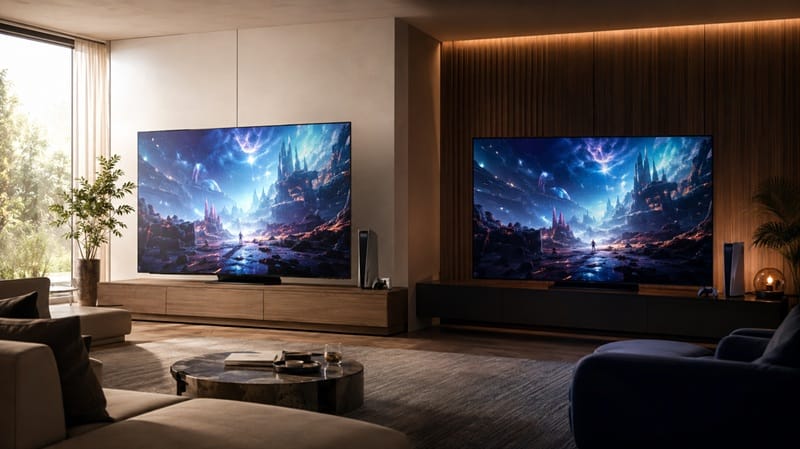
📍 Want the full lineup, not just these two? Every current LG OLED is ranked side by side in our OLED TV roundup.
Our Verdict
For most rooms and budgets, the LG B6 covers what defines the OLED experience — deep, per-pixel black levels — at a fraction of the G5’s cost. Step up to the G5 if the room gets real daylight or you’re chasing every frame above 144Hz.
Prices change frequently — click for current price.
LG B Series vs G Series OLED: Common Questions
Is the LG G5 better than the B6 for movies?
In a dark or dimly lit room, not by much. Both TVs deliver the same near-infinite contrast and true blacks that define OLED, so a typical home theater setup won’t show a dramatic gap between them for movie night.
Is the LG G5 worth the extra cost over the LG B6?
It depends on how you’ll use the extra brightness. According to RTINGS’ LG G5 review, the G5 is built to hold up in bright rooms and handle high-refresh gaming particularly well. If either describes your setup, that premium buys performance you’ll notice daily. If your room stays dim and your gaming is console-based, you’re paying for headroom you won’t use.
Does the LG B6 have the same burn-in risk as the G5?
Yes, in practical terms. Both use OLED panels, so both carry the same general susceptibility to burn-in under extreme, static-image use, and both include LG’s standard protection features — pixel shifting, logo dimming, and periodic pixel refresh. The G5’s extra brightness doesn’t raise its burn-in risk relative to the B6; brightness and burn-in aren’t directly linked in LG’s current OLED generation.
Will the LG G6 change this comparison?
Likely, yes. LG’s 2026 G6 brings further brightness and reflection-handling improvements over the G5, based on published specifications, which would widen the gap with the B6 even further on brightness while leaving the B6’s value position largely intact. We’ll update this comparison once the G6 is fully verified in our lineup.
Do the B6 and G5 use the same OLED panel?
No. Both are WOLED at a fundamental level, but the G5 uses LG’s newer Primary RGB Tandem panel with an added brightness-boosting layer, while the B6 uses a standard WOLED panel without that extra structure — the main reason the brightness gap between them is so large.

iYaiii
Editor, GearPulse360
iYaiii is the editor and founder of GearPulse360, specializing in TV reviews and consumer electronics. He researches every recommendation before publishing, drawing on RTINGS test data and LG’s official specifications.
✅ Based on LG’s official specifications and RTINGS data — last verified August 2026