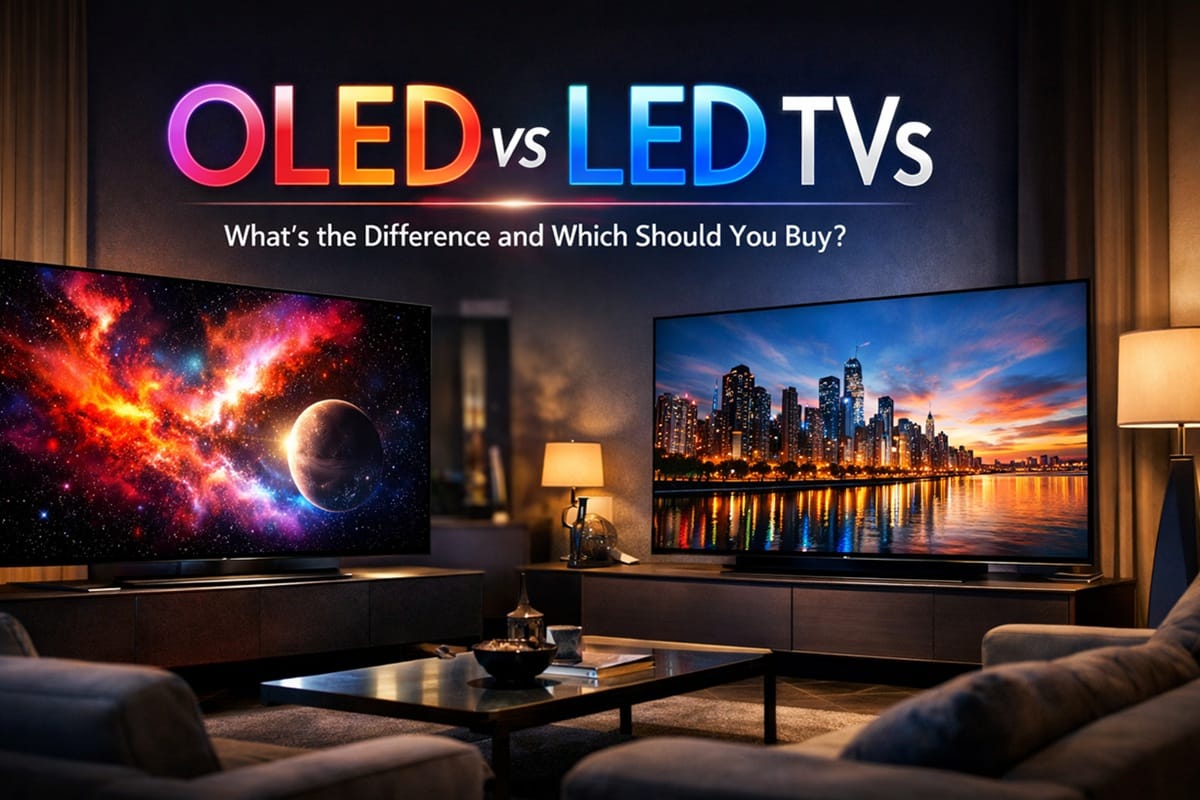
OLED vs LED TVs: What’s the Difference and Which Should You Buy?
Disclosure: As an Amazon Associate I earn from qualifying purchases. This article contains affiliate links — we may earn a small commission if you buy through them, at no extra cost to you.
Almost every TV sold for under $600 uses LED. So when you see “OLED” on a store tag — or hear someone insisting you need one — it’s worth asking: what are you actually gaining, and is the price difference justified for your living room? The honest answer isn’t “OLED always wins.” It depends on how your room is lit, what you watch, and what you’d rather spend. This guide cuts through the noise and gives you a real verdict.
The truth is messier than most comparison articles admit. OLED’s contrast is genuinely in a different league — but LED has gotten fast enough and bright enough that in the right room, the gap isn’t as clear-cut as it used to be. Here’s where it actually matters, and where it doesn’t.
Note that this comparison covers the broad OLED vs LED technology gap. If you’re specifically comparing OLED to QLED (Samsung’s quantum dot LED range), we cover that in detail in our full OLED vs QLED comparison. And if Mini LED is on your shortlist, OLED vs Mini LED compared goes deeper on that specific match-up.
💡 Looking for specific model picks? We’ve ranked the best OLED TVs available right now by budget, size, and use case. See Our OLED TV Roundup
Table of Contents
Quick Verdict: OLED vs LED TV
Editorial assessment only. Bar scores reflect relative performance across key categories.
Ready to shop? See our best OLED TVs under $1,000 for a starting point if budget is a factor.
How OLED and LED Actually Differ
What Is OLED?
OLED stands for Organic Light-Emitting Diode. What makes it different from every other TV technology is that each pixel generates its own light — and can switch off completely. There’s no backlight. When a scene calls for pure black, those pixels simply go dark. That’s why OLED contrast ratios are effectively infinite: the black in a night scene isn’t a dim gray, it’s actual off.
For a deeper explanation of how OLED technology works, including the difference between WOLED and QD-OLED panels, we cover that separately. For this comparison, the key point is this: the self-emissive pixel is what gives OLED its core advantage over any backlit technology — and everything else follows from it.
What Is LED?
LED TVs use a liquid crystal display (LCD) panel illuminated by a backlight made of LEDs. The LCD layer blocks or passes light to create the image, while the backlight provides the brightness. This means even the “darkest” areas of an image still receive some backlight — creating a glow in dark scenes that OLED doesn’t have.
LED is a broad category. Standard edge-lit LED TVs are the most affordable. Full Array Local Dimming (FALD) LEDs add zones of backlight control to improve contrast. Mini LED takes this further — thousands of smaller LEDs allow for tighter dimming control and much higher peak brightness. But even the best Mini LED panels still have a physical backlight, which means they can’t fully eliminate the contrast gap with OLED. Put simply: OLED pixels are the light source. LED pixels control a light source. That single difference is what drives every other comparison on this page.
Contrast and Black Levels: OLED Wins
Contrast ratio is the single most important specification for perceived picture quality — and it’s where the gap between OLED and LED is widest. A high contrast ratio means bright highlights and dark shadows can exist on screen simultaneously without either compromising the other. This is what gives a film a “cinematic” look.
Why OLED’s advantage here is real
OLED panels can achieve true blacks because those pixels turn off completely. The contrast ratio is, in practical terms, infinite — measured at over 1,000,000:1 in lab conditions. Even a premium Full Array LED panel with local dimming typically achieves 3,000:1 to 6,000:1 contrast. Mini LED panels push higher, sometimes exceeding 10,000:1, but still can’t eliminate all backlight bleed in very dark scenes.
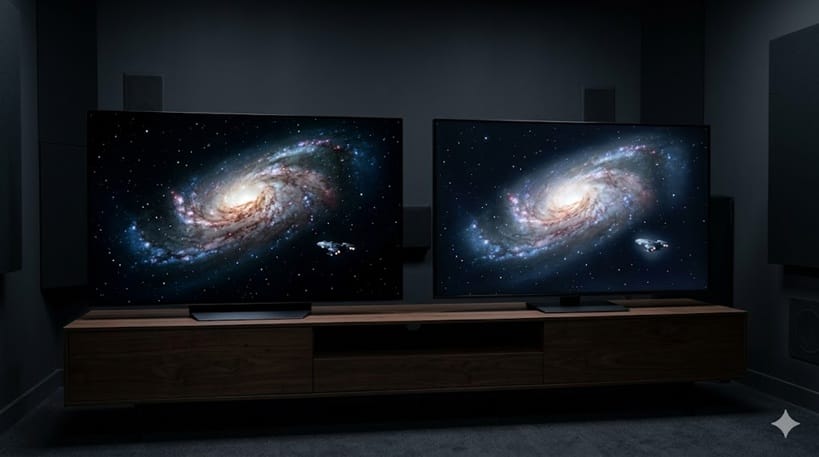
The practical result: in a movie with a starfield or a night scene, an OLED shows stars against true black. A standard LED TV shows stars against a dark gray. If you’ve seen it side by side, it’s not subtle. This is the difference that matters most in a dim or dark viewing environment.
When does it matter less?
In a bright room with windows and overhead lighting, ambient light reflects off the screen and washes out that contrast advantage significantly. In those conditions, the LED’s higher sustained brightness can keep the image looking vivid even under strong light — while OLED’s contrast advantage becomes harder to see. If that describes your main viewing space, the contrast gap shrinks more than the spec sheets suggest.
Brightness: LED Wins
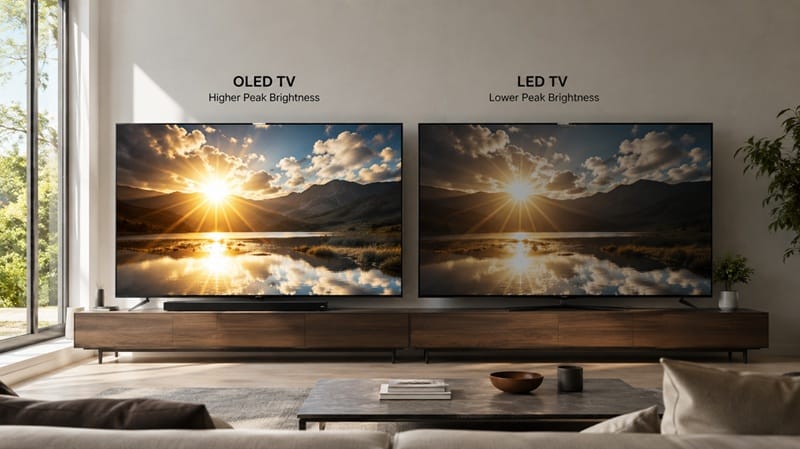
Peak brightness is measured in nits, and LED TVs — particularly premium Full Array and Mini LED models — produce more of them than most OLED panels. A mid-range Full Array LED can hit 800–1,200 nits sustained across the full screen; premium Mini LED panels push 1,500–2,000 nits or higher in high-brightness zones. Most WOLED panels peak at around 800–1,000 nits on small highlights, with sustained full-screen brightness closer to 200–350 nits — ranges confirmed across multiple panel reviews at RTINGS.
Does more brightness mean a better picture?
In HDR content, yes — up to a point. Specular highlights (sun glinting on water, a lamp in a dark scene) look more impactful with higher peak brightness. LED’s advantage here is real and measurable. But brightness only matters if contrast is also high enough to make those highlights meaningful. A panel that hits 1,500 nits against a 3,000:1 contrast ratio looks less impressive than 800 nits against infinite contrast — the highlights pop more when they’re rising from true black.
Where LED’s brightness advantage is most useful is in well-lit rooms. Higher sustained brightness means the image competes better with ambient light. OLED’s auto brightness limiter (ABL) can reduce output on bright, high-sustained scenes — a trade-off that matters more in daytime sports viewing than in an evening movie watch.
Color and Viewing Angles: OLED Wins
OLED panels hold up when viewed off-axis in a way that LED VA panels simply don’t. Sit at 45 degrees on an OLED and you’d barely notice you moved. Do the same on a VA-panel LED and the blacks go gray, colors wash out. It’s the kind of difference that matters when three people are watching from the same couch — the person at the end isn’t getting a different picture on an OLED. IPS LED panels handle off-axis viewing better than VA, but typically trade away contrast to do it.
Color coverage
QD-OLED panels (found in Samsung and Sony OLED TVs) combine OLED self-emission with a quantum dot layer, pushing color volume coverage beyond 90% of the DCI-P3 color space and into BT.2020 territory. Standard WOLED panels (LG’s technology, used in most non-Samsung OLEDs) are slightly behind on raw color volume but still exceed the coverage of most LED TVs at the same price tier. In everyday viewing, the color on a well-calibrated OLED tends to look richer and more natural — particularly in skin tones and saturated film content.
In practice, the difference shows up most in content that was mastered with wide color in mind — recent Netflix originals, 4K Blu-ray releases, and HDR gaming. On older SDR content, the gap is much smaller.
Motion and Response Time: OLED Wins
OLED pixels respond in under 0.1ms — effectively instantaneous. LED panels, even premium ones, typically measure 2–8ms gray-to-gray response time. The visible result is that fast-moving content on an OLED shows sharper edges with less trailing — what display testers call “blur.” In gaming, this pairs with OLED’s near-zero input lag (often under 1ms in game mode) to make the whole experience feel more immediate.
For gaming specifically, modern OLED TVs also support 4K at 120Hz over HDMI 2.1, VRR (Variable Refresh Rate) via G-Sync Compatible and FreeSync Premium, and in some models 144Hz — features that make them a better match for current-generation consoles than most LED TVs in the same price bracket.
A premium 120Hz Full Array LED with BFI will handle most content fine — the motion is clean enough for casual gaming and sports. Where the gap opens up is in fast-paced gaming: LED panels introduce more motion artifacting at the pixel level, and HDMI 2.1 with full 48Gbps bandwidth is still inconsistent on LED sets under $1,500. If you’re running a PS5 or Xbox Series X at 4K 120Hz with VRR, the OLED pipeline is more reliable across the board.
Price and Value: LED Wins
LED TVs are available in large sizes for significantly less money. A 75-inch LED TV from a major brand can be found for a fraction of what a similarly sized OLED costs — that’s a real gap, and for buyers who prioritize screen size, it’s often the deciding factor. If you want to see what that trade-off actually looks like on a specific model, our LG 75NU850B review breaks down exactly what a large-format budget NanoCell LED gains and gives up compared to OLED.
OLED pricing has come down considerably over the past three years. Entry-level OLED TVs (typically 55-inch) now start under $1,000. The value equation has shifted enough that OLED is no longer exclusively a premium category — but LED still wins on cost per inch at every size point.
What does the price difference actually buy?
The upgrade from LED to OLED isn’t like buying a faster processor or more RAM — it’s a different kind of picture. The contrast, black levels, and viewing angles change how a film or show actually looks on screen, not just how it scores on a spec sheet. Whether that difference is worth the price depends on how much time you spend watching in conditions where OLED’s advantages show up. For a TV that’s on all day in a bright kitchen, probably not. For a dedicated viewing room or a bedroom TV watched at night, probably yes. For more on that trade-off, see our OLED pros and cons breakdown.
Burn-In and Longevity: Honest Assessment
OLED burn-in — permanent image retention from static content displayed for long periods — was a real concern in first-generation panels. In 2026, it’s a much smaller risk for typical home viewing, but it hasn’t disappeared entirely. OLED TVs used as PC monitors, or in commercial settings with static UI elements running for hours daily, remain at elevated risk.
For normal home use — varied content, reasonable daily hours, modern panel protections like pixel shifting and ABL — burn-in is unlikely over a 5–7 year lifespan. LED TVs don’t have this risk at all. If you’re planning to use the TV primarily as a gaming display with persistent HUDs, or run a news channel as a background screen for hours per day, that’s worth factoring in.
LG’s published specification for current OLED panels is 100,000 hours to half-brightness — roughly 27 years at 10 hours a day. In practice, the lifespan concern for home users has shifted from “will it last” to “will burn-in happen first.” For typical varied viewing, neither is likely to be a real problem. LED TVs don’t carry that burn-in asterisk at all, which still makes them the safer call for high-static use cases.
OLED vs LED by Use Case
Editorial assessment — winner reflects the better fit for that specific use case and environment.
Which Should You Buy?
If you’re genuinely undecided, start with your room. Walk in during the time you usually watch TV and look at the ambient light. If it’s a dark or dimmable space, OLED is the right call at 55 or 65 inches — the contrast advantage is real and you’ll notice it every time you watch something with a dark scene. If windows are flooding the room with afternoon sun and you watch a lot of daytime sports, a premium Full Array LED will serve you better and cost less.
If your room is genuinely bright — morning sun, no curtains, fluorescent overhead lighting — a premium Full Array or Mini LED TV can match OLED in those conditions and won’t cost as much. In strong ambient light, that brightness advantage effectively closes what the spec sheet shows as a wide gap. In that environment, spending less on a good LED TV and putting the saving toward a larger screen is the smarter trade-off.
If budget is the primary constraint and you need 75 inches or more, LED is the only realistic option — OLED at that size carries a significant premium. But if you’re comparing 55 or 65-inch TVs and picture quality is your priority, OLED is worth stretching for. For a broader look at whether the upgrade makes sense for your situation, see is OLED worth it in 2026 — and for our current model recommendations.
OLED vs LED TVs: Common Questions
Is an OLED TV better than LED for watching movies?
Yes — for most movie-watching situations, OLED is the better choice. The infinite contrast ratio means black levels in dark film scenes are genuinely dark, not a washed-out gray, and HDR highlights look more impactful when they’re rising from true black. The difference is most pronounced in a dim or dark room, which is how most people watch films in the evening.
Is OLED worth the extra cost over LED?
For a 55 or 65-inch TV in a room you actually dim to watch movies or gaming — yes, the premium is justified. It’s a different category of picture, not just a better one. For a bright kitchen TV, a secondary bedroom set, or anyone who primarily needs maximum screen size on a fixed budget, a quality Full Array LED is the smarter call. Display testing organizations like RTINGS have consistently found OLED outperforms LED on contrast in controlled conditions, which tracks with what you’ll see in real use.
Does OLED have burn-in compared to LED?
LED TVs don’t have burn-in risk. OLED panels can experience image retention if static content — like a persistent game HUD, news ticker, or channel logo — is displayed for extended hours over a long period. For typical home use with varied content, modern OLED panels have built-in protections that make burn-in unlikely over a 5–7 year lifespan. It’s a real consideration for commercial use or dedicated gaming screens, less so for general home viewing.
Will LED TVs close the picture quality gap with OLED?
Mini LED has narrowed it — high-end Mini LED panels with thousands of dimming zones now deliver contrast and HDR performance that competes with entry-level OLED, especially in brighter rooms. But the fundamental physics still favor OLED: a self-emissive pixel that can switch off completely will always have a contrast advantage over a panel with a backlight. That distance has shrunk; it hasn’t disappeared. If you’re comparing Mini LED specifically to OLED.
What about QLED — is that the same as LED?
QLED is a marketing term used primarily by Samsung for their quantum dot LED TVs. It is still an LED-backlit LCD TV — the quantum dot layer improves color accuracy and peak brightness, but doesn’t change the fundamental backlight architecture. QLED is not OLED. If you’re deciding between QLED and OLED specifically.

iYaiii
Editor, GearPulse360
iYaiii is the editor and founder of GearPulse360, specializing in TV reviews and consumer electronics. He tests and researches every recommendation before publishing.
✅ Based on spec analysis data plus RTINGS — last verified June 2026