LG vs Samsung vs Sony OLED: Which Brand Makes the Best TV in 2026?
Last updated: June 2026
🕒 9 min read
Disclosure: As an Amazon Associate I earn from qualifying purchases. This article contains affiliate links — we may earn a small commission if you buy through them, at no extra cost to you.
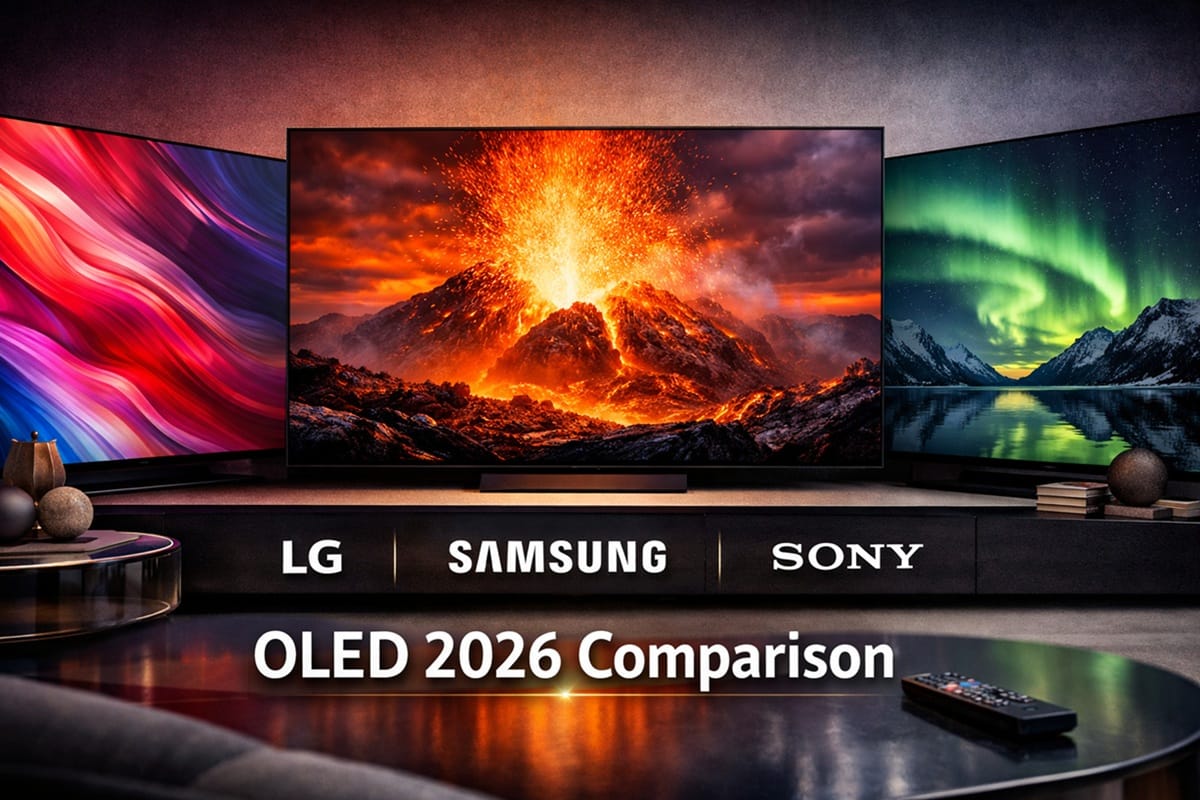
You’ve already decided on OLED. The real question now is LG vs Samsung vs Sony OLED — which brand actually deserves your money in 2026. All three make excellent panels, but they’re not interchangeable: each one is built around a different priority, and picking the “wrong” brand for your specific use case is an easy way to end up mildly disappointed with an otherwise great TV.
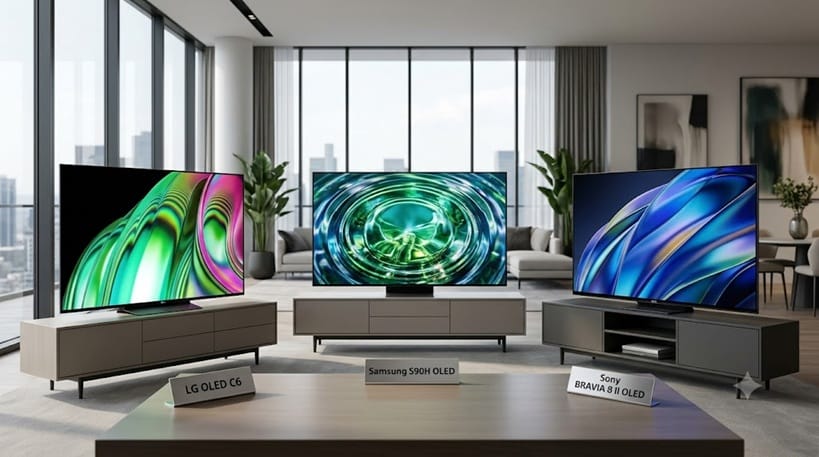
Based on manufacturer specifications and independent testing data, there’s no single winner here. LG’s OLED C6 leans hardest into gaming flexibility and value, Samsung’s S90H pushes brightness and glare resistance for living rooms with windows, and Sony’s BRAVIA 8 II is built around out-of-the-box color accuracy for movie-first households.
This comparison covers all three brands at a glance, with links throughout to our deeper head-to-head breakdowns wherever you want more detail on a specific pair.
Table of Contents
LG OLED — the safest pick for most buyers, with Samsung and Sony each winning specific use cases
LG’s OLED C6 pairs the broadest gaming feature set with a similarly competitive price to Samsung’s S90H, making it the default recommendation for mixed-use households. Step to Samsung if glare in a bright living room is your main complaint about OLED, or to Sony if movie-night color accuracy matters more to you than raw specs.
How LG vs Samsung vs Sony OLED Panels Actually Differ in 2026
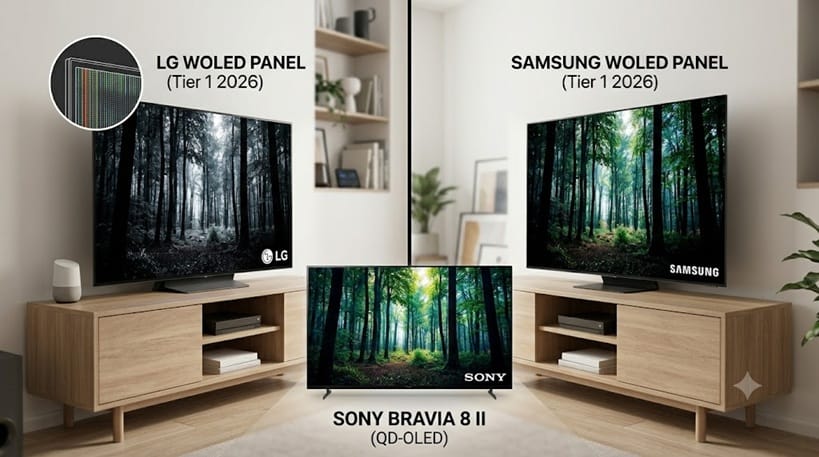
For years, the easy shorthand was “Samsung and Sony make QD-OLED, LG makes WOLED.” That’s no longer accurate. In 2026, Samsung quietly switched its mid-range S90H lineup over to a WOLED panel sourced from LG Display, based on the TV’s own official model number and spec sheet on Samsung’s site. Sony’s BRAVIA 8 II, by contrast, sticks with a third-generation QD-OLED panel sourced from Samsung Display.
That makes this year an unusual matchup: LG and Samsung are both running WOLED panels at this tier, while Sony is the only one of the three still using QD-OLED. If you want the full breakdown of how these two panel families differ technically, we cover it in our QD-OLED vs WOLED comparison.
What Is LG’s OLED Lineup?
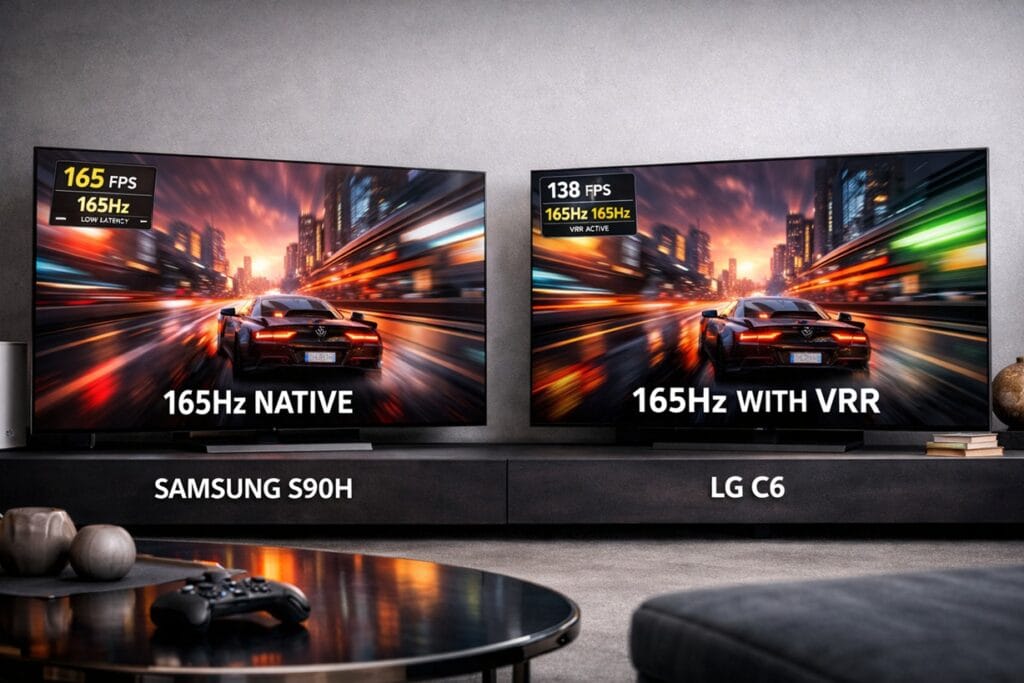
LG’s OLED C6 is the brand’s mid-flagship for 2026, running a WOLED evo panel with LG’s Alpha 11 AI processor (Gen 3). Based on LG’s official specifications, the panel runs at 120Hz native with VRR support up to 165Hz — a detail several early reviews mistakenly reported as a native 144Hz panel. For readers deciding purely within LG’s own lineup rather than across brands, our LG C5 vs G5 comparison covers that internal tier choice separately.
What Is Samsung’s OLED Lineup?
Samsung’s S90H sits in the same mid-flagship tier, now built on a WOLED panel with a native 165Hz refresh rate and Samsung’s new Glare Free coating — previously reserved for Samsung’s pricier S95-series sets.
What Is Sony’s OLED Lineup?
Sony’s BRAVIA 8 II is priced and positioned a step above both, running a genuine QD-OLED panel at 120Hz native, tuned through Sony’s XR processor. According to RTINGS and Sony’s own marketing, the focus here is out-of-the-box accuracy rather than headline spec numbers.
Picture Quality: Which Brand Wins?
Picture quality is the dimension buyers care about most, and it’s also the one where Sony’s panel choice gives it a structural edge. QD-OLED panels generally produce wider color volume and brighter highlights at the same power draw than WOLED panels, and based on RTINGS’ published measurements of Sony’s third-generation QD-OLED implementation, the BRAVIA 8 II’s color accuracy out of the box is consistently among the best on the market.
LG and Samsung are closer to each other this year since both now run WOLED panels. LG’s Alpha 11 Gen 3 processor and Samsung’s NQ4 AI Gen3 processor both do real-time tone mapping and upscaling, and the practical difference between them is smaller than the difference between either WOLED set and Sony’s QD-OLED panel. For a deeper look at how Sony’s QD-OLED panel compares against an LG WOLED panel specifically, see our Sony OLED vs LG OLED comparison.
Gaming Performance: Which Brand Wins?
This is LG and Samsung’s category. Both ship with a full set of HDMI 2.1 ports, Nvidia G-Sync support, and AMD FreeSync. Samsung’s S90H runs a 165Hz native refresh rate this year, edging out LG’s C6, which runs 120Hz native with VRR extending up to 165Hz. In practice, console gamers on a PS5 or Xbox Series X will see almost no difference between the two, since neither console outputs past 120Hz currently.
Sony’s BRAVIA 8 II caps out at 120Hz native with no VRR boost beyond that, and skips Nvidia G-Sync entirely. Where it claws back ground is PS5-specific integration — Sony’s “Perfect for PlayStation 5” features and auto HDR tone-mapping are tuned in ways LG and Samsung can’t fully replicate. If competitive PC gaming is the priority, the gap between LG and Samsung is worth examining directly — our LG OLED vs Samsung OLED comparison breaks down input lag and VRR range model-by-model.
Design & Build: Which Brand Wins?
Samsung’s biggest differentiator this year isn’t a spec — it’s the screen finish. The S90H’s Glare Free coating, previously limited to Samsung’s flagship sets, cuts reflections dramatically in rooms with windows or overhead lighting. LG and Sony both stick with a traditional glossy finish, which preserves deeper-looking blacks in a dark room but reflects more light in a bright one.
Sony’s design language leans minimalist, with a slim, centered-stand build aimed at wall-mounting. LG’s C6 uses a similar central-pedestal design with a brushed metal finish. Neither LG nor Sony currently offers an anti-glare option at this tier — that’s Samsung’s alone for 2026. We compared Sony and Samsung’s screen treatments directly in our Sony OLED vs Samsung OLED comparison if reflections in your room are a dealbreaker either way.
Price & Value: Which Brand Wins?
At the same screen size, LG and Samsung land in roughly the same price bracket, which makes the decision between them come down to features rather than budget — LG’s broader VRR range and processor reputation versus Samsung’s native 165Hz panel and Glare Free coating. Sony’s BRAVIA 8 II sits a tier above both on price, positioning it as the option for buyers who’ve already decided picture accuracy is worth paying extra for.
Based on editorial research across all three lineups, LG’s C6 currently offers the strongest ratio of gaming features to price, which is why it’s our default pick for most buyers who haven’t already committed to a specific use case. That doesn’t make Samsung or Sony worse values — it just means their value proposition is tied to a specific need (glare resistance, or color accuracy) rather than a general one. If neither of those needs applies to you, there’s less reason to pay for them.
LG vs Samsung vs Sony OLED: At a Glance
Editorial assessment — not sponsored rankings.
Which Should You Buy?
For most buyers, LG’s OLED C6 is the safer default — it covers gaming, everyday viewing, and price equally well without forcing a tradeoff. If your priority is taming reflections in a sun-facing living room, Samsung’s S90H and its Glare Free coating solve a problem neither LG nor Sony currently address. And if you watch mostly movies and care more about how accurate the picture looks straight out of the box than chasing refresh-rate numbers, Sony’s BRAVIA 8 II is worth the step up in price.
Want to see every model in a specific brand’s lineup, not just the one we’ve highlighted here? Our Samsung OLED roundup ranks the S85H, S90H, and S95H side by side.
Leaning Sony or LG instead? See our Sony OLED roundup or our LG OLED roundup for the full lineup breakdown.
📍 Still weighing OLED against other panel types entirely? See our full picks across every brand in our best OLED TVs of 2026 roundup.
LG vs Samsung vs Sony OLED: Common Questions
Is LG, Samsung, or Sony better for gaming?
LG and Samsung are both stronger choices than Sony for gaming this year. Per RTINGS’ testing of the S90H, Samsung’s panel runs a native 165Hz refresh rate, while LG’s C6 reaches the same ceiling through VRR. Sony’s BRAVIA 8 II caps at 120Hz but offers deeper PS5-specific integration.
Is Sony’s BRAVIA 8 II worth the premium over LG or Samsung?
It depends on what you watch most. Sony’s QD-OLED panel delivers noticeably stronger out-of-the-box color accuracy, which matters most to movie-first viewers. Gamers and general-use households are less likely to see enough of a difference to justify the added cost over LG or Samsung.
Do LG and Samsung OLED TVs have burn-in risk?
All OLED panels, regardless of brand, carry some long-term burn-in risk under heavy static-image use, though modern pixel-shifting and panel refresh features have reduced it significantly. This holds true across LG, Samsung, and Sony equally — it’s not a brand-specific weak point for any of the three.
Will Samsung bring QD-OLED back to the S90H lineup?
Samsung hasn’t said. The shift to WOLED on the S90H for 2026 appears to be a deliberate cost and brightness-consistency decision rather than a one-year experiment, so buyers shouldn’t assume next year’s model reverses course.
Which brand has the best smart TV platform — LG, Samsung, or Sony?
LG’s webOS is generally considered the most polished and gaming-friendly of the three. Samsung’s Tizen platform integrates more tightly with other Samsung devices, while Sony runs Google TV, which trades some polish for the widest app ecosystem.
If I’m upgrading within the same brand, will a new Sony OLED definitely look better than my old one?
Not automatically, at least not in the first few days. Owners replacing an older Sony OLED sometimes find the new set looks flatter or dimmer out of the box, which usually comes down to picture-mode defaults rather than the panel itself underperforming. We break down what’s actually going on in this look at why a new Sony OLED can look worse than the old Sony TV it’s replacing.

iYaiii
Editor, GearPulse360
iYaiii is the editor and founder of GearPulse360, specializing in TV reviews and consumer electronics. He researches every recommendation before publishing.
✅ Based on spec analysis and LG’s, Samsung’s, and Sony’s official data, plus RTINGS — last verified June 2026