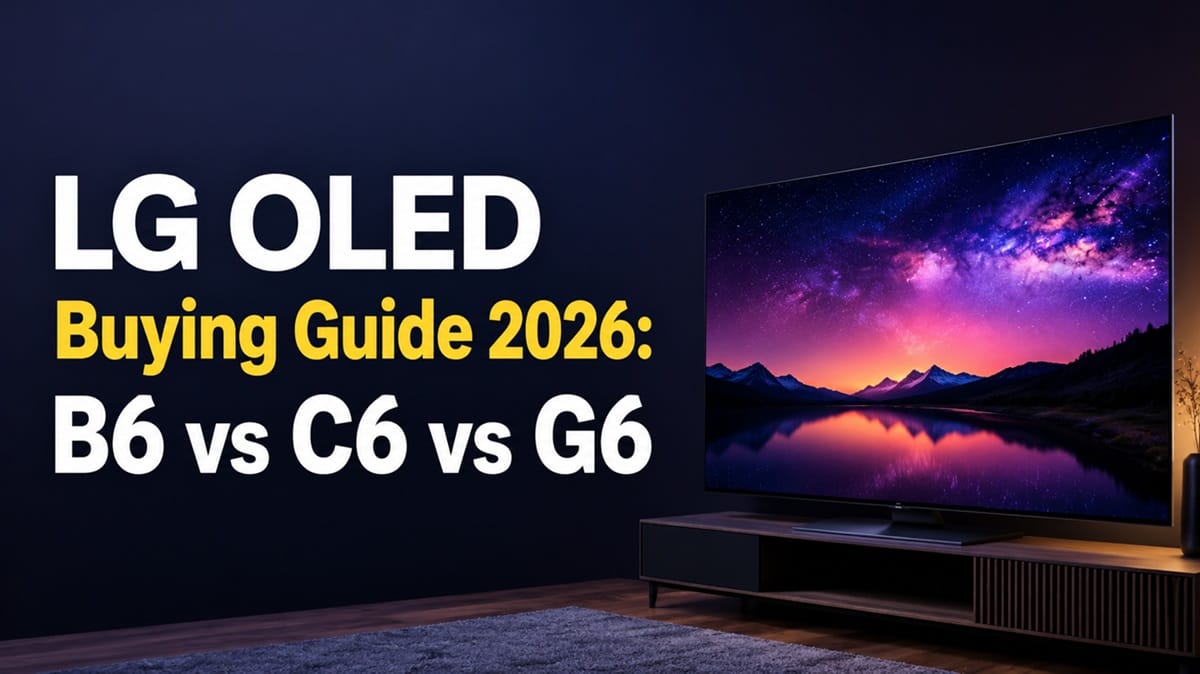
LG OLED Buying Guide 2026: Which Model Is Right for You?
Last updated: June 2026
🕒 8 min read
Disclosure: As an Amazon Associate I earn from qualifying purchases. This article contains affiliate links — we may earn a small commission if you buy through them, at no extra cost to you.
You’ve decided you want an LG OLED. Then you actually look at the lineup and hit a wall: B6, C6, C6H, G6 — four names that all sound like minor variations of the same TV, with no obvious way to tell which one is worth the jump in price.
That confusion is by design more than by accident. LG reuses these letter-and-number names every year, and in 2026 it added a wrinkle: C6H isn’t a separate model line, it’s a specific upgraded version of the C6 that only exists in two screen sizes. Most buyers never figure that out until after they’ve bought the wrong one.
This guide walks through what actually separates B6, C6, C6H, and G6 — panel technology, processor, and the features that change how the TV looks in your specific room — so you can match a model to your budget and viewing habits instead of guessing. If you want the basics of how OLED works before diving into model differences, our primer on what OLED TV technology is covers that first.
One thing this guide assumes: that you’ve already decided a 2026 model is the move. If you’re still weighing whether it’s worth trading in your current LG OLED at all, we cover that decision on its own in is it worth upgrading to LG OLED 2026 before you get into picking a specific model.
Table of Contents
The Short Answer: Which LG OLED Should You Buy in 2026?
For most people, the C6 is the easiest recommendation — it pairs LG’s flagship-level processor with a standard WOLED panel at a mid-range price. Buy the B6 if budget is the deciding factor and you’re not picky about peak brightness. Step up to C6H only if you specifically want a 77″ or 83″ screen and the brighter Tandem panel. Reserve the G6 for bright rooms or home theaters where reflection handling and peak brightness matter most.
What Sets Each LG OLED Model Apart
B6: the budget entry point
The B6 is LG’s entry-level 2026 OLED, available in 65″, 77″, and 83″ sizes. It uses a standard WOLED panel — no Tandem layer — paired with the Alpha 8 AI Gen 3 processor, a step below the chip used in the C6 and G6. It still supports Dolby Vision and Dolby Atmos, and based on LG’s official specs, it carries a brightness bump over last year’s B5. What it doesn’t get is the anti-reflective screen treatment found higher in the lineup, so a glossy B6 in a bright room will show more glare than its pricier siblings.
C6 and C6H: the same name, two different panels
Here’s the part that trips people up. The standard C6 — in 42″, 48″, 55″, and 65″ sizes — uses a regular WOLED panel, just like the B6, but runs the same Alpha 11 AI Gen 3 processor as the flagship G6. That processor gap is a big part of why the C6 punches above its panel spec.
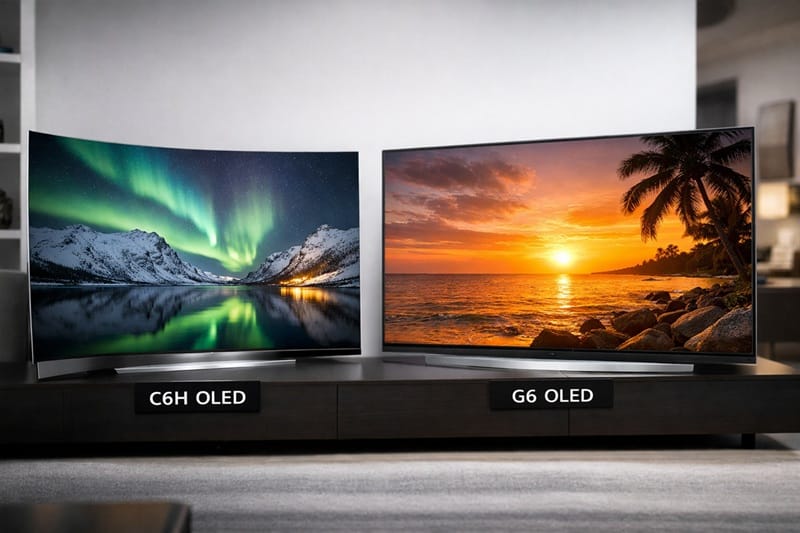
The C6H is a different physical panel, not just a renamed C6. It’s only available in 77″ and 83″, and it uses LG’s upgraded Tandem WOLED panel with “Hyper Radiant” technology — the same family of panel making its way into the G6, tuned to a lower brightness ceiling.
According to RTINGS’ testing, the C6H is considerably brighter than the standard C6 and displays a wider color range in HDR, but the two aren’t direct competitors since they don’t overlap in screen size.
G6: the brightness and reflection-handling flagship
The G6 runs LG’s second-generation Primary RGB Tandem panel with Hyper Radiant Color Technology, and per LG’s published specs, it’s rated for meaningfully higher peak brightness than the G5 it replaces. It also gets a new anti-reflective coating that’s a real step up for bright-room viewing — independent testing from RTINGS confirms the G6 leads the lineup in both brightness and reflection handling. That coating is also more delicate than a standard glass screen, so it’s worth knowing how to clean it safely before you buy — our guide on the LG OLED anti-glare filter problem covers what to avoid.
One detail worth knowing: the 48″ and 97″ G6 sizes use a standard WOLED panel rather than the Tandem panel found in 55″–83″, so the size you pick changes what’s actually inside it.
Why It Matters in 2026
Gaming is strong across the entire lineup
All four models support Dolby Vision gaming, VRR, and ALLM, with NVIDIA G-Sync and AMD FreeSync Premium compatibility. Refresh rate is where they split: the smaller C6 sizes top out higher than the B6, and LG’s official specs list up to 165Hz on select C6 sizes. If gaming refresh rate is your top priority, check the specific screen size’s spec sheet rather than assuming every size in a series matches.
AI processing now separates the tiers more than panel type does
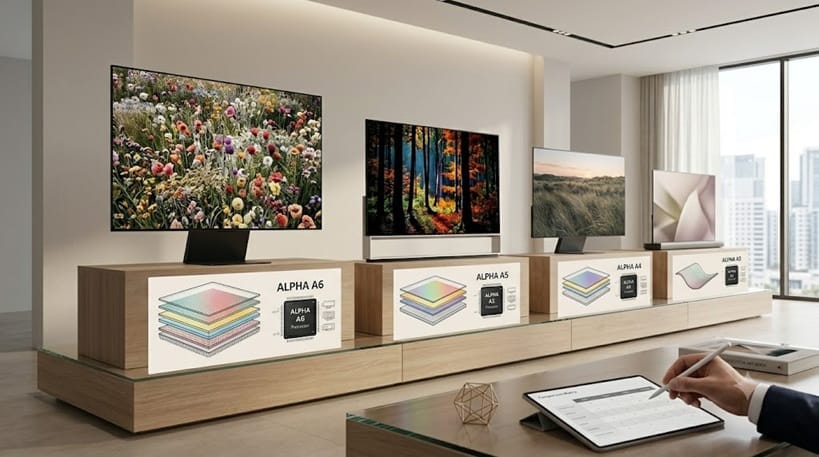
The Alpha 11 AI Gen 3 chip in the C6, C6H, and G6 handles upscaling, scene-by-scene picture optimization, and webOS 26’s on-device AI features. The B6’s Alpha 8 chip is a generation behind on those tasks. In practice, this means the gap between a B6 and a C6 showing the same content can be more about processing than panel brightness.
If you’re still weighing OLED against other panel technologies before settling on LG specifically, our best OLED TVs of 2026 roundup compares picks across brands, not just within LG’s own lineup.
C6 vs. C6H: Does the Tandem Panel Upgrade Actually Matter?
The honest answer is: only if you’re buying 77″ or 83″. Below that size, C6H doesn’t exist as an option — you’re choosing between the standard C6 and stepping all the way up to a G6 in a smaller size instead. At 77″ or 83″, the C6H gets you most of the G6’s brightness improvement without the full flagship price, which makes it a legitimate middle ground for large-screen buyers who don’t need the G6’s reflection-handling coating. For a closer side-by-side of the two, our LG C6H vs LG G6 compared breakdown covers it in more depth.
What This Means for You in Practice
Buy This If…
You’re set on the C6 if you want LG’s best processing at a mid-range price and your room isn’t fighting heavy glare. You’re set on the G6 if you watch in a bright room, want the lowest reflections LG makes, or you’re building a dedicated home theater where peak brightness and color volume matter most. The C6H earns its place specifically for 77″/83″ buyers who want a brightness step up without the full G6 cost.
Skip This If…
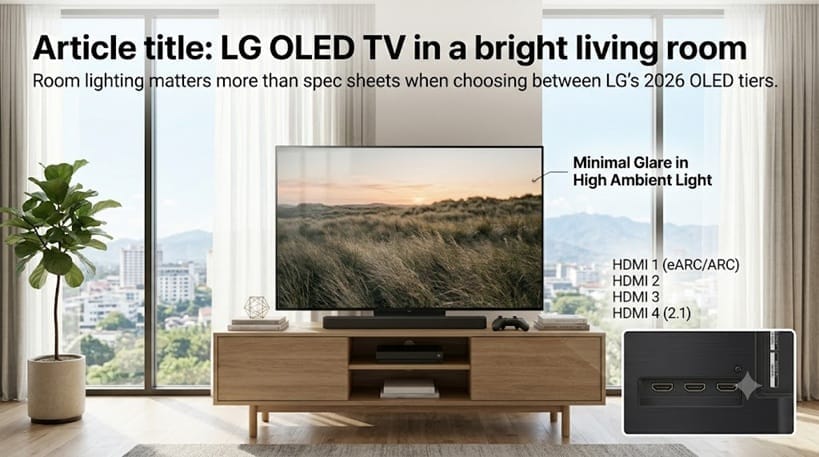
Skip the B6 if you watch primarily during the day in a sun-facing room — its glossier, non-treated screen will show more glare than you’ll want to live with. Skip the G6 if your room is already dim or curtained most of the time; you’d be paying for reflection handling and peak brightness you won’t notice. For the full ranked comparison across all four models in one place, see our LG OLED roundup.
FAQs: LG OLED Buying Guide
What’s the difference between LG OLED C6 and C6H?
The standard C6 uses a regular WOLED panel and comes in 42″–65″ sizes. The C6H uses an upgraded Tandem WOLED panel and is only available in 77″ and 83″ — it’s brighter than the standard C6, based on RTINGS’ published testing, but the two don’t compete directly since they’re sold in different size ranges.
Is the LG G6 worth it over the C6?
It depends on your room. The G6 leads the lineup in peak brightness and reflection handling, according to LG’s official specs and independent RTINGS testing, which matters most in bright or sunlit rooms. In a controlled-lighting room, the C6’s processor and panel performance close most of the practical gap for less money. Our full LG G6 review covers the gaming-specific case for the upgrade. If dropping to last year’s C5 or G5 to save money is on the table too, our LG C5 vs G5 comparison walks through that trade-off.
Does the LG B6 use the same panel as the C6?
Yes — both the B6 and the standard C6 use a regular WOLED panel rather than LG’s Tandem technology. The difference between them comes down to the processor and the screen’s anti-reflective treatment, not the underlying panel type.
Is LG C6H worth the upgrade over a standard C6 size?
Only if you’re already buying 77″ or 83″, since that’s the only size range where C6H exists. Our full LG C6H review goes through whether the brightness gain justifies the price step at those sizes specifically.
Which LG OLED is best for gaming in 2026?
All four models support VRR, ALLM, G-Sync, and FreeSync Premium, so gaming features aren’t the deciding factor. Refresh rate ceiling varies by specific screen size rather than by series name, so check LG’s official spec page for the exact size you’re considering before assuming a higher-tier model automatically means faster gaming performance.
What’s the return and warranty window if I need to send an LG OLED back?
Return windows are set by the retailer you buy from, and they’re separate from LG’s manufacturer warranty coverage — the two timelines don’t always match. Before you buy, our warranty claim return window guide breaks down how those windows typically work, so you’re not scrambling to figure it out after a problem shows up.

iYaiii
Editor, GearPulse360
iYaiii is the editor and founder of GearPulse360, specializing in TV reviews and consumer electronics. He researches every recommendation before publishing.
✅ Based on spec analysis and LG’s official and RTINGS data — last verified June 2026