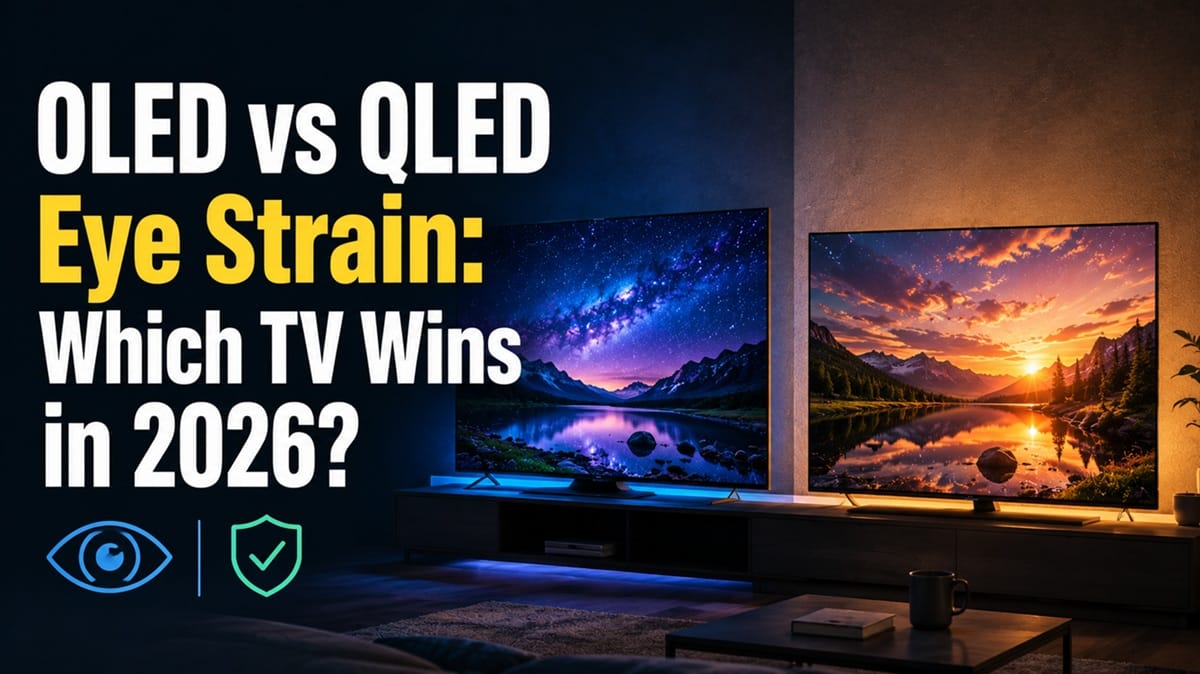
OLED vs QLED Eye Strain: Which TV Is Easier on Your Eyes?
Last updated: July 2026
🕒 9 min read
Disclosure: As an Amazon Associate I earn from qualifying purchases. This article contains affiliate links — we may earn a small commission if you buy through them, at no extra cost to you.
If your eyes feel tired, dry, or achy after a long night of TV watching, you’ve probably wondered whether the screen itself is part of the problem. It’s a fair question — not all TVs light up their pixels the same way, and that difference matters more for eye comfort than most spec sheets let on.
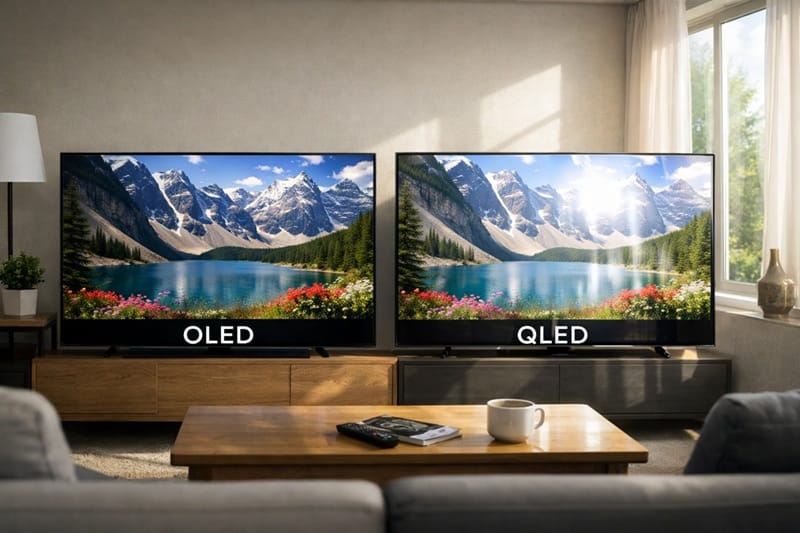
Here’s the short version: OLED TVs are the better choice for eye strain in most homes, mainly because they don’t rely on a flickering backlight to control brightness. QLED and Mini LED sets often do, and that flicker is one of the most common triggers people report.
This isn’t the full technology rundown — for that, see our full OLED vs QLED comparison. Here, we’re narrowing in on one specific question: which panel type is genuinely gentler on your eyes during long viewing sessions.
Table of Contents
OLED — because it doesn’t need a flickering backlight to dim itself
OLED’s self-emissive pixels skip the pulse-width-modulation (PWM) backlight dimming that many Mini LED and QLED sets use, and LG Display’s OLED panels carry independent low-blue-light certifications. The exception: if you watch mostly in a sunlit room and rely on maximum sustained brightness, a bright Mini LED/QLED set can actually be more comfortable than pushing an OLED panel to its brightest, most reflective setting.
How They Compare
Flicker-Free Dimming — OLED
Flicker-Free Dimming — QLED
Blue Light Emission — OLED
Blue Light Emission — QLED
Bright-Room Glare Control — OLED
Bright-Room Glare Control — QLED
Long-Session Comfort — OLED
Long-Session Comfort — QLED
Editorial ratings based on RTINGS and manufacturer data, not standardized lab scores.
Ready to act on that verdict? See our picks for best OLED TVs for gaming →.
How OLED and QLED Actually Differ Where Eye Comfort Is Concerned
What Is OLED?
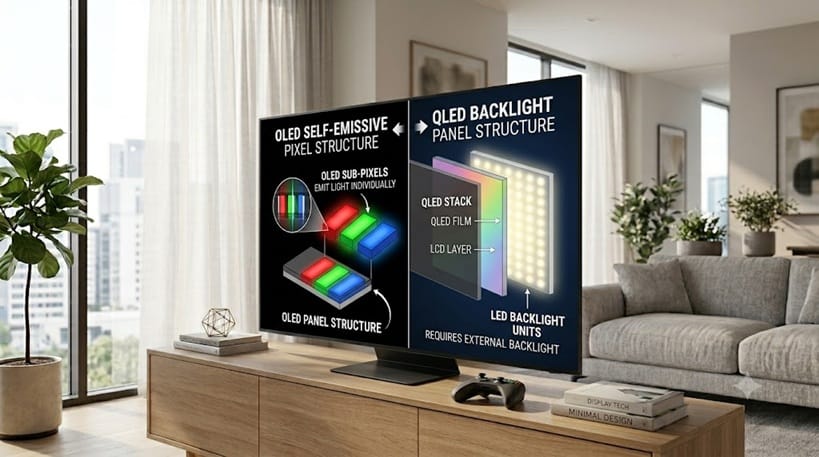
OLED panels are self-emissive — every pixel produces its own light and can switch fully off. There’s no separate backlight sitting behind the panel, and no need for a dimming circuit to fight with in order to control brightness at the pixel level.
What Is QLED?
QLED, Neo QLED, and Mini LED sets are all still LCD panels at their core, with a quantum-dot or NanoCell filter layer sitting in front of an LED backlight. To dim the picture, many of these backlights use PWM — rapidly switching the LEDs on and off many times per second rather than smoothly lowering their voltage.
The Key Structural Difference
That backlight is the whole story here. A panel with no backlight has nothing to flicker. A panel that depends on one has to manage that flicker somehow, and how well it manages it varies a lot between brands and even between models from the same brand.
PWM Flicker & Backlight Dimming: Who Wins?
Flicker is the single biggest eye-strain complaint tied to display technology, and it’s also the one with the clearest technical explanation. If you’ve ever felt fine on one TV but fatigued on another with no obvious cause, backlight dimming behavior is a strong suspect.
Why OLED Doesn’t Flicker
OLED wins this dimension decisively. Both QD-OLED and WOLED panels are self-emissive — see our QD-OLED vs WOLED comparison for how the two differ — so neither relies on a PWM-driven backlight, and TÜV Rheinland and UL testing has verified LG Display’s OLED TV panels as flicker-free. Many Mini LED and QLED TVs, by contrast, use PWM specifically at lower brightness settings, which is exactly when a lot of people watch TV — evenings, dim rooms, late-night sessions.
Where Sensitivity Varies
This doesn’t mean every QLED flickers noticeably, or that every viewer is sensitive to it. Flicker sensitivity varies a lot from person to person, and some people never notice it consciously even when it’s present.
Blue Light Emission: Who Wins?
Blue light gets blamed for a lot of screen-related discomfort, and while the health claims around it are still debated by researchers, it’s worth understanding what’s actually measurable.
What LG’s Certification Claims
According to LG’s official OLED eye-comfort page, tests found LG OLED displays emit less blue light than LED-backlit LCD panels, and LG Display’s OLED panels have received low-blue-light and flicker-free certification marks from TÜV Rheinland and UL. That’s LG’s own claim, backed by third-party certification bodies rather than independent lab testing from GearPulse360, so treat the specific numbers as directional rather than gospel.
Why QLED Tends to Run Higher
QLED and Mini LED panels generally rely on blue LED backlights with color-conversion layers, which tends to push overall blue light output higher, particularly at brighter settings. If blue light exposure specifically concerns you — say, because of evening viewing and sleep — that structural difference favors OLED.
None of this means QLED is unsafe to watch. Every screen you own, including your phone, emits some blue light, and most TVs — OLED or QLED — now ship with a “warm” or “reading” color-temperature preset that reduces blue light output at the cost of a slightly yellower picture. If sleep disruption is your main worry, using that preset in the evening helps regardless of which panel type sits in your living room.
Brightness & Glare in Different Room Lighting: Who Wins?
This is the dimension where the eye-strain conversation gets more nuanced, because the “winner” depends heavily on your room, not just the panel.
Dark Rooms Favor OLED
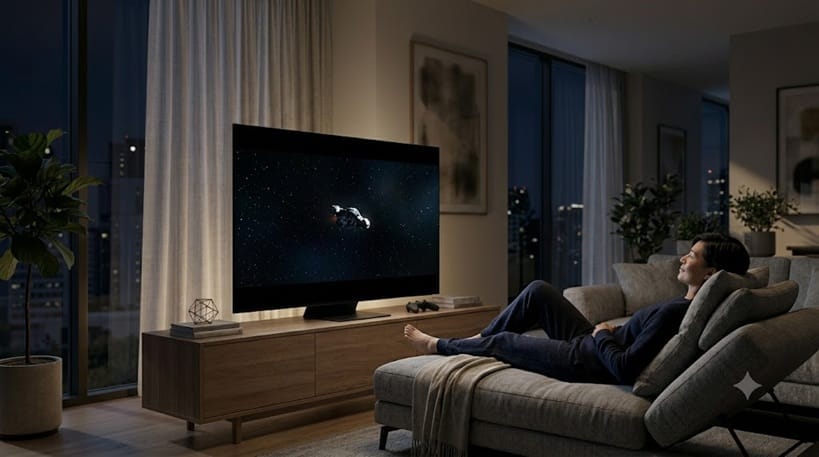
In a dark or dim room, OLED’s near-infinite contrast means you don’t need to push brightness very high to get a comfortable, punchy image — your pupils aren’t fighting a bright backlight glowing through supposedly black areas of the screen. That’s a genuine comfort advantage for evening and nighttime viewing.
Bright Rooms Favor QLED
In a bright, sunlit living room, the math flips somewhat. Neo QLED and Mini LED TVs are generally built to sustain very high peak brightness for hours, which can mean less squinting and less reliance on maximum backlight output compared to an OLED panel working hard to overcome ambient light. Glossy OLED screens can also pick up more reflections in strong ambient light than some matte or anti-glare QLED coatings, which adds its own kind of visual fatigue over a long day.
Contrast, Dark Rooms & Pupil Fatigue: Who Wins?
Constant pupil adjustment — dilating and contracting as the screen alternates between bright highlights and washed-out “black” areas — is its own source of eye fatigue, separate from flicker or blue light.
OLED wins here for typical home theater use. Because unlit OLED pixels are genuinely off rather than dimly backlit, dark scenes stay dark without forcing your eyes to keep readjusting to a hazy black level. QLED panels, even good ones with local dimming, still show some blooming and raised black levels around bright objects on a dark background, which can mean more subtle pupil work over a two-hour movie.
Extended Gaming & Streaming Sessions: OLED vs QLED by Use Case
| Use Case | Winner | Why |
|---|---|---|
| Late-night dark-room binge-watching | OLED | True blacks limit pupil-dilation swings; no backlight flicker to contend with |
| Sunlit living room, TV on most of the day | QLED | Sustained peak brightness overcomes glare without maxing out the panel |
| Long gaming sessions (4+ hours) | OLED | No PWM flicker at any brightness level reduces cumulative strain |
| Shared family room, mixed lighting | Room setup matters more | Ambient lighting control often outweighs panel-type differences here |
| Known photosensitivity or flicker sensitivity | OLED | LG Display’s OLED panels carry Eyesafe and TÜV Rheinland flicker-free certification for this exact concern |
Which Should You Buy?
For most buyers concerned about eye strain, OLED is the safer default. The lack of PWM backlight flicker addresses the most commonly reported trigger, and the lower blue light emission LG cites as independently certified is a genuine, if secondary, bonus.
If your priority is all-day viewing in a bright, sun-filled room, a high-end Neo QLED or Mini LED set can still be the more comfortable pick — sustained brightness without pushing an OLED to its glare-prone maximum has its own eye-comfort logic.
If your priority is dark-room movie nights or long gaming sessions, OLED’s combination of true blacks and flicker-free dimming is hard to beat, and it’s worth reading LG OLED vs Samsung OLED compared if you’re deciding between OLED brands specifically.
Also consider: Samsung S90H — a more budget-friendly WOLED option that still skips PWM backlight flicker entirely, if the LG C6 is more than you want to spend.
📍 Still deciding which OLED to actually buy? Our roundup ranks every current model by picture quality, gaming, and value — see our OLED TV roundup.
OLED vs QLED for Eye Strain: Common Questions
Is OLED or QLED better for eye strain?
OLED is better for eye strain in most cases, mainly because it doesn’t need a flickering backlight to control brightness the way many QLED and Mini LED TVs do. The exception is very bright rooms, where a high-brightness QLED can be more comfortable than an OLED pushed to its glare-prone maximum.
Is the OLED price premium worth it just for eye strain?
If eye strain is a real, ongoing problem for you, it’s a reasonable factor to weigh alongside picture quality and gaming performance — not a reason on its own to overspend. RTINGS’ PWM flicker testing is a useful way to check any specific model you’re considering before you commit to the upgrade.
Does OLED ever flicker like some QLED and Mini LED TVs?
OLED panels don’t use PWM backlight dimming, since there’s no backlight to modulate in the first place. Some very old or unusual OLED implementations have had other flicker-adjacent quirks, but current-generation WOLED and QD-OLED TVs are consistently tested as flicker-free.
Will future QLED and Mini LED TVs close the eye-comfort gap with OLED?
Backlight dimming technology keeps improving, and some newer Mini LED sets use finer-grained, less aggressive PWM schemes than older models. That narrows the gap somewhat, but as long as these TVs depend on a backlight at all, they’re working from a structural disadvantage OLED simply doesn’t have.
How can I make either TV type easier on my eyes?
Regardless of panel type, keeping brightness matched to your room’s ambient light, avoiding overly vivid or “dynamic” picture modes, and taking regular breaks all help. If you’re specifically flicker-sensitive, checking a model’s PWM test results before buying is worth the five minutes it takes.

iYaiii
Editor, GearPulse360
iYaiii is the editor and founder of GearPulse360, specializing in TV reviews and consumer electronics. He researches every recommendation before publishing.
✅ Based on spec analysis and LG’s and Samsung’s official data plus RTINGS — last verified July 2026