Best 4K TVs 2026: Mini-LED and QLED Picks Ranked by Value, Gaming and Screen Size
Last updated: August 2026
🕒 9 min read
Disclosure: As an Amazon Associate I earn from qualifying purchases. This article contains affiliate links — we may earn a small commission if you buy through them, at no extra cost to you.
OLED isn’t the only serious option for a 2026 TV, and for a lot of buyers it isn’t even the right one. A bright, sun-facing living room, a screen bigger than 65 inches on a non-flagship budget, or just wanting one less thing to think about with burn-in — all three point toward Mini-LED or QLED instead.
These two technologies do most of the work in the best 4K TVs 2026 has to offer outside of OLED, and the picture-quality gap has closed the most in exactly the areas non-OLED already had an edge: peak brightness and large-screen pricing. Per-pixel contrast in a dark room is still OLED’s advantage, and that tradeoff runs through every pick below. Our top overall choice is the TCL 65QM8L, a flagship-tier Mini-LED set priced well under most true flagships.
This roundup covers five picks across TCL, Samsung, Hisense, Sony, and LG, organized by what you’re actually solving for — overall value, tight budget, Mini-LED performance, gaming, or screen size — rather than one brand’s product tiers. For the technical breakdown of how these panels stack up against OLED, our OLED vs Mini-LED comparison covers the tradeoffs in more depth than we can here.
Table of Contents
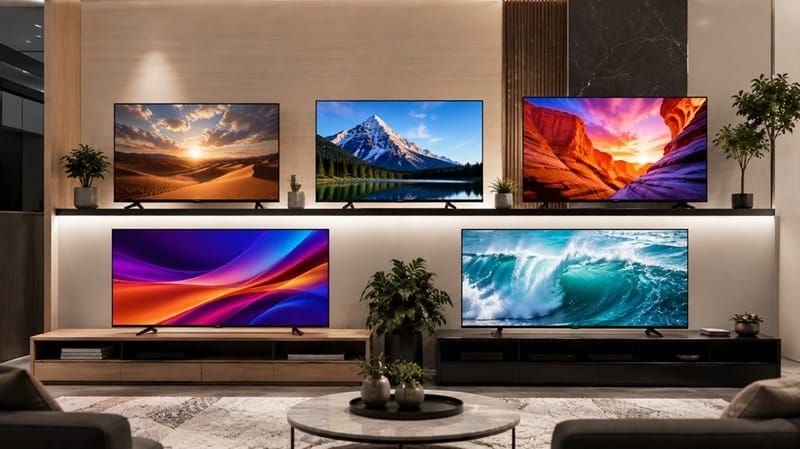
Best 4K TVs 2026: Quick Picks
Ranked for value, panel performance, and screen size
📺
LG 115QNED92B
QNED evo Mini-LED · 120Hz native
Room-filling size without OLED pricing
↻ Prices change frequently — click through for current pricing.
✓ Scores reflect our independent editorial assessment, not Amazon customer reviews.
Mini-LED vs QLED: What’s the Difference
These terms get used loosely, so it’s worth being precise. QLED describes the quantum-dot color layer on top of an LCD panel — it’s about color, not backlighting. Mini-LED describes the backlight itself: thousands of tiny LEDs instead of a few dozen, grouped into dimming zones that can brighten or darken independently of each other — see our breakdown of what a TV backlight is for how that hardware actually works and what it looks like when it fails.
Most premium non-OLED TVs today combine both — a Mini-LED backlight underneath a QLED color layer — which is exactly what all five picks in this list use. More dimming zones generally means less “blooming” (light haze around bright objects on a dark background), and higher peak brightness is where Mini-LED still comfortably beats OLED, especially in rooms with a lot of ambient light. For the full picture-quality tradeoff against OLED panels specifically, our OLED vs QLED comparison breaks down where each technology wins.
What to actually check before buying
Dimming zone count and peak brightness (in nits) are the two specs that matter most for picture quality on any Mini-LED set. Refresh rate and VRR support matter more if gaming is a priority — we cover that under the gaming pick below.
Best Overall: TCL 65QM8L
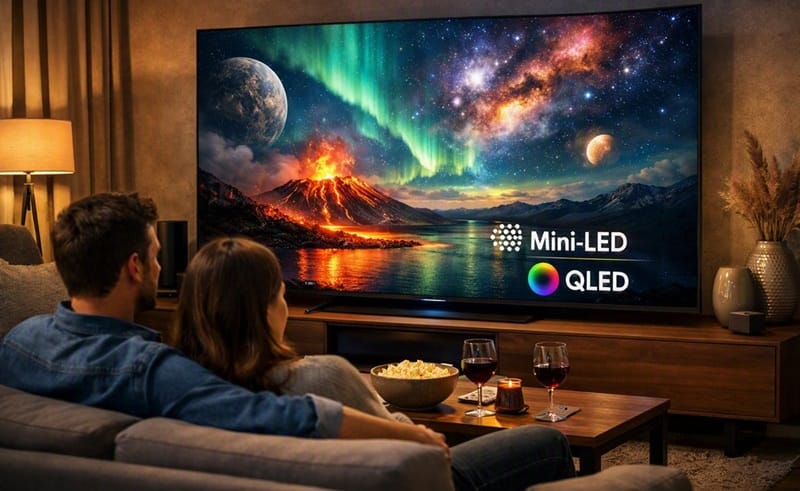
4,000 dimming zones and up to 6,000 nits of peak brightness, per TCL’s spec sheet, put the QM8L’s numbers near the top of what Mini-LED currently ships with — that combination is what keeps blooming in check during dark, high-contrast scenes. The 144Hz native refresh rate and wide VRR range also make it a legitimate pick for gamers, not just movie watchers.
Its main tradeoff against true OLED is contrast in a fully dark room — Mini-LED can’t switch off individual pixels the way OLED does. But for mixed-use rooms with any ambient light, this is a strong all-rounder. Read our full TCL 65QM8L review for the complete breakdown.
Best Value: Samsung 65M70H
The 65M70H is Samsung’s entry point into Mini-LED backlighting for 2026, and the tradeoff for the price is a lower dimming-zone count than the step-up models above — less precise control over blooming in dark scenes than the QM8L or U7SG offer. It isn’t a gaming-focused set either, so competitive gamers should look elsewhere on this list.
What it delivers instead is unambiguous: real Mini-LED backlighting, HDR10+, and Samsung’s Tizen platform, at the lowest price point in this roundup. Read our full Samsung 65M70H review for what RTINGS found on real local-dimming performance.
Best Mini-LED: Hisense 65U7SG
Hisense’s U7-series has ranked among RTINGS’ recommended value Mini-LED sets in prior generations (pending our own verification pass on the 2026 U7SG specifically), and its spec sheet continues that pattern: Dolby Vision and HDR10+ support means it’s covered regardless of which HDR format a given streaming service or disc uses. Our breakdown of how TCL’s Mini-LED compares to OLED covers similar tradeoffs that apply here too.
At 165Hz, its panel runs faster than the native refresh rate on every other set in this list — TCL and LG top out at 144Hz and 120Hz native respectively, Sony at 120Hz. Read our full Hisense 65U7SG review for the one real catch we found.
Best for Gaming: Sony K-65XR70M2
The BRAVIA 7 II uses separate red, green, and blue LEDs in its backlight instead of a single white LED per zone — Sony’s stated aim with this design is better color purity than a standard Mini-LED backlight achieves, a claim we haven’t yet confirmed against RTINGS’ own measurements. For PS5 owners specifically, Sony’s auto HDR tone-mapping and game-optimized picture modes are a concrete, verifiable advantage over competing brands’ generic game modes.
Two of its four HDMI ports are HDMI 2.1 with VRR and ALLM support, which covers current-generation console and PC gaming needs. Read our full Sony K-65XR70M2 review to see whether the RGB backlight justifies the price over Sony’s standard Mini-LED sets.
Best Large-Screen: LG 115QNED92B
At 115 inches, OLED production costs remain high enough that Mini-LED currently wins the price-per-inch argument outright — there’s no competing 115-inch OLED at any price most buyers would consider. LG’s Precision Dimming Ultra, its highest local-dimming tier in the 2026 QNED range, is what keeps a panel this large watchable in dark scenes instead of washing into a single gray field.
This is a dedicated home-theater or media-room purchase, not a casual upgrade — but for buyers who’ve already decided on a screen this size, it’s the clearest non-OLED path there. Read our full LG 115QNED92B review for whether it’s worth building a room around.
Non-OLED vs OLED: Which Should You Buy
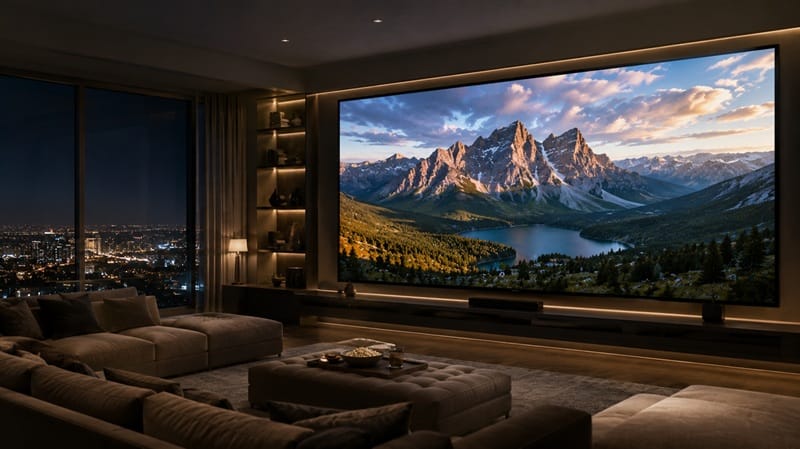
None of this makes OLED the wrong choice — it makes non-OLED the right choice for specific situations. A room with a lot of ambient light, a screen larger than 77–83 inches without flagship-level spending, or wanting to skip thinking about burn-in risk altogether: Mini-LED and QLED solve those directly.
If deep, fully-dark-room contrast and per-pixel precision matter more to you than brightness or size-per-dollar, that’s where OLED still leads.
How to Choose the Right Non-OLED TV for Your Room
Room lighting is one of the biggest factors here, for the same brightness reasons covered above. A bright, sun-facing living room favors high peak brightness — the TCL and Hisense picks lead on that front. A dedicated, mostly-dark media room can lean more on dimming-zone count for contrast control instead.
Match the size to the room, not the budget
It’s tempting to buy the biggest screen the budget allows, but viewing distance matters more than most buyers expect. A 115-inch set like the LG above needs real distance to look right — measure your room before assuming bigger is automatically better.
Don’t ignore the smart platform
Google TV, Tizen, and Fire TV all handle app support differently, and that’s a daily-use factor as much as picture quality is. If you’re comparing tiers within Samsung’s Crystal UHD lineup specifically, our Samsung Crystal UHD buying guide goes deeper on that range.
📍 Not sure OLED is fully off the table for you? If deep-black contrast in a dark room matters more than brightness or screen size, see our OLED TV roundup before deciding.
Best 4K TVs 2026 FAQs
Which 4K TV should I buy in 2026?
For most buyers, the TCL 65QM8L offers the strongest overall balance of picture quality, gaming features, and price among non-OLED 4K TVs this year. Budget-focused buyers should look at the Samsung 65M70H instead.
What’s the difference between Mini-LED and QLED?
QLED refers to the quantum-dot color layer; Mini-LED refers to the backlight behind it. Most premium non-OLED TVs in 2026, including every pick in this list, use both technologies together.
Do non-OLED TVs have burn-in issues?
No — burn-in is a risk specific to OLED’s organic pixel technology, not Mini-LED or QLED backlighting. This is one reason some buyers choose non-OLED sets for displays that show static content for long periods, like news channels or computer monitors. See RTINGS’ Mini-LED testing for more on how these panels are evaluated.
Is a non-OLED 4K TV as good as OLED?
Not on every measure — OLED still leads on per-pixel contrast in a fully dark room. Mini-LED and QLED sets generally win on peak brightness and large-screen affordability instead, which matters more in bright rooms or above 83 inches.
Is Mini-LED worth the extra cost over standard LED?
For most buyers, yes — the dimming-zone control noticeably reduces the washed-out blacks that plague standard LED TVs in dark scenes, without OLED’s price premium or burn-in considerations.

iYaiii
Editor, GearPulse360
iYaiii is the editor and founder of GearPulse360, specializing in TV reviews and consumer electronics. He researches every recommendation before publishing.
✅ Based on spec analysis and TCL’s, Samsung’s, Hisense’s, Sony’s, and LG’s official data — RTINGS verification pending — last verified August 2026