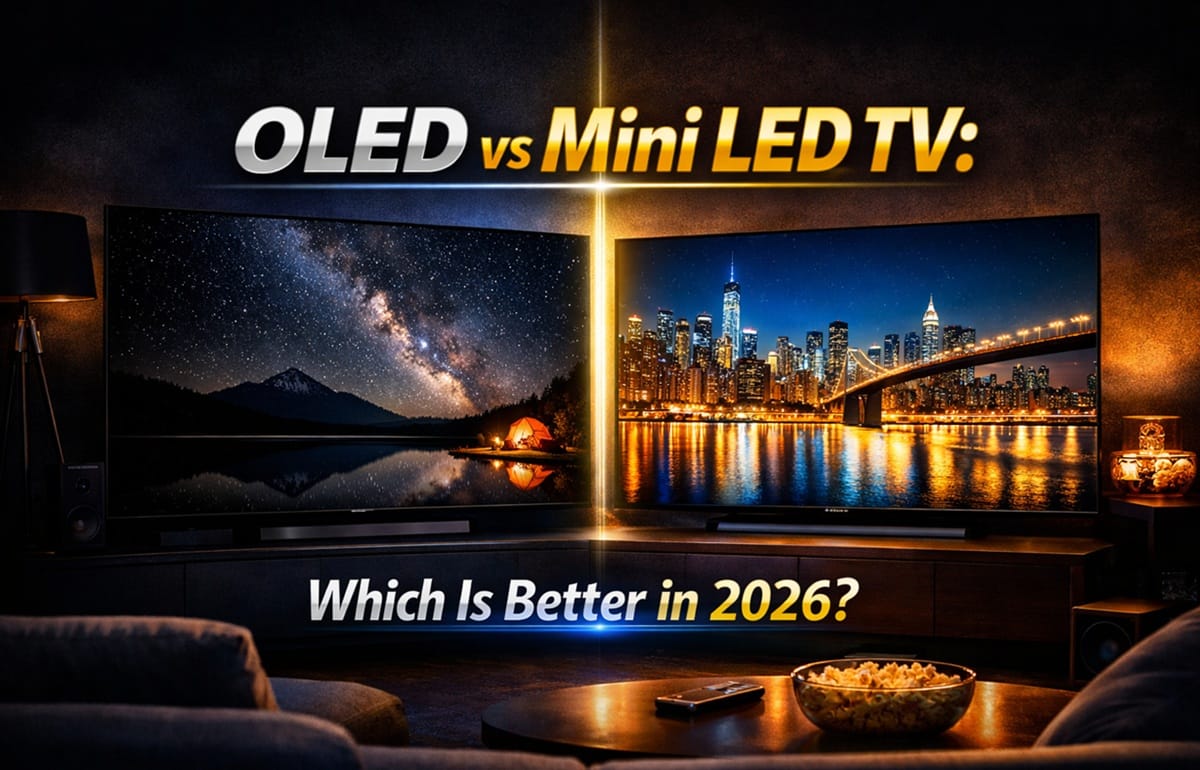
OLED vs Mini LED TV in 2026: Which Technology Is Worth Your Money?
Last updated: June 2026
Disclosure: As an Amazon Associate I earn from qualifying purchases. This article contains affiliate links — we may earn a small commission if you buy through them, at no extra cost to you.
You’ve got two TVs shortlisted — same price, completely different technology. One promises perfect blacks. The other promises blinding brightness. And you’re not sure which one actually matters in your living room.
That’s the OLED vs Mini LED TV decision in 2026. Both technologies have closed the gap significantly this year, which makes the choice harder — but also means you can’t go wrong if you pick the right one for your specific setup. For most buyers in a mixed-use room, Mini LED now offers genuine competition to OLED on picture quality. But OLED still wins where it counts most: contrast, viewing angles, and gaming response.
In this comparison, we break down contrast, brightness, gaming performance, price-to-value, and burn-in risk. If you’re also deciding between OLED and QLED, our full OLED vs QLED comparison covers that ground separately.
Table of Contents
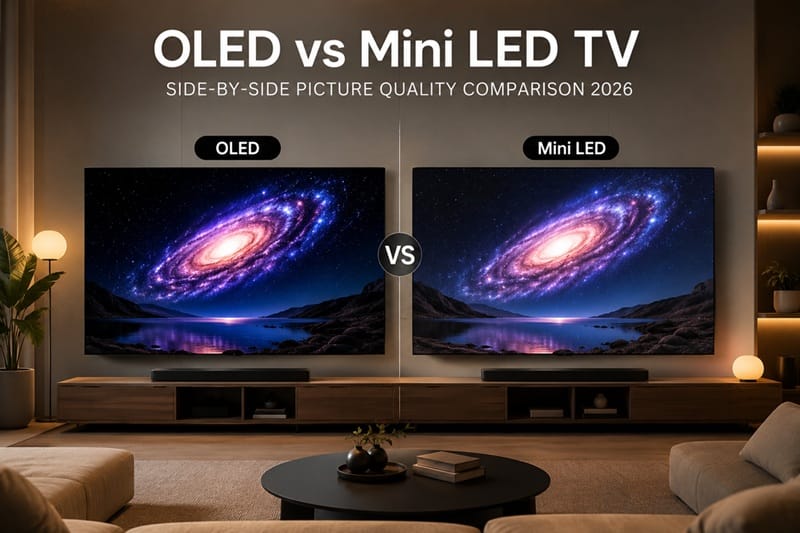
OLED vs Mini LED TV: Quick Verdict
OLED vs Mini LED TV: Our Verdict
Winner for most buyers: OLED — deeper blacks, better viewing angles, and lower input lag make it the stronger all-round performer.
Exception: Mini LED wins if your room is bright, you watch a lot of HDR sports or outdoor content, or you want a larger screen for less money.
Buy OLED if:
- You watch movies or TV in a dim or dark room
- Gaming is a priority — especially PS5 or Xbox Series X
- You sit at an angle or share the screen with others
Buy Mini LED if:
- Your room has a lot of natural light or overhead lighting
- You want maximum brightness for sports, HDR movies, or daytime use
- Budget is tight and you need a 75″+ screen for the money
How They Compare
Picture Quality / Contrast — OLED
Picture Quality / Contrast — Mini LED
Brightness — OLED
Brightness — Mini LED
Gaming Performance — OLED
Gaming Performance — Mini LED
Price / Value — OLED
Price / Value — Mini LED
How OLED and Mini LED Actually Differ
What Is OLED?
OLED (Organic Light-Emitting Diode) uses pixels that produce their own light individually. When a pixel needs to show black, it switches off completely — producing true zero-light blacks. There’s no backlight, no dimming zones, no light leakage. For a deeper look at the underlying technology, see our explainer on what OLED TV technology is.
What Is Mini LED?
Mini LED is an evolution of standard LED backlighting. Instead of a few dozen large LEDs behind the panel, Mini LED TVs use thousands of tiny LEDs — sometimes 2,000 to 5,000+ — grouped into local dimming zones. The Samsung QN90D, for example, uses over 2,000 dimming zones. More zones means finer control over which areas of the screen go dark, which dramatically improves contrast compared to standard LED TVs.
Despite the similar-sounding name, don’t confuse Mini LED with true MicroLED — a separate, self-emissive display technology sold as modular, professionally installed panels rather than a standard LCD TV. If you’ve seen that term in CES coverage, our MicroLED vs OLED comparison breaks down why it’s not a mainstream buying decision yet.
The Key Structural Difference
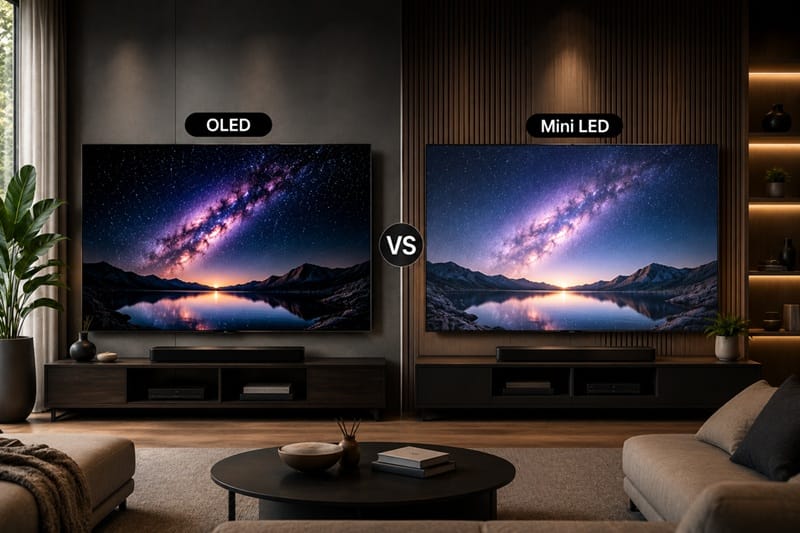
OLED’s advantage is pixel-level precision — every single pixel dims independently, giving it an essentially infinite contrast ratio. Mini LED’s advantage is volume — those thousands of LEDs can be driven harder, producing peak brightness levels that OLED currently can’t match. That’s really the whole story — blacks vs brightness.
Contrast and Black Levels: OLED Wins Clearly
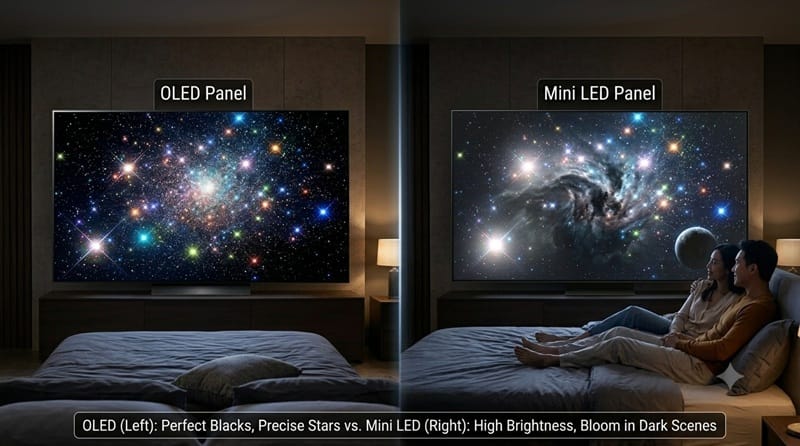
This is where the OLED vs Mini LED TV gap is most obvious. Each pixel switches off completely when it needs to show black — zero light, zero glow. In a dark room, the difference between the two technologies is immediately visible to the naked eye.
Mini LED TVs, even top-tier models like the Samsung QN90D or TCL QM8, produce blacks that measure around 0.001–0.005 nits in the darkest content. Compared to OLED’s 0.0000 nits, you’ll see a faint glow in letterbox bars or dark cinematic scenes. This effect — known as blooming — appears as a soft halo of light around bright objects against a dark background.
How Noticeable Is Mini LED Blooming?
On flagship Mini LED sets with 2,000+ dimming zones, blooming is subtle under normal viewing conditions. You’d need a dark room and a challenging scene — a bright explosion against a black sky — to notice it regularly. On mid-range Mini LED TVs with fewer zones (500–800), it’s more apparent. OLED has no equivalent issue because every zone is a single pixel.
Brightness: Mini LED Wins by a Wide Margin
This is Mini LED’s strongest argument. The Samsung QN90D reaches peak brightness of around 2,000–2,500 nits on a 10% HDR window. The LG C5 OLED tops out at roughly 800–1,000 nits in the same test. That’s nearly a 2:1 brightness advantage for Mini LED.
In a bright living room with sunlight coming through windows, that difference is real. HDR highlights — sunlight on water, explosions, stadium lights during sports broadcasts — pop harder on a Mini LED TV. In a bright room, your eyes adjust to the ambient light anyway — so OLED’s perfect blacks matter less than you’d think.
Brightness in Context
For dark-room viewers, OLED’s 800–1,000 nit peak brightness is more than sufficient — the perceived punch of highlights is excellent because the black floor is so low. It’s only in bright rooms where Mini LED’s extra brightness headroom becomes a genuine practical advantage rather than a spec-sheet win.
That said, raw brightness doesn’t automatically solve glare. Screen coating and reflection handling still vary by model, and a high nit count can actually make reflections more distracting rather than less — worth checking on a per-model basis before assuming more nits always means a clearer picture in a sunlit room.
Gaming Performance: OLED Wins on Response Time
For gaming, the OLED vs Mini LED TV comparison tilts clearly toward OLED. Input lag on current OLED panels measures between 1–2ms in game mode. Mini LED TVs typically measure 5–15ms. Both are below the 20ms threshold where input lag becomes perceptible in casual play, but competitive players and fast-reflex genres will feel OLED’s edge.
Pixel response time is where OLED has the biggest technical lead. OLED pixels respond in under 0.1ms, effectively eliminating motion blur on fast-moving objects. Mini LED panels, even at 144Hz, typically measure 2–8ms pixel response, producing visible trailing on fast horizontal movement in demanding titles.
HDMI 2.1 and Console Features
Both OLED and Mini LED flagships in 2026 include HDMI 2.1 ports supporting 4K/120Hz, VRR, and ALLM. This is no longer an OLED exclusive. Where OLED maintains its advantage is input lag under 2ms and pixel response under 0.1ms — numbers Mini LED still can’t match for PS5 and Xbox Series X.
Price and Value: Mini LED Wins at Every Size Tier
Mini LED TVs cost meaningfully less than OLED at equivalent screen sizes. A 65″ flagship Mini LED (Samsung QN90D, TCL QM8) typically runs $300–$600 less than a comparable 65″ OLED. At 75″ and 85″, the gap widens — large OLED panels are more expensive to manufacture, and Mini LED scales more economically. That said, OLED pricing has come down enough that a strong 55″ or 65″ set is within reach on a tighter budget — our roundup of the best OLED TVs under $2,000 has the current picks worth considering.
If you’re prioritizing screen size over absolute picture quality — common in larger living rooms where viewing distance reduces the visibility of contrast differences — Mini LED gives you more inches for the money. A 75″ Mini LED at the price of a 65″ OLED is a legitimate value proposition for casual family TV use and sports. Our Samsung 75M70H review covers exactly this trade-off on one of the more affordable 75″ Mini LED options available now.
For a second option at the same size and price point, our Hisense 75U7SG review looks at an alternative with a higher peak-brightness spec — useful if you’re cross-shopping the two before deciding.
Long-Term Value Considerations
OLED’s main long-term concern is burn-in — static elements like news tickers, sports scoreboards, and game HUDs can permanently damage pixels over years of heavy, repetitive use. Modern OLED TVs have built-in screen refresh tools that help, but the risk hasn’t disappeared entirely. Mini LED has no equivalent concern — its backlight degrades gradually and uniformly over the panel’s lifespan.
OLED vs Mini LED TV by Use Case
| Use Case | Winner | Why |
|---|---|---|
| Dark room movies | OLED | Infinite contrast, no blooming, true blacks |
| Bright living room | Mini LED | 2,000+ nit brightness cuts through ambient light |
| Console gaming (PS5/Xbox) | OLED | Sub-2ms input lag, 0.1ms pixel response time |
| Sports and live TV | Mini LED | Higher brightness, lower burn-in risk from static graphics |
| Large screen (75″+) | Mini LED | Significantly better value at larger sizes |
Use case assessment based on independent spec analysis and published panel measurements — not manufacturer claims.
Not every large-screen budget stretches to Mini LED pricing, though. Some manufacturers also sell a plain flat-LED tier at the same big sizes, with no local dimming at all — our Sony K-85XR30M2 review covers what that trade-off actually looks like on an 85-inch screen.
Want the deep dive for your specific use case? See our breakdown of OLED vs Mini LED for movies if film is the priority, or our OLED vs Mini LED for sports comparison if fast action and HDR sports matter more.
Which Should You Buy?
For most buyers watching in a dark or mixed environment — and especially anyone who games — OLED is still the better TV in 2026. The contrast advantage is real, persistent, and visible in everyday content. No Mini LED panel currently matches OLED’s response time for gaming.
If your room gets a lot of natural light, or you’re a sports household where the TV runs for hours with static broadcast graphics on screen, Mini LED is the smarter buy. You’ll get brighter HDR, no burn-in risk, and more screen for the same budget.
If you want the absolute best picture at 55″ or 65″, OLED remains the benchmark. If you’re still weighing whether the premium is justified, our piece on is OLED worth it in 2026 breaks it down honestly.
📍 See our top OLED picks for 2026 Ranked by picture quality, gaming performance, and value — across every budget. See Best OLED TVs 2026 →.
OLED vs Mini LED TV: Common Questions
Is OLED better than Mini LED for watching movies?
Yes — for dark-room movie watching, OLED wins clearly. The infinite contrast ratio and per-pixel dimming produce blacks and shadow detail that Mini LED can’t replicate, regardless of how many dimming zones the panel uses. Dark cinematic content looks noticeably more immersive on an OLED vs Mini LED TV.
Is Mini LED worth buying over OLED in 2026?
In a bright room or on a tight budget for a large screen, yes. Mini LED’s brightness and value advantage are real and practical. For dark-room cinephiles and gamers, OLED still justifies the premium. For measured data across multiple current models, RTINGS’ Mini LED vs OLED analysis is the most thorough independent resource available.
Does OLED have burn-in compared to Mini LED?
OLED has a burn-in risk that Mini LED doesn’t. In practice, casual viewers watching varied content are unlikely to experience it. The risk is real for heavy sports viewing with persistent on-screen graphics, dedicated gaming sessions with static HUDs, or TVs used as permanent commercial displays. Modern OLED TVs have improved significantly — but the risk hasn’t been eliminated.
Will Mini LED close the gap with OLED on contrast?
Mini LED continues to improve with more dimming zones and better local dimming algorithms each year. But the fundamental physics of LCD-based backlighting means some blooming and imprecision will always exist compared to per-pixel OLED control. The gap in the OLED vs Mini LED TV contrast comparison is narrowing — but it won’t close entirely with current technology.
Which is better for streaming — OLED or Mini LED?
Panel type isn’t really what decides this — your streaming experience depends mostly on the smart-TV platform, processor, and how well it handles compressed bitrates from Netflix or Disney+, not whether the backlight is OLED or Mini LED. The one place panel type does show up is room lighting: a dim room favors OLED’s deep blacks for evening streaming, while a sun-lit living room benefits more from Mini LED’s brightness headroom. Our guide to the best OLED TVs for streaming ranks picks by app support and HDR compatibility specifically.
Our Verdict
OLED wins for dark rooms, gaming, and viewing angles. Mini LED wins for bright rooms, large screen value, and sports. Pick based on your room — not the spec sheet.
Prices change frequently — click for current price.

iYaiii
Editor, GearPulse360
iYaiii is the editor and founder of GearPulse360, specializing in TV reviews and consumer electronics. He tests and researches every recommendation before publishing.
✅ Based on spec analysis and RTINGS data — last verified June 2026