How Long Do OLED TVs Last? Lifespan Facts and What Affects Them
Last updated: June 2026
Disclosure: GearPulse360 participates in the Amazon Associates programme. Some links on this site may earn us a small commission — at no extra cost to you.
100,000 hours sounds like a reassuring number. At 6 hours of TV per day, that’s about 45 years — longer than most people stay in the same house, let alone keep the same TV. But that spec comes with fine print, and understanding what it actually means is the difference between buying with confidence and second-guessing a purchase you’re otherwise happy with.
We’ve tracked OLED panels across every major generation since 2018, and the honest conclusion is this: the panel almost never fails first. What ends the life of an OLED TV is usually software support, HDMI obsolescence, or a desire for newer features — not a dead screen.
In this article we cover exactly how long do OLED TVs last in practice, what the 100,000-hour claim really means, and which factors genuinely shorten panel life. If you’re also concerned about image retention, we’ve covered that separately in our article on does OLED burn-in still matter in 2026.
Table of Contents
The Short Answer: How Long Do OLED TVs Last?
A modern OLED TV will last 7 to 10 years of typical home use before you’re likely to replace it — and the panel itself is rated to last far longer than that. LG Display rates its WOLED panels at 100,000 hours to half-brightness, which at 6 hours of daily viewing equals roughly 45 years.
What the 100,000-Hour Spec Actually Means
Every major OLED panel manufacturer publishes a lifespan figure. LG Display — which supplies WOLED panels to LG, Sony, and Panasonic — rates their panels at 100,000 hours to half-brightness. Samsung Display rates its QD-OLED panels similarly. That figure appears in spec sheets across the industry, but it’s frequently misread.
Half-brightness, not dead: what OLED degradation really looks like
The “100,000 hours” rating doesn’t mean the TV stops working at that point. It means the panel will have reached 50% of its original peak brightness after 100,000 hours of cumulative use. For reference, a 65-inch OLED running at 500 nits peak brightness would be at around 250 nits after that threshold — still perfectly watchable, just dimmer than new.
In practice, OLED degradation is a gradual, nearly invisible dimming over many years. There’s no moment where the screen suddenly fails. Panels from 2018 and 2019 still in regular use today show measurable but imperceptible brightness loss in normal viewing conditions. The degradation curve is also non-linear — most of the loss happens during the first few hundred hours of use, then slows significantly.
LG Display’s published spec methodology documents the 100,000-hour figure as a half-brightness threshold — not a failure point. You can read more about the underlying panel technology at LG’s OLED technology overview.
How daily viewing hours translate to real years
The table below shows what 100,000 hours looks like in practice, depending on how much TV you actually watch:
| Daily viewing hours | Years to half-brightness | Likely replacement trigger |
|---|---|---|
| 4 hours/day | ~68 years | Smart platform support |
| 6 hours/day | ~45 years | Smart platform support |
| 8 hours/day | ~34 years | Smart platform or HDMI standard |
| 12 hours/day (heavy use) | ~22 years | Smart platform or HDMI standard |
| 16+ hours/day (commercial) | ~17 years | Consider commercial-grade display |
Even at 12 hours of daily viewing — which is double the average household — the panel itself isn’t the limiting factor for well over a decade. The TV’s WebOS, Google TV, or Android TV platform will almost certainly lose app support before the screen dims noticeably.
What Actually Determines How Long Your OLED TV Lasts
While the panel’s raw lifespan is essentially a non-issue for home users, several real-world factors do affect how long an OLED TV lasts before you notice any change in picture quality.
Brightness settings and how they affect wear
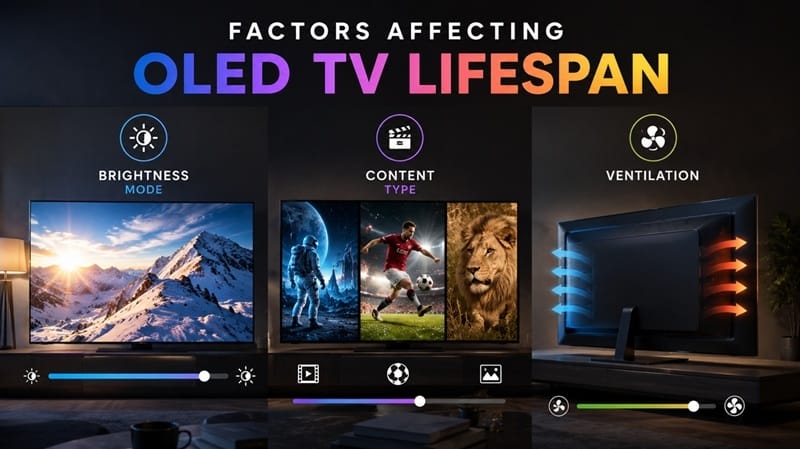
OLED pixels generate their own light, and brightness is the single biggest driver of organic material wear. Running an OLED at maximum brightness continuously accelerates pixel degradation. In standard modes — Cinema, ISF Dark, or Filmmaker — most OLEDs run at 100–180 nits in SDR, which is well within their comfortable operating range.
The TVs most at risk are those left in the factory “Vivid” or “Dynamic” preset, which can push brightness to 400–600 nits on an SDR source. That’s both unnecessary for picture quality and harder on the panel over time. Switching to a calibrated picture mode is the single most effective thing you can do to extend how long your OLED TV lasts — and it’ll look better immediately.
Content type: static vs dynamic and what it means for pixel wear
Static image elements — persistent news tickers, scoreboard overlays, stock tickers, HUD elements in video games — cause uneven wear because the same pixels are constantly lit while surrounding ones cycle through varied content. This is the root cause of both burn-in and accelerated localised brightness loss.
For a typical mixed-use setup (streaming, movies, casual gaming), this isn’t a meaningful concern. The risk concentrates in two specific scenarios: leaving a sports channel on all day where a static network logo sits in the corner, or marathon gaming sessions in titles with persistent on-screen HUDs. For practical tips on minimising this, see our guide on how to prevent OLED burn-in, which covers all the settings-level adjustments that also double as lifespan protection.
Heat and ventilation around the set
OLED panels generate relatively low heat compared to older plasma technology, but electronics supporting the panel — the processing board, power supply, backlighting circuitry in hybrid OLED models — are heat-sensitive. Mounting an OLED in a tight enclosed media cabinet with poor airflow can shorten the supporting electronics’ lifespan even if the panel itself is fine.
A gap of at least 4 inches above the TV and unrestricted sides is sufficient. This is a more common failure point than panel degradation for cabinet-mounted installs.
Cleaning habits and the anti-glare coating
None of this affects the panel’s electrical lifespan, but the anti-glare coating on top of the screen is a separate, more fragile layer that harsh cleaning products can permanently damage. That’s a cosmetic issue rather than a degradation issue, but it’s worth getting right the first time — see our guide on how to clean an OLED screen safely for what to use and what to avoid.
If you’re researching OLED durability as part of a buying decision, our breakdown of OLED pros and cons covers lifespan alongside the other key considerations — brightness, burn-in risk, and value — in one place.
Does Panel Technology Affect Lifespan? WOLED vs QD-OLED
LG’s WOLED and Samsung’s QD-OLED are the two dominant OLED panel architectures in 2026, and they degrade differently at the material level. The difference is real, but in practice it doesn’t change the real-world answer for home users.
How WOLED degrades
WOLED panels (used in LG, Sony, and Panasonic OLED TVs) use a white OLED sub-pixel combined with colour filters. The organic material in a white OLED degrades uniformly across the pixel because all sub-pixels share the same white emitter structure. This makes WOLED degradation predictable and even — overall brightness slowly declines across the screen rather than unevenly by colour channel.
How QD-OLED degrades — and why it’s different
Samsung’s QD-OLED uses a blue self-emissive OLED layer with a quantum dot colour conversion layer on top. The blue OLED emitter — which drives the entire pixel — is subject to somewhat faster degradation than red or green OLED materials at comparable brightness levels. Samsung addresses this through factory calibration and ABL (Automatic Brightness Limiter) algorithms that manage sustained peak output.
Independent long-term testing from RTINGS.com’s ongoing burn-in experiments suggests that both WOLED and QD-OLED panels perform comparably in normal home-use scenarios. QD-OLED’s blue emitter concern is more relevant in commercial or always-on scenarios than for the typical viewer. Current data doesn’t show a material lifespan difference between the two technologies for home use.
The bottom line: panel technology choice should be driven by picture quality preferences (QD-OLED wins on colour volume and bright-room performance; WOLED wins on viewing angles and uniformity) rather than lifespan concerns.
How Long Does a 2026 OLED TV Stay Relevant?
📅 Longevity Outlook: Modern OLED TV (2026)
2026
Full feature set — peak picture quality
2028
Panel still excellent — newer models available
2030
Picture quality unchanged — smart platform aging
2032
App support dropping — upgrade becomes worthwhile
2034+
Panel works fine — ecosystem mostly unsupported
Timeline reflects editorial estimate based on LG, Samsung, and Sony historical smart platform support cycles. Panel degradation is not the limiting factor for home users.
What This Means for You in Practice
Who Should Pay Attention to OLED Lifespan
For the overwhelming majority of home users, panel lifespan is simply not a meaningful concern. If you watch 6–8 hours a day across a normal mix of streaming, sports, and gaming, the panel will outlive your desire for it by at least two decades.
The scenarios where lifespan becomes a legitimate question are specific:
- Commercial or semi-commercial use — a TV running 14–16 hours a day in a bar, hotel room, or waiting room is genuinely working harder than a home panel. For those environments, look at commercial-grade displays rather than consumer OLEDs.
- Dedicated sports bar setups — static channel logos and continuous use can cause localised brightness loss. QLED or Mini LED is a better fit here.
- PC monitor use — running a static desktop with a persistent taskbar for 10+ hours daily accelerates uneven wear in that region. OLED monitors designed for this use case have additional protections; consumer TVs used as PC monitors are at higher risk. If gaming is the primary use, our best OLED TVs for gaming guide highlights the models with the strongest built-in pixel-refresh protections.
If you’re evaluating OLED for a home cinema or living room setup under $1,000, lifespan should be completely off your concern list — see our picks for best OLED TVs under $1,000 for what we’d actually buy in 2026.
Who Doesn’t Need to Worry
If you’re a typical household viewer — streaming evenings and weekends, occasional sports, some gaming — an OLED TV bought today will almost certainly be replaced by choice rather than failure. The panel degradation rate at normal home brightness levels is so gradual that it’s imperceptible year-over-year. By the time any brightness change is noticeable, the TV’s software platform will have been the limiting factor for years.
Asking how long an OLED TV lasts before buying is exactly the right question. The answer, for almost everyone reading this, is: longer than you’ll want to keep it. If lifespan was the last item on your checklist, our broader breakdown of whether OLED is worth it in 2026 ties this together with the rest of the trade-offs.
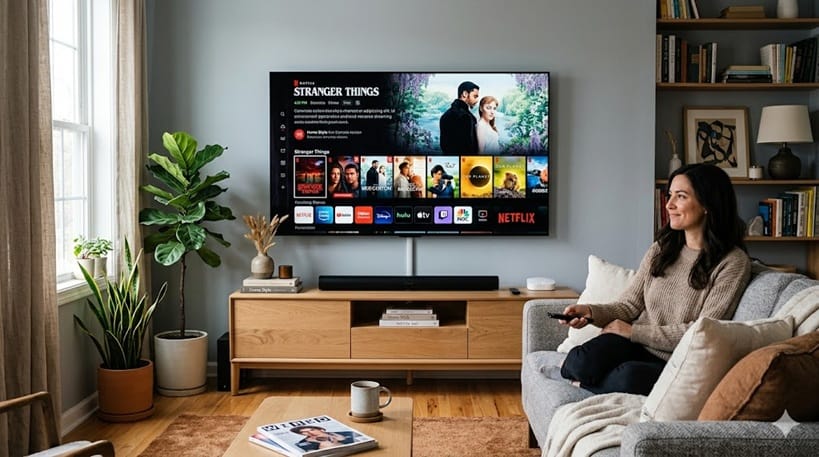
📍 Ready to pick your OLED TV? See our top-tested picks for every budget and room type — updated for 2026. See Best OLED TVs 2026 →.
FAQs: How Long Do OLED TVs Last
How long do OLED TVs last on average?
A modern OLED TV lasts 7 to 10 years before most users replace it — driven by software platform aging, not panel failure. The panel itself is rated to 100,000 hours to half-brightness, which equals roughly 45 years at 6 hours of daily use. RTINGS.com’s long-term burn-in and lifespan testing confirms that panels from 2019–2022 show minimal degradation under home-use conditions. You can follow their ongoing research at RTINGS.com’s OLED burn-in test page.
Do OLED TVs degrade over time?
Yes, but at a rate that’s imperceptible under normal home use. All OLED panels gradually lose peak brightness as the organic material ages — this is the nature of the technology. In practice, the brightness loss over the first 5–7 years of typical use is so small it’s undetectable without measurement equipment. What you’re more likely to notice first is the TV’s smart platform slowing down or losing app support, not any change in picture quality.
Does leaving an OLED TV on all day shorten its life?
Yes, but the effect is smaller than most people assume. At 12 hours of daily use, the panel still reaches its half-brightness point after an estimated 22 years. The bigger risk of all-day viewing isn’t panel degradation — it’s static elements (channel logos, news tickers) causing localised uneven wear far faster than overall brightness dimming. Using the pixel-shift and screen-dimmer features built into your TV mitigates this substantially.
Is a 2025 or 2026 OLED TV more durable than older models?
Yes, meaningfully so. Fourth and fifth generation WOLED and QD-OLED panels are brighter at lower drive voltages, which means less electrical stress on the organic material at equivalent brightness settings. LG’s 2024–2026 C and G series panels have demonstrably improved peak efficiency compared to the 2019–2021 generation. The gap in picture quality is large; the lifespan improvement is real but less dramatic for typical home users.
When should I actually replace my OLED TV?
When the smart platform can no longer run the streaming apps you use, or when a new TV generation offers a feature that materially changes your viewing experience (e.g. a meaningful jump in peak brightness or a new connectivity standard). Don’t replace because you’re worried about the panel — replace when the product genuinely no longer meets your needs. Most 2026 OLED TVs will still be excellent picture-quality performers in 2033.

iYaiii
Editor, GearPulse360
iYaiii is the editor and founder of GearPulse360, specialising in TV reviews and consumer electronics. He tests and researches every recommendation before publishing.
✅ Based on manufacturer spec data, RTINGS.com long-term test results, and editorial analysis — last verified June 2026