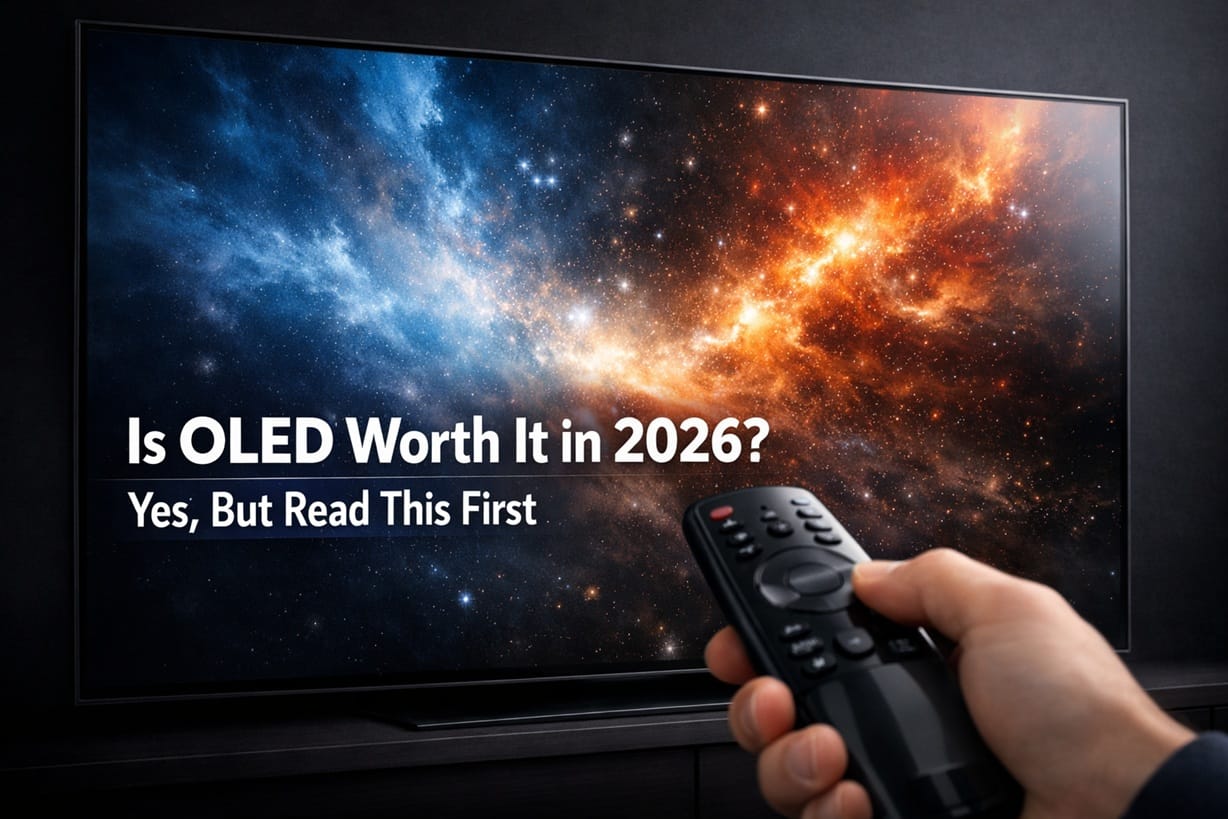
Is OLED Worth It in 2026? Here’s the Honest Answer
Last updated: June 2026
🕒 8 min read
Disclosure: GearPulse360 participates in the Amazon Associates Program. This particular article contains no affiliate links; other content on our site may.
A decent 65-inch Mini LED TV costs meaningfully less than a comparable OLED, and the price climbs quickly once you move up to OLED. That’s a real gap for what looks, on the spec sheet, like the same category of TV. So the question is fair: what exactly are you paying for, and is it actually worth it?
For most buyers in 2026, OLED is worth it — with one important condition. If you watch TV in a room with controlled lighting, or if you use your TV for movies and gaming at night, OLED’s advantages are immediately visible and worth paying for. If you’re mostly watching daytime TV in a bright living room, the math changes considerably.
We’ll break it all down below. See our full OLED vs Mini LED compared breakdown if you want the full head-to-head first.
Table of Contents
The Short Answer: Is OLED Worth It?
OLED is worth it if you watch in a dim or controlled-light environment, care about picture quality, or use your TV for gaming. It is not worth it if your room gets a lot of natural light during your main viewing hours, or if your budget is tight. That’s the honest summary — the rest of this article explains the reasoning behind it.
What You’re Actually Paying Extra For
Strip away the marketing and there are three things your extra dollars are actually buying. All three are real differences — not spec-sheet improvements that vanish in real-world use.
Perfect Black Levels
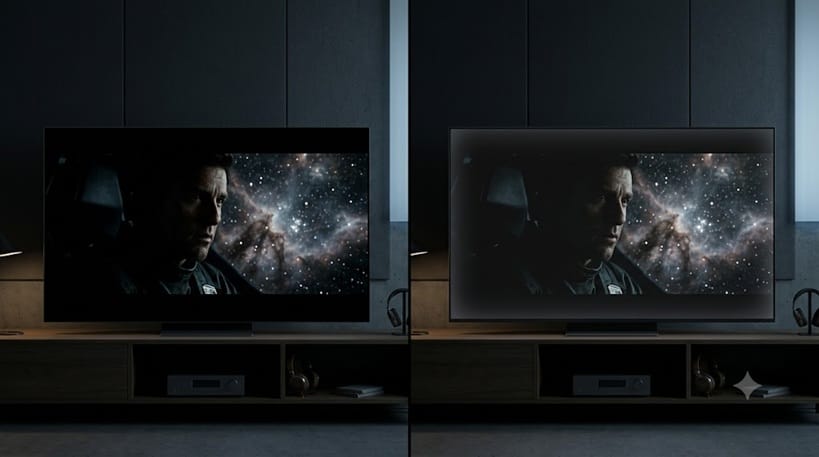
OLED panels turn individual pixels completely off when displaying black. There’s no backlight bleeding into dark areas, no grey haze where shadow should be. In measurement terms, OLED blacks register at effectively 0.0000 nits — the best Mini LED panels measured by RTINGS’ Mini LED vs. OLED testing typically land in the 0.001–0.005 nit range. That sounds close on paper, but the human eye sees it clearly in a dark room.
Watch any film with a dark sky, a night scene, or letterbox bars — on an OLED, those areas are genuinely black. On a Mini LED, they’re dark grey. You notice it in the first five minutes of anything shot at night, and you keep noticing it. This is the single biggest practical difference between the two technologies and the main reason serious movie watchers pay the premium.
Response Time and Gaming Performance
OLED pixels respond in fractions of a millisecond — around 0.1ms versus 1–4ms for Mini LED panels. In gaming terms, that translates to sharper fast motion, less blur on quick camera pans, and cleaner visuals when things are moving at speed. The LG C5 and Samsung S90F both deliver near-zero input lag with VRR enabled — performance that competing Mini LED panels have not consistently matched.
For competitive gaming, the difference between OLED and a good Mini LED is small enough that many players won’t feel it. But for immersive single-player gaming where visual quality matters — RPGs, open world games, cinematic titles — OLED’s faster pixel response produces a noticeably cleaner image.
Per-Pixel Control and Image Accuracy
Every pixel on an OLED screen controls its own light output independently. Mini LED panels use zones — groups of pixels sharing the same backlight segment. Even the best Mini LED panels have hundreds or thousands of zones, and when content demands very different brightness levels in adjacent areas (a bright window next to a dark wall, a white subtitle over a black background), those zones can bleed into each other. The technical term is “halation.” It’s subtle on a high-end Mini LED, but it’s there.
OLED has no zones to manage. The image that reaches your eye is cleaner, with tighter contrast transitions and more accurate colour in dark areas. You don’t need to go looking for this — it shows up naturally in normal content.
Scenarios Where OLED Is Absolutely Worth the Money
Dark room or dedicated home theater
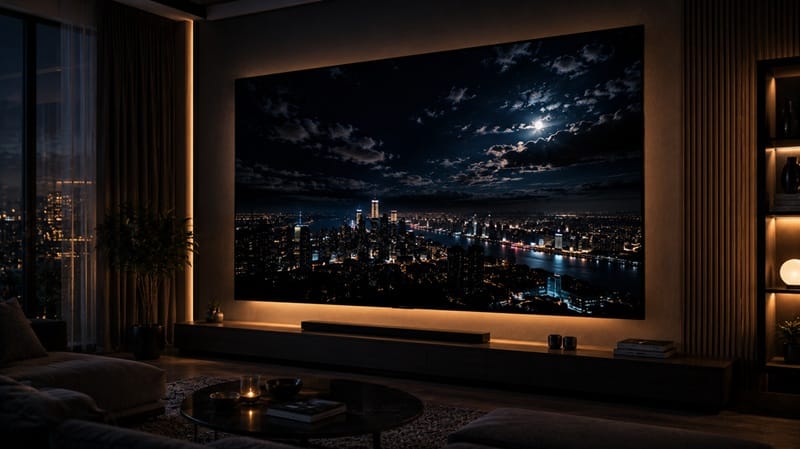
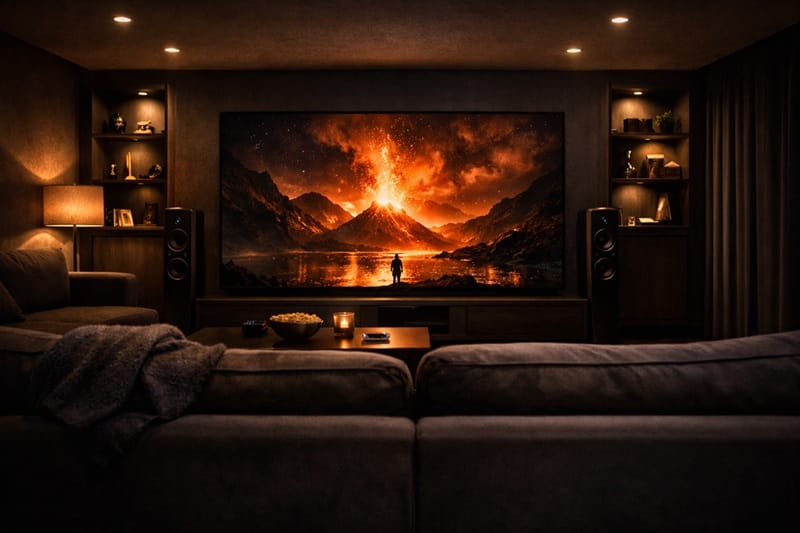
This is OLED’s strongest argument. If you’ve set up a viewing room with blackout curtains, or if you watch most content in the evening with the lights down, OLED’s contrast advantage is at its maximum. A mid-range LG C5 in a dark room will outperform a pricier flagship Mini LED TV in a bright room, every time. The technology is designed for exactly this environment.
Console gamers on PS5 or Xbox Series X
OLED panels support 4K/120Hz, VRR, ALLM, and Dolby Vision Gaming on both major consoles. The combination of near-instant pixel response and true black levels produces a visual experience that even high-end Mini LED sets can’t fully replicate. If your TV doubles as a gaming monitor, the premium pays off.
Movie enthusiasts and cinephiles
HDR performance, colour volume, and contrast accuracy all favour OLED when content is mastered for dark viewing environments — which most major theatrical releases are. If you care about watching films the way they were graded, OLED is the closest you’ll get at consumer TV prices.
Anyone upgrading from an LCD older than five years
If your current TV was bought before 2020, the jump to OLED will be immediately obvious. Not just in blacks — in sharpness, colour pop, and the general sense that the screen looks like a window rather than a monitor. The comparison to a budget Mini LED won’t feel as important because the baseline has moved so dramatically.
Where OLED Doesn’t Justify the Extra Cost
Bright living rooms
OLED screens typically peak at 800–1,500 nits of sustained brightness. Premium Mini LED panels now reach 2,000–3,000 nits in RTINGS’ brightness testing — and maintain that output in the areas that need it. If your room gets direct sunlight in the afternoon, or if you leave the lights fully on during viewing, Mini LED wins on practical visibility. OLED’s black-level advantage is significantly reduced when ambient light is washing over the screen.
Tight budgets
There are no OLED TVs worth recommending at the low end. Budget OLEDs exist, but the panel quality, processing, and build compromise what makes OLED worthwhile in the first place. A well-chosen budget Mini LED or QLED will outperform a cheaply executed OLED at the same price. Save up, or pick a strong Mini LED now — or if you want the full picture on standard LED as well, our OLED vs LED comparison lays out that trade-off too.
Casual daytime TV watching
If your main content is news, sports on a Sunday afternoon, or background TV while doing other things, OLED’s picture quality advantages are largely invisible. The controlled-lighting scenarios where OLED excels simply don’t apply. A well-chosen Mini LED performs well in these conditions for meaningfully less money.
Heavy static content viewers
Burn-in is still a real risk. If you leave a news ticker running for hours, or if the same channel logo is on screen for extended daily periods, OLED burn-in remains a legitimate concern. It’s much less common than it was five years ago, and pixel refresh technology has improved — but the risk hasn’t disappeared. We cover this in detail in our OLED burn-in in 2026 explainer. Mini LED carries no equivalent risk at all.
OLED vs Mini LED: What You’ll Actually Notice
Put an LG C5 and a similarly-priced Mini LED side by side in a dim room, and the difference is clear within seconds. Load any content with dark backgrounds — the OLED shows inky blacks while the Mini LED shows uniformly dark grey. The OLED image has more visual depth, more apparent sharpness in shadow areas, and better colour saturation in scenes that mix dark and bright elements.
Switch the same test to a bright room at midday. The gap closes fast. The Mini LED now holds its brightness more effectively, HDR highlights pop more visibly, and the OLED’s advantage in black accuracy becomes less relevant because the room’s ambient light is affecting both displays equally. For some viewers in this environment, the Mini LED actually looks better.
The short version: OLED wins in controlled or dim conditions. Mini LED is more versatile across lighting environments. Neither is objectively better without knowing how you’ll actually use it.
Who Should Buy OLED
Evening and night viewers — anyone whose primary viewing happens in reduced light conditions will see a clear, immediate payoff. Console gamers who want the complete picture quality package also benefit, since OLED’s combination of response time, HDR, and contrast produces an experience that’s hard to match. So do home theater builders investing in a proper setup — decent speakers, calibrated room, streaming in 4K HDR — since OLED is the display technology most aligned with that investment.
Anyone planning to keep a TV for eight to ten years benefits too: OLED panels generally hold up well over years of normal usage, and the premium looks more reasonable when amortised over a decade of viewing.
Who Should Consider Mini LED Instead
If your TV lives in a living room with large windows and you rarely use blackout curtains, Mini LED is the smarter choice — you get strong peak brightness, excellent HDR, and wide colour without paying the OLED premium for an advantage you won’t see in your lighting conditions. Budget-focused buyers should stay in the Mini LED category until they can afford a mid-range OLED, since a well-chosen budget Mini LED will run circles around an OLED that’s been cut at every corner to hit the same price point.
News or daytime TV viewers should also lean Mini LED — static news graphics, channel logos, and score bugs all carry burn-in risk on OLED panels, and Mini LED removes that concern entirely while performing well in the bright-room conditions that usually accompany daytime TV watching.
The same goes for families with young children who tend to leave the TV on at high brightness for extended hours — for high-wear usage, Mini LED is simply the safer long-term choice.
Our Verdict: Is OLED Worth It in 2026?
For most dedicated viewers — people who watch films and TV shows in the evening, anyone using a console as their primary gaming platform, and anyone building a home theater — OLED is worth it in 2026. The picture quality difference over Mini LED is real, visible, and consistent. It’s not a marginal spec improvement. You’ll see it in the first hour.
For bright-room viewers, daytime TV watchers, and anyone on a tighter budget, Mini LED is the more rational choice. The technology has meaningfully improved and the value proposition at mid-range prices is strong. OLED’s advantages only manifest in conditions that don’t match those viewing environments. Ask yourself whether you watch TV mostly in the evening, with the lights down or dimmed — if the answer is yes, the OLED premium is worth spending. If the answer is no, save it. For a full side-by-side of every strength and weakness covered here, our OLED pros and cons breakdown lays it all out in one place.
📍Not sure which brand is right for you? See our full roundup of the Best OLED TVs of 2026. from LG, Samsung, and Sony at every price point.
OLED TVs — Common Questions
Is OLED worth it over QLED?
Yes — if you watch in a dim room or care about black levels and contrast, OLED is worth it over QLED. QLED uses LCD backlighting, which means it can’t match OLED’s per-pixel control in dark scenes. In bright rooms, the gap narrows, and premium QLED panels compete well on brightness and colour volume.
What’s the real-world difference between OLED and Mini LED?
In a dim room, OLED blacks are clearly deeper and dark scenes have more visual depth — this is easy to notice in any film or game with dark environments. In a bright room, Mini LED’s higher peak brightness partially offsets that advantage. Independent panel testing shows OLED maintains a consistent contrast advantage across test conditions, but Mini LED’s real-world visibility advantage in well-lit rooms is genuine.
Should I worry about OLED burn-in in 2026?
Burn-in is a real risk if you watch a lot of static content — news channels, sports with persistent score overlays, or menus left on-screen for extended periods. For mixed-content viewers who watch movies, streaming, and gaming across the day, burn-in is rarely a practical issue. Panel manufacturers have improved pixel refresh technology significantly since 2020.
Which brand makes the best OLED TV for the money in 2026?
LG offers the widest range of OLED TVs at the most competitive prices — the C5 series remains the benchmark for mid-range value. Samsung’s QD-OLED panels in the S90F deliver stronger peak brightness, which suits buyers with brighter rooms. Sony targets premium color accuracy and processing — our piece on are Sony OLED TVs worth it digs into whether that premium is justified.
Will OLED TV prices drop in 2027?
OLED panels have been getting cheaper every year, and that trend is likely to continue as manufacturing yields improve and competition between panel makers increases. Retailers sometimes offer better pricing around major sales events later in the year, though timing and discount depth vary and we can’t promise anything specific. If current pricing already fits your budget, there’s no guarantee a meaningfully better deal arrives before year end.

iYaiii
Editor, GearPulse360
iYaiii is the editor and founder of GearPulse360, specializing in TV reviews and consumer electronics. He researches every recommendation before publishing.
✅ Based on spec analysis and LG’s, Samsung’s, and Sony’s official data plus RTINGS — last verified July 2026