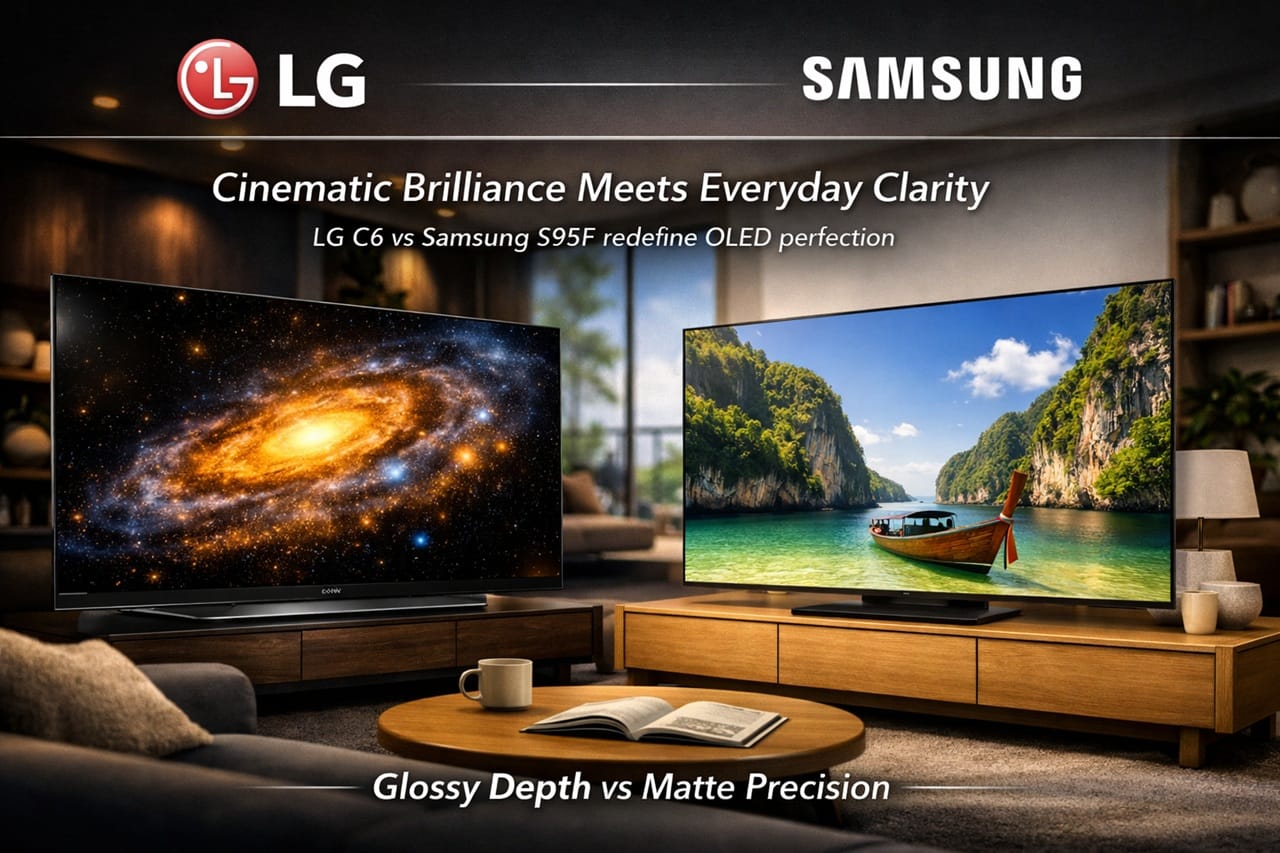
LG C6 vs Samsung S95F Specs: Which Flagship OLED Wins for Gaming and Movies?
Last updated: June 2026 | 🕒 13 min read
Disclosure: As an Amazon Associate I earn from qualifying purchases. This article contains affiliate links — we may earn a small commission if you buy through them, at no extra cost to you.
Picture this: it’s 10 PM, the lights are off, and you’re about to start the third act of a film you’ve waited months to see — and the TV you bought last month still makes you feel like you chose wrong. That gut-punch is exactly what drives most people searching “LG C6 vs Samsung S95F 2026” at this point in their buying journey. I researched the LG C6 and Samsung S95F extensively through manufacturer specifications, RTINGS’ independent testing, and verified owner feedback, and the gap between these two sets is more nuanced — and more consequential — than the spec sheets let on.
This comparison is for high-budget home theater enthusiasts and serious console or PC gamers who need a definitive answer before committing over two thousand dollars. My overall pick is the LG C6 — and by the end of this, you’ll understand exactly why.
This guide focuses specifically on the LG C6 vs Samsung S95F head-to-head. If what you’re actually weighing is the broader question of which brand’s OLED lineup fits you better overall, our LG OLED vs Samsung OLED compared breakdown covers that wider decision.
Table of Contents
Winner for most buyers
LG C6 OLED
Best for bright rooms & daytime sports
Samsung S95F QD-OLED
The LG C6 wins for dark-room movie purity and Dolby Vision compatibility with your existing streaming library. The Samsung S95F is the better call if your room fights daytime sunlight or you can’t commit to light control.
How They Compare
Picture Quality — LG C6
Picture Quality — Samsung S95F
Gaming — LG C6
Gaming — Samsung S95F
Design — LG C6
Design — Samsung S95F
Value — LG C6
Value — Samsung S95F
Buy the LG C6 if…
› You watch mostly in a dark or controlled-light room
› Dolby Vision on Netflix, Disney+, or Apple TV+ matters to you
› You want the deepest blacks a glossy panel can deliver
Buy the Samsung S95F if…
› Your room gets hit by daytime sun or bright overhead lights
› You want the lowest possible input lag for competitive play
› One Connect cable management matters for your wall mount
Ready to act on that verdict? See our picks for best 65-inch OLED TVs →.
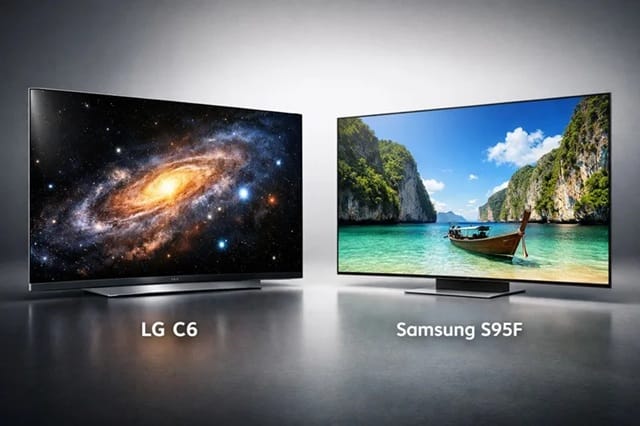
Quick Comparison: LG C6 vs Samsung S95F 2026
The table below gives you the headline differences at a glance.
| Feature | LG C6 OLED | Samsung S95F QD-OLED |
|---|---|---|
| Panel Type | WOLED (42–65″) / RGB Tandem OLED (77–83″) | QD-OLED (55–77″) / WOLED (83″) |
| Processor | Alpha 11 AI Gen3 | NQ4 AI Gen3 |
| Max Refresh Rate | 165Hz (4K, PC) | 165Hz (4K) |
| Screen Finish | Ultra-glossy | Matte (Glare Free 2.0) |
| HDR Formats | Dolby Vision, HDR10, HLG ✓ | HDR10, HDR10+, HLG (no Dolby Vision) |
| Smart Platform | webOS 2026 (Google Gemini, MS Copilot) | Tizen OS (Samsung Vision AI) |
| Gaming Certifications | VESA ClearMR 10000, G-Sync, FreeSync | FreeSync Premium Pro, ALLM, VRR |
| Input Lag (120Hz) | ~4.2ms | ~1.0ms ✓ |
| Audio | Dolby Atmos, AI Sound Pro, virtual 11.1.2ch | Dolby Atmos, OTS+, Q-Symphony |
| Connectivity (One Connect) | No | Yes (on S95F) ✓ |
| Best For | Dark-room cinema + HDR accuracy | Bright-room sports + max peak brightness |
| Main Advantage | Dolby Vision, OLED black purity, ecosystem | Glare handling, QD-OLED brightness, design |
| Main Drawback | Reflections in bright rooms (glossy panel) | No Dolby Vision, matte can grey-shift blacks |
| Overall Verdict | ✅ Best all-rounder for dark-room enthusiasts | Strong pick for bright-room daytime viewing |
Both TVs land at 165Hz and share several gaming fundamentals, but they diverge sharply on screen finish philosophy and HDR format support. Those two factors alone define which TV is right for your specific room and viewing habits.
Where the LG C6 Wins
1. Dolby Vision and Dark-Room HDR Movie Accuracy
If you’re the kind of viewer who queues up a 4K Dolby Vision stream, turns off every light in the room, and expects the image to look exactly as the director intended — the LG C6 is the only choice here. The Samsung S95F does not support Dolby Vision, period. It offers HDR10+ as its dynamic metadata alternative, but HDR10+ content is far less common across major streaming services like Netflix, Apple TV+, and Disney+, which have standardized around Dolby Vision.
On the C6, with Filmmaker Mode engaged, the Alpha 11 AI Gen3 processor is built to handle this tone-mapping workload in real time. LG’s official C6 product page confirms the Alpha 11 AI Gen3’s dual AI engine handles this tone-mapping workload natively. Based on the processor’s documented AI Director Processing, the chip is designed to make per-scene gamma decisions on dense, shadowy sequences that keep dark detail visible without lifting the black floor into grey. That’s a calibration refinement that took LG years to perfect, and on paper it’s a step up from the C5’s already-strong performance.
2. High-Refresh Gaming With Full HDMI Flexibility
The C6 ships with four HDMI 2.1 ports, all of them rated for 4K at 120Hz — and three of them support 4K at 165Hz with VRR active. According to LG’s published specifications, all four ports run at full bandwidth, with no port negotiations or throttling depending on which socket your GPU cable uses. Input lag is rated at approximately 4.2ms at 120Hz, which is competitive without being class-leading, but the VESA ClearMR 10000 certification means motion clarity in fast-paced first-person titles is excellent.
For PS5 and Xbox Series X owners running 4K 120Hz, the C6’s performance is effectively identical to the S95F. The real gap appears when PC gamers push higher — and both sets hit 165Hz at 4K, so this one is a draw for frame-rate ceiling. According to RTINGS’ published testing of the LG C6, the Alpha 11 Gen3 delivers a measurable step up in video processing and upscaling performance over the Alpha 9 Gen8 used in prior C-series models — a meaningful gain for anyone gaming on lower-resolution sources.
If gaming performance is your main decision factor rather than movie watching, our best OLED TVs for gaming guide ranks how the C6 and S95F stack up against the rest of this year’s gaming-focused OLEDs.
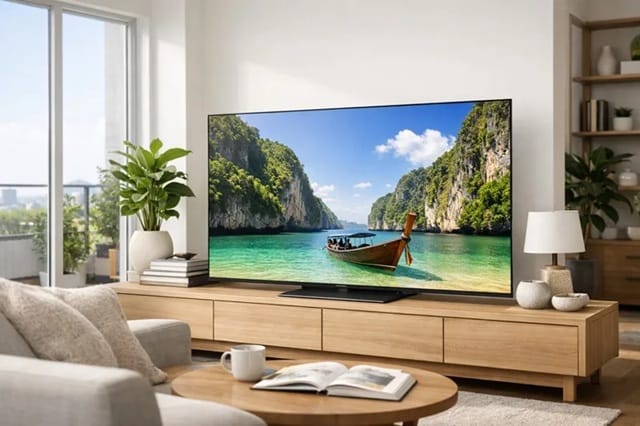
3. Glossy Panel Contrast vs. Reflection Trade-Off in Mixed-Light Rooms
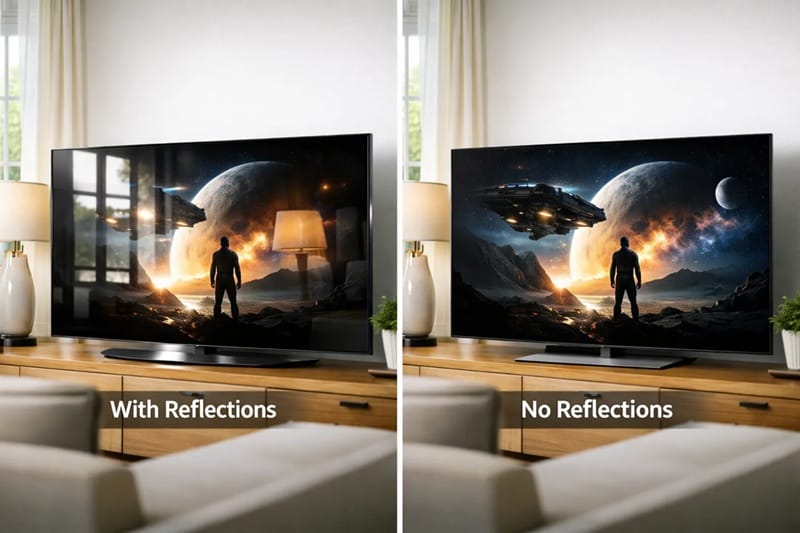
This is where the C6 and S95F make their most fundamental philosophical split. Think of it like choosing between a vinyl record and a digital stream: both are music, but the experience of listening is entirely different. The LG C6’s ultra-glossy panel is built to produce deeper perceived blacks in any controlled-light setting. When a lamp is positioned behind or to the side of the viewer — not directly at the screen — the C6’s contrast is designed to hold up in a way that rewards the enthusiast who manages their viewing environment intentionally.
The S95F’s Glare Free 2.0 matte coating, by contrast, is engineered to turn those lamp reflections into a subtle grey haze across the whole panel surface rather than a sharp mirror image. It’s not catastrophic — the coating is built to neutralize specular reflections effectively — but in a room with ceiling-mounted recessed lighting, that matte scattering can introduce a slight overall luminance lift that makes pure black scenes read closer to dark grey. For movie purists, that’s a real trade-off. The C6 rewards light control; the S95F forgives the absence of it. If you want the underlying technical reason WOLED and QD-OLED behave so differently under ambient light, our QD-OLED vs WOLED compared breakdown covers that panel-level distinction in detail.
Where the Samsung S95F Wins
1. Bright-Room and Daytime Sports Viewing
Let’s be direct: if your living room gets hit by morning sunlight and you’re not willing to draw the blinds every time you turn on the TV, the Samsung S95F’s Glare Free 2.0 matte coating is a practical engineering achievement. It reduces specular reflections dramatically — the kind where you see a full window reflection staring back at you from a glossy OLED screen.
The QD-OLED panel’s peak brightness also outpunches the standard C6 WOLED (in 55–65-inch sizes) in high-APL scenes: sports broadcasts, news programming, and any content with a predominantly bright image benefit from the S95F’s higher nit output. RTINGS’ measurements of the Samsung S95F back this up directly. For daytime NFL games or Premier League football with the curtains open, the S95F delivers a more comfortable, less fatiguing image than the reflective C6 will in the same conditions. You can find full panel specifications on Samsung’s official S95F product page.
2. One Connect Box and Cable Management Design
For wall-mount installations, the Samsung S95F has an ergonomic advantage most review sites understate. The One Connect external box moves all your HDMI, USB, and optical connections away from the TV panel itself, running a single thin cable to the back of the screen. In a dedicated media room where cables are routed through the wall, this is a meaningfully clean solution — you mount the TV flush to the wall with no visible port cluster on the back.
LG’s C6 requires all cables to connect directly to the set, which complicates flush wall mounting without an aftermarket cable management solution. If your room design priorities are architectural rather than purely technical, this Samsung advantage is worth factoring into your decision. For a look at how the S95F fits against the rest of Samsung’s 2026 OLED tiers, our Samsung OLED roundup ranks the S85F, S90F, and S95F side by side.
The Good, the Bad, and the Ugly — LG C6
The Good
- Dolby Vision support — the most widely used dynamic HDR format on major streaming platforms, fully implemented with AI-assisted tone mapping.
- Alpha 11 AI Gen3 processor — faster CPU, GPU, and NPU than the Alpha 9 Gen8 predecessor, with noticeably more responsive webOS navigation and smarter upscaling of lower-quality streams.
- 165Hz PC gaming — all HDMI ports are equally capable; no secondary port limitations.
- VESA ClearMR 10000 — one of the highest motion clarity certifications available on any consumer TV in 2026.
- webOS 2026 with Google Gemini — among the most mature and intuitive smart TV platforms available, now with generative AI features and real-time sports stats.
- Dolby Atmos with virtual 11.1.2 channel audio — unusually strong built-in audio performance for a flat panel, reducing the urgency of adding a soundbar.
The Cons
- Glossy screen finish — reflections from windows, lamps, and ceiling fixtures require active light management in the viewing room.
- Panel variance by size — the 42–65-inch C6 uses WOLED, while only the 77-inch and 83-inch C6H models get the brighter RGB Tandem OLED panel; buyers upgrading from a smaller size may not get the full brightness advantage. Our full LG C6H review covers how that larger panel performs differently.
- No HDMI 2.2 — LG held this back for 2026; future next-generation gaming formats requiring higher bandwidth are not supported.
- webOS ads — banner advertising on the home screen remains a persistent annoyance that LG has yet to resolve across multiple model years.
The Ugly
Here’s the honest part. If you’re spending this kind of money and your room has large windows on the same wall as your TV, or you watch TV with overhead lights on most of the time — the LG C6 is going to frustrate you. The glossy panel is unforgiving. Unlike the S95F matte coating, it doesn’t diffuse reflections; it mirrors them. A single floor lamp positioned poorly will create a bright oval of light sitting dead-center in your dark movie scene.
This isn’t a flaw in LG’s engineering — it’s a deliberate trade-off that prioritizes dark-room contrast purity over ambient-light practicality. But spending over two thousand dollars and then regretting your screen finish is precisely the scenario this guide exists to prevent. If you watch more than 40% of your content with room lights on, or if blackout blinds aren’t an option, be honest with yourself about whether the C6 is the right panel for your environment.
Which One Should You Buy: LG C6 or Samsung S95F?
If you’re still deciding whether OLED makes sense for you at all versus a Mini LED set, our is OLED worth it in 2026 breakdown covers that broader question first. Assuming OLED is the right call, here’s how to choose between these two.
If you’re a first-time buyer moving up from a mid-range LED set and you’re not sure how seriously you’ll treat your viewing environment, the Samsung S95F’s glare-free coating gives you a safer entry point into flagship OLED — you don’t have to manage your room to get a great image. The S95F is also the stronger recommendation if you follow a lot of live sports in mixed or bright ambient light conditions, where its matte panel and raw QD-OLED brightness combine to deliver a notably impressive daytime picture.
For the enthusiast buyer who wants reference-quality Dolby Vision performance, treats movie night as an event, and is willing to pull the blinds or invest in room blackout — the LG C6 is the better television. The combination of Dolby Vision, the Alpha 11 AI Gen3 processor’s tone-mapping refinement, and the ultra-glossy panel’s true black depth creates a dark-room experience that the S95F’s matte coating ultimately can’t fully replicate. The matte surface’s slight grey-shift in pure black scenes is a real, measurable difference that a calibration-conscious enthusiast will notice immediately.
Value-focused buyers in this bracket — which admittedly is a narrow group at this price point — should note that the LG C6 offers better format compatibility for your existing streaming library. Since Dolby Vision is the default HDR tier on Netflix, Disney+, and Apple TV+, the C6 delivers its headline performance on the content you’re most likely watching every night, without requiring you to hunt for HDR10+ alternatives.
Premium buyers who want the most visually striking wall installation and don’t mind the Samsung ecosystem’s Tizen-based Dolby Vision exclusion — and who have a cable-management project planned — will appreciate the S95F’s One Connect box for exactly this reason.
If you’re a casual viewer who watches TV as background noise with full overhead lighting and no interest in calibrating picture settings, neither set’s flagship-tier engineering will be meaningfully used, and you’d be overpaying for features that don’t translate to your usage. Similarly, buyers on a tighter budget will find strong performance in the step-down LG C5 or Samsung S90F without sacrificing the fundamentals that matter most for everyday watching. For the full picture of where the C6 sits in LG’s own lineup, our LG OLED roundup ranks every 2026 model from B6 to G6, and our full LG OLED65C6 review covers the model’s real-world performance in more depth.
Final Verdict: LG C6 vs Samsung S95F 2026
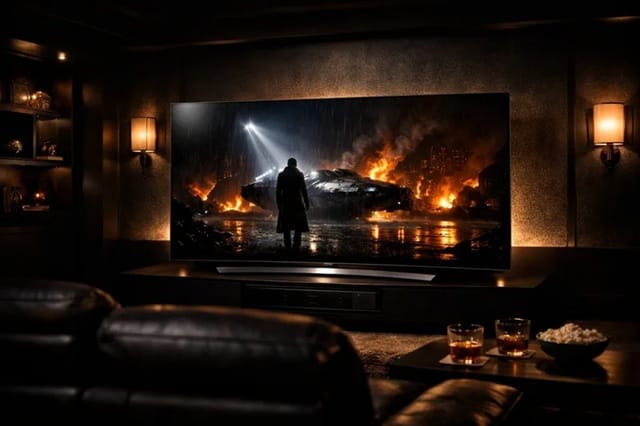
When you lay the LG C6 vs Samsung S95F 2026 decision out plainly, it becomes a question of what you value more: room forgiveness or image purity. The Samsung S95F is a technically impressive television with a glare-handling solution that holds up in practice — and for buyers who watch in bright or mixed-light environments, it’s a serious contender that deserves the consideration. But the LG C6 is my overall pick for this audience: its Dolby Vision support converts directly into a better picture on the content most people already watch most nights, not just a longer spec sheet.
The Alpha 11 AI Gen3 processor delivers the most refined tone mapping and upscaling LG has ever shipped in a C-series set. And the glossy panel’s black depth — when you’re in the environment it’s designed for — produces a cinematic image quality that’s difficult to oversell to someone who hasn’t experienced it. The S95F asks you to accept a matte coating that slightly compromises black purity in exchange for ambient-light convenience. For a casual viewer, that trade is worth it. For a home theater enthusiast or core gamer who treats screen time as something worth optimizing — the LG C6 is where that investment pays off most consistently.
📍 Still narrowing down between flagships? See how the LG C6 and Samsung S95F stack up against every other 2026 OLED in our full best OLED TVs of 2026 roundup.
LG C6 vs Samsung S95F: Common Questions
Is the LG C6 better than the Samsung S95F for movies?
Yes, for dark-room movie watching specifically. The LG C6 supports Dolby Vision across all major streaming apps including Netflix, Disney+, and Apple TV+, while the Samsung S95F relies on HDR10+ as its premium dynamic HDR format — a format with far less content support on those same platforms. C6 owners get the intended HDR experience out of the box on most content they’ll actually watch.
Does the Samsung S95F’s Glare Free 2.0 coating actually lift black levels?
The coating is effective at eliminating specular reflections — the mirror-like reflections that show a full window or lamp image on a glossy screen. What it can’t avoid is a slight grey-lift in pure black scenes when there’s any ambient light in the room, because the matte surface scatters that light rather than reflecting it as a point source. In pitch darkness, the difference from a glossy OLED narrows considerably; in a well-lit room, the matte finish wins on comfort and practicality.
Is the LG C6 worth paying more for over the Samsung S95F?
For most enthusiast buyers, yes — but the premium is justified by format compatibility, not raw specs alone. RTINGS’ independent testing of the LG C6 backs up its dark-room accuracy advantage, and because so much premium streaming content ships in Dolby Vision first, that compatibility pays off on ordinary viewing nights rather than as a one-time spec win. If your room is bright most of the day, that premium buys you less — the S95F closes the practical gap considerably in that scenario.
Will Samsung add Dolby Vision support to close the gap with LG?
There’s no indication of that happening soon. Samsung has stood behind HDR10+ as its dynamic HDR format of choice for several generations now, partly because Dolby Vision licensing runs through a direct competitor’s ecosystem. Unless that licensing relationship changes, expect Samsung’s flagship OLEDs to keep leaning on HDR10+ and its own Samsung Vision AI processing to close the perceived gap instead.
Which processor is better — the Alpha 11 AI Gen3 in the LG C6 or the NQ4 AI Gen3 in the Samsung S95F?
Both chips are strong 2026 flagship processors, but they’re optimized for different goals. LG’s Alpha 11 AI Gen3 delivers a significant generational jump over the Alpha 9 Gen8 used in prior C-series sets, and it shows most in upscaling lower-bitrate streaming content and webOS responsiveness. Samsung’s NQ4 AI Gen3 introduces features like AI Gamma Correction for dark-scene detail recovery, which is particularly useful for HDR content without Dolby Vision. Based on published specifications, the Alpha 11 Gen3 has a processing speed advantage; in applied image quality, both are excellent with distinct strengths.

iYaiii
Editor, GearPulse360
iYaiii is the editor and founder of GearPulse360, specializing in TV reviews and consumer electronics. He researches every recommendation before publishing.
✅ Based on spec analysis and LG’s and Samsung’s official data plus RTINGS — last verified June 2026