Best OLED TVs Under $2000 in 2026: Premium Performance Without the Flagship Price
Last updated: June 2026
🕒 9 min read
Disclosure: As an Amazon Associate I earn from qualifying purchases. This article contains affiliate links — we may earn a small commission if you buy through them, at no extra cost to you.
You’ve probably already looked at the flagship OLEDs and winced at the price tag. The good news: a $2,000 budget still buys a legitimately excellent OLED TV in 2026 — you just have to know which models actually sell anywhere near that number, and which ones only look like they do. For a broader look at every price tier and use case, our full OLED roundup covers the whole lineup.
Our top pick for most people is the LG C5, which leads on gaming features without straining the budget. If you want the brightest picture in this group, the Samsung S90F‘s QD-OLED panel is the one to look at. One honest caveat up front: $2,000 is close to the ceiling for OLED altogether — even the newest budget-tier releases barely clear it at 65 inches, and nothing larger fits this budget at all.
Table of Contents
Best OLED TVs Under $2000: Quick Comparison
LG C5 (65″)
WOLED · 144Hz VRR
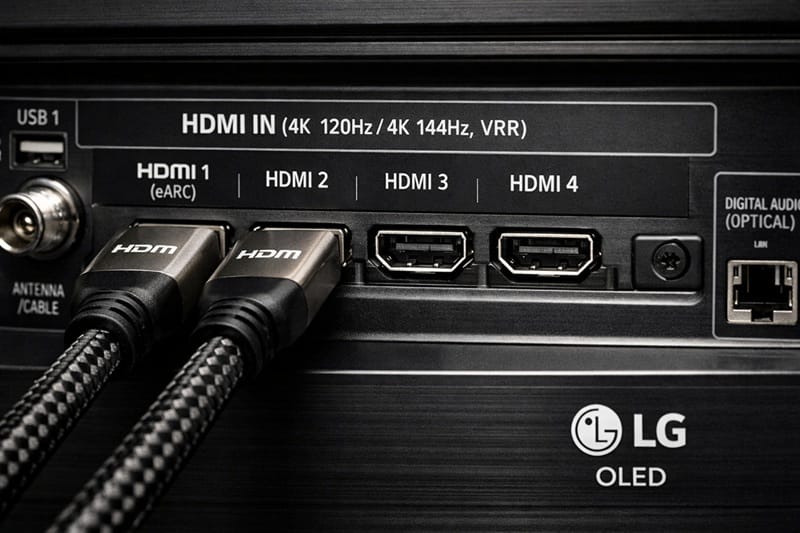
4 HDMI 2.1 ports, G-Sync and FreeSync Premium support
Samsung S90F (65″)
QD-OLED · 144Hz
Brighter, more saturated color than WOLED at this tier
LG B6 (65″)
WOLED · 120Hz
LG’s 2026 entry OLED — the only current-year pick that still fits
Sony BRAVIA 8 (65″)
WOLED · 120Hz
Sony’s color processing and studio-calibrated picture modes
↻ Prices change frequently — click through for current pricing.
✓ Categories above reflect our independent editorial assessment, not Amazon customer reviews.
Best Gaming Pick: LG C5
According to LG’s official spec sheet, the C5 supports up to 144Hz with VRR across all four of its HDMI 2.1 ports, plus G-Sync Compatible and AMD FreeSync Premium certification. That combination is rare at this price — most OLEDs in the $1,000–1,500 tier cap out at 120Hz.
RTINGS’ independent review of the LG C5 backs this up, noting low input lag in Game Mode and near-instantaneous pixel response. For console gaming on a PS5 or Xbox Series X, you’ll get 4K at up to 120Hz; PC gamers with a 144Hz-capable graphics card get the full benefit. The WOLED panel also handles dark-room contrast the way OLED is known for, so it’s not a one-trick gaming TV.
Where it gives something up: based on manufacturer specifications, the C5 doesn’t match a QD-OLED panel’s peak color saturation. If that matters more to you than refresh rate, the next pick is the one to look at.
Best Picture Quality: Samsung S90F
QD-OLED panels — the kind Samsung and Sony’s pricier sets use — have historically lived above the $2,000 line, but the S90F breaks that pattern: it brings that panel tech down to a price that used to be WOLED-only territory. Based on Samsung’s official spec sheet, it supports 144Hz refresh, FreeSync Premium Pro, and G-Sync compatibility across all four HDMI 2.1 ports.
RTINGS’ independent testing of the S90F places it just below Samsung’s flagship S95F for brightness and color volume — a small step down for a meaningful price difference. One tradeoff worth knowing: it skips Dolby Vision, relying on HDR10+ instead. If Dolby Vision content matters to you specifically, the LG and Sony picks in this guide both include it.
Best New 2026 Model: LG B6
Every other pick in this guide is a 2025 or 2024 release — that’s normal at this budget, since flagship-adjacent 2026 models typically launch well above $2,000. The B6 is the exception. Per LG’s official listing, the 65-inch model launches at just under the $2,000 line, making it the newest TV that actually belongs in this guide.
RTINGS has not published a direct review of the B6 yet — predecessor-only coverage is the norm for a release this fresh, and we’d expect similar real-world behavior to last year’s LG B5 until that testing lands. Based on manufacturer specifications, the B6 caps out at 120Hz rather than the C5’s 144Hz, and it skips the Brightness Booster tech LG reserves for the C and G series. What you get instead is this year’s processor and webOS build in the least expensive 2026 OLED LG currently sells.
Best for Movies: Sony BRAVIA 8
RTINGS’ review of the BRAVIA 8 lineup (covering the 55, 65, and 77-inch sizes) highlights Sony’s Studio Calibrated picture modes, built specifically for Netflix and Prime Video content. The screen itself doubles as the speaker through Acoustic Surface Audio+, which is a rare feature at any price below flagship.
It’s the oldest release in this guide — a 2024 model — and that’s exactly why it fits the budget. Per Sony’s published specs, refresh rate tops out at 120Hz rather than 144Hz, so if competitive gaming is the priority, the LG C5 above is the stronger choice. For movie-first viewing, the BRAVIA 8 has a case the others don’t.
Picture quality at this tier has gotten close enough that the real decision often comes down to ecosystem and use case rather than which panel wins on a spec sheet — something our full OLED vs QLED comparison covers in more depth if you’re still weighing panel types at all.
What to Look for in an OLED TV Under $2000
Brightness and HDR headroom vs the $1,000–1,500 tier
The biggest real-world jump from the cheaper tiers is peak brightness in HDR. Based on manufacturer specifications and RTINGS’ published measurements, the picks in this guide run noticeably brighter in HDR highlights than the budget-tier sets one price step down. That difference shows up most in HDR content with bright highlights against dark backgrounds — explosions, sunlit exteriors, that kind of scene.
Refresh rate and gaming features at this price point
This is where the $2,000 tier earns its premium over cheaper OLEDs. Three of the four picks here support 144Hz with VRR, HDMI 2.1 across all four ports, and either G-Sync or FreeSync certification — features that are inconsistent or missing entirely below $1,500. If gaming is your main use case, our dedicated OLED vs Mini LED comparison goes deeper into why OLED’s pixel response time matters more than brightness for fast-moving games.
Processor generation and upscaling
Every pick here runs a current or near-current processor generation — LG’s Alpha 9 Gen8 or Alpha 8 Gen3, Samsung’s NQ4 AI Gen3, Sony’s XR Processor. The practical effect is better upscaling of non-4K content and smoother motion handling, which matters more than spec-sheet bragging rights once you’re actually watching cable news or an older streaming title.
Panel type: WOLED vs QD-OLED at $2,000
This is the one panel-tech decision that’s still live at this price. WOLED (LG, Sony) tends to run brighter in SDR and full-screen content; QD-OLED (Samsung) tends to win on color volume and HDR highlight pop. Neither is wrong — it depends on what you watch most.
Is a $2,000 OLED actually worth it compared to a similarly priced Mini LED or QLED set? Brightness in a sunlit room still favors Mini LED, but for anything watched with the lights down, OLED’s contrast advantage is hard to give up once you’ve seen it.
Is a $2,000 OLED Worth It vs $1,500 — or Saving for Flagship?
The honest answer: it depends on which spec you actually use. If gaming refresh rate and HDMI 2.1 count matter to you, the jump from $1,500 to $2,000 is where those features stop being inconsistent. If you mostly watch streaming content in SDR, the difference is smaller than the price gap suggests — our best OLED TVs under $1,500 guide covers what you’d be giving up to save that money.
Going the other direction, stepping down further to our under-$1,000 picks means losing 144Hz gaming and some HDR brightness headroom, but you still get genuine OLED contrast — for a lot of living rooms, that’s the tier that actually makes sense.
💡 Budget stretching a little further? LG’s C6H and Samsung’s S90H — this year’s step-up versions of two picks above — both currently launch well above this guide’s budget at 65 inches. If that’s within reach, we cover the C6H in our full LG C6H review.
How We Picked These TVs
We started from LG, Samsung, and Sony’s official 2026 OLED lineups and cross-referenced current retail pricing at Best Buy and Amazon against each manufacturer’s listed MSRP — not just the series tier a model belongs to. That step mattered more than usual this round: two current-year flagship-adjacent models we initially considered for this guide turned out to retail well outside this budget at 65 inches, and were dropped in favor of models that actually sell under $2,000 today.
For performance claims, we relied on RTINGS’ published testing where a direct review exists, and on manufacturer specifications where it doesn’t — the LG B6 is too new to have RTINGS data yet, which we’ve noted plainly rather than guessing at numbers.
We re-check this guide periodically as new models launch and current picks change price, and we’ll update it when a pick no longer reflects what’s actually available at this budget.
📍 Not sure $2,000 is your number? See how every price tier and use case stacks up in our complete 2026 OLED roundup.
OLED TV Under $2000 FAQs
What is the best OLED TV under $2000 right now?
The LG C5 is our top overall pick, mainly because of its 144Hz refresh rate and full HDMI 2.1 support — features that aren’t consistent below this price tier. The Samsung S90F is the better choice if color and HDR brightness matter more to you than gaming specs.
Is a $2,000 OLED actually worth the extra money over a $1,000 model?
It depends on use case rather than a blanket yes or no. The jump mainly buys faster refresh rates, more complete HDMI 2.1 support, and brighter HDR highlights — not a different category of contrast or black level, which OLED delivers at every price tier. Our full breakdown of whether OLED is worth it in 2026 covers this from every angle, not just this price tier.
Do OLED TVs at this price still have burn-in issues?
According to RTINGS’ testing, modern OLED panels have meaningfully reduced burn-in risk compared to early generations, and normal mixed-content viewing is unlikely to cause visible issues. Our dedicated piece on whether OLED burn-in still matters in 2026 goes through the specifics.
Should I buy OLED or Mini LED at the $2,000 price point?
If your room stays dim for most viewing, OLED’s contrast wins. If you’re fighting daytime glare in a bright living room, a Mini LED set at the same budget will likely look better — see the buyer’s guide section above for where each panel type pulls ahead.
What’s the biggest OLED TV I can get for $2000?
65 inches is the practical ceiling for this budget. The jump to 77 inches isn’t a small step up — panel cost scales sharply at that size, which is why even the entry-tier 2026 OLEDs from LG and Sony price their 77-inch versions well above their 65-inch counterparts. Until that pricing gap narrows, there’s no OLED size above 65″ that fits $2,000.

iYaiii
Editor, GearPulse360
iYaiii is the editor and founder of GearPulse360, specializing in TV reviews and consumer electronics. He researches every recommendation before publishing.
✅ Based on spec analysis and LG’s, Samsung’s, and Sony’s official data plus RTINGS — last verified June 2026