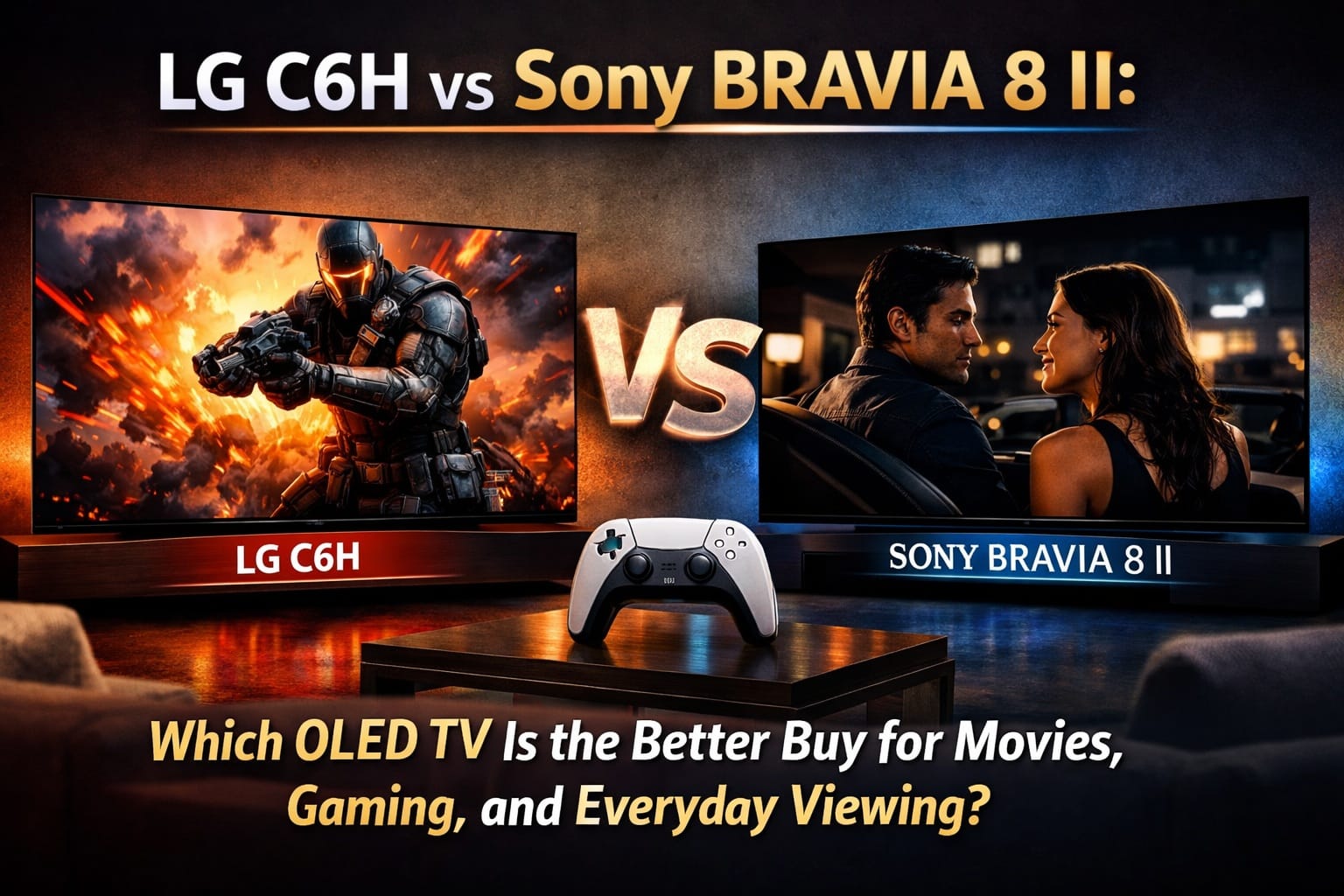
LG C6H vs Sony BRAVIA 8 II Comparison: Gaming, Movies, HDR, and Everyday Viewing
As an Amazon Associate I earn from qualifying purchases. This article contains affiliate links — we may earn a small commission if you buy through them, at no extra cost to you.
Picture this: it’s a Friday night, you’ve just fired up your PS5, and the TV you’re staring at is the one you’ll be living with for the next five to seven years. That’s exactly the kind of decision thousands of buyers face when they land on the LG C6H vs Sony BRAVIA 8 II comparison — two premium OLED TVs sitting in the same price bracket, each with a genuinely strong case. We spent time cross-referencing official specifications, hands-on professional reviews, lab test data, and verified owner feedback to cut through the noise and give you a clear answer.
This comparison is written for home theater enthusiasts, console gamers, and premium TV buyers who’ve already done the research and just need one honest voice to help them choose. If you want to go deeper on the LG side before reading further, our full LG C6H review covers its panel performance in detail. covers its panel performance in detail. In short: the LG C6H is our overall pick — especially if gaming performance and connection flexibility are your top priorities — but the Sony earns its place too, and we’ll tell you exactly when to choose it instead.
Table of Contents
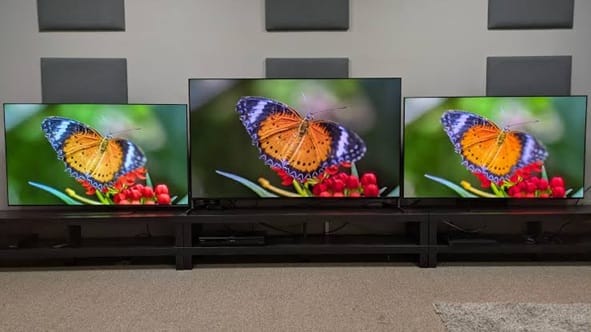
Quick Comparison: LG C6H vs Sony BRAVIA 8 II at a Glance
If you’re scanning before you commit to reading the full breakdown, this card comparison covers the key differences. For more context on how the LG stacks up in a broader OLED category, see our LG C6 vs Samsung S95F 2026 comparison — a lot of the same strengths carry over. If you’re deciding between LG’s own models instead, our LG C6H vs LG G6 compared breakdown is worth a look too.
The headline difference is clear: the C6H leads on gaming responsiveness and connection flexibility, while the BRAVIA 8 II pushes ahead on motion smoothness and built-in audio. For most buyers, the LG’s advantages add up to better all-round value — but if cinematic movie performance is your single priority, the Sony makes a compelling argument.
Where the LG C6H vs Sony BRAVIA 8 II Contest Favours LG
Gaming Performance: The C6H Is in a Different League
When we look at gaming responsiveness, the gap between these two TVs is significant enough to matter on a Saturday night with a controller in hand. The LG C6H delivers roughly 1 ms input lag at 4K/120Hz — the kind of figure that makes fast-paced shooters and action games feel genuinely tight and immediate. Its four full-bandwidth HDMI 2.1 ports mean you can have a PS5, Xbox Series X, a gaming PC, and a media player all plugged in simultaneously without compromising signal quality on any port.
The C6H also supports 144Hz panel refresh, NVIDIA G-Sync compatibility, and AMD FreeSync Premium Pro, making it one of the most versatile gaming TVs at this price point. These aren’t just spec-sheet numbers — in real-world play, tear-free motion and near-zero lag translate to a noticeably smoother experience versus a TV that tops out at 120Hz with only two 2.1 ports.
HDR Brightness and Dark-Room Movie Watching
The OLED evo panel inside the C6H reaches strong peak brightness for its class, making specular highlights — the glint on a car, the edge of a flame — pop convincingly in Dolby Vision content. For buyers setting up a dedicated dark-room home theater, the combination of near-infinite contrast ratios and accurate colour reproduction means Dolby Vision films look exactly as the director colour-graded them.
Professional testing consistently shows the C6H holding up well in dark scenes where shadow detail can look muddy on lesser panels. In this area, the WhatHiFi’s hands-on assessment of the Sony BRAVIA 8 II actually confirms that both panels trade blows on peak brightness — which reinforces just how competitive LG’s OLED evo technology is at this tier.
Everyday Streaming, Value, and webOS Usability
For mixed everyday use — streaming Netflix after work, catching a live sports match, then switching to a console — the C6H’s webOS 25 interface is one of the more intuitive smart TV platforms available. App load times are fast, the home screen isn’t cluttered with unwanted content, and the Magic Remote makes navigation feel fluid rather than frustrating.
When you factor in four HDMI 2.1 ports, a 144Hz panel, and a processor that handles upscaling confidently across a range of streaming qualities, the LG C6H represents genuinely strong value against everything else at this price point in 2026.
Product Name: LG C6H OLED evo TV — 55 Inches
Screen Size: 55 inches (also available in 65″, 77″)
Check Availability on Amazon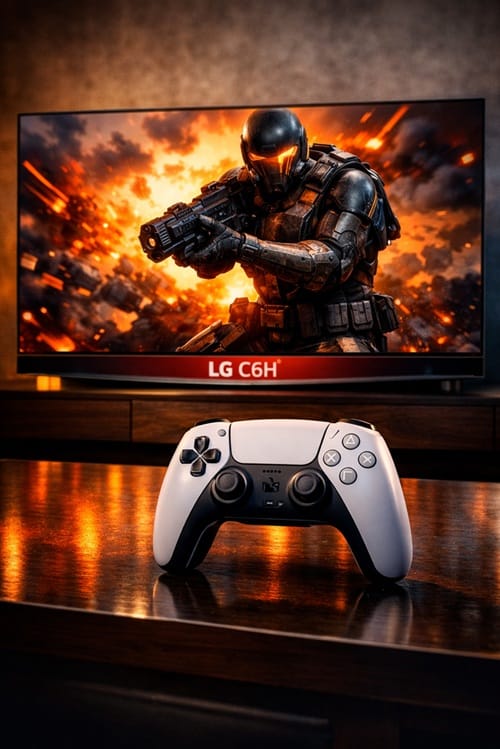
Where the Sony BRAVIA 8 II Outperforms the C6H
Motion Handling and Cinematic Processing
Sony’s XR Motion Clarity processing is the strongest argument for choosing the BRAVIA 8 II over the LG. In fast-paced cinema — think an action sequence with wide panning shots or a sports broadcast — Sony’s XR Cognitive Processor applies motion compensation that genuinely reduces judder in a more natural-looking way than LG’s equivalent processing. It’s the difference between motion that looks “processed” and motion that looks like you’re watching a film at a proper cinema.
For buyers who spend most of their viewing time watching Hollywood films and streaming high-quality cinematic content, the Sony’s motion pipeline is a tangible real-world advantage. Sony’s official BRAVIA 8 II product page details the full XR processing stack, and the Cognitive Processor’s ability to analyse content across the entire picture — not just zone by zone — does produce a noticeably cohesive result in practice.
Built-In Audio: Acoustic Surface Audio
The BRAVIA 8 II’s Acoustic Surface Audio system uses actuators behind the panel itself to vibrate the screen as a speaker, so sound appears to come directly from the action on screen rather than from a downward-firing driver below the cabinet. For movies and TV drama, this creates a sense of immersion that the LG’s 40W 2.2-channel speaker system — good as it is — simply can’t match.
If you’re watching without a soundbar and your room isn’t acoustically set up for external audio, the Sony BRAVIA 8 II’s built-in audio system delivers a noticeably richer experience straight out of the box. It’s a meaningful differentiator for buyers who don’t want to immediately invest in separate speakers.
Product Name: Sony BRAVIA 8 II OLED TV — 55 Inches
Screen Size: 55 inches (also available in 65″, 77″)
Check Availability on Amazon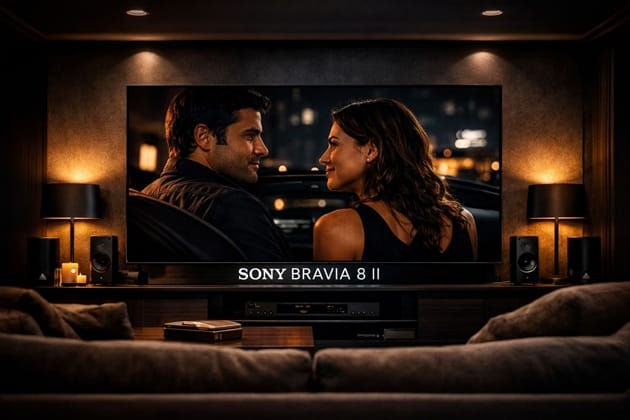
The Good, the Bad, and the Ugly — LG C6H
Pros
- ✅ Four HDMI 2.1 ports — lets you run a PS5, Xbox Series X, gaming PC, and streaming device simultaneously without a switch, at full 4K/120Hz bandwidth on every port
- ✅ ~1 ms input lag at 4K/120Hz — among the fastest response times on any OLED TV in 2026; genuinely perceptible in competitive gaming and fast action titles
- ✅ 144Hz panel refresh rate with G-Sync and FreeSync Premium Pro — future-proofed for PC gaming as well as current consoles
- ✅ OLED evo panel with strong Dolby Vision performance — accurate colour, near-infinite contrast, and excellent dark scene rendering make it equally capable for movies
- ✅ webOS 25 is one of the cleanest smart TV platforms — fast, well-organised, and doesn’t bury the apps you actually use behind promotional content
Cons
- ❌ Motion processing trails Sony’s XR system — in cinematic content with wide panning shots, LG’s motion handling, while very good, doesn’t feel as natural as the BRAVIA 8 II’s Cognitive Processor output
- ❌ Built-in audio is functional but not impressive — the 40W 2.2ch system handles everyday TV and streaming acceptably, but it’s a step behind the Sony’s Acoustic Surface Audio for immersive movie watching without a soundbar
The Ugly
Here’s the honest part: buying the wrong OLED TV at this price point is a frustration you’ll feel every time you sit down to watch. If you primarily use your TV for dark-room cinematic viewing — long feature films, prestige drama series, documentary content where motion handling and audio immersion matter most — the LG C6H is not the stronger choice. Its motion processing is genuinely behind the Sony in that specific use case, and the audio gap without a soundbar is noticeable.
The C6H is also, like all OLED panels, susceptible to image retention with prolonged static content — news tickers, sports scoreboards, HUD overlays in games. LG has pixel refresher routines built in, but if you leave static images on screen regularly, it’s a real long-term risk to be aware of before you buy.
Which One Should You Buy?
If you’re a gamer first and everything else second, the answer is straightforward: the LG C6H. Whether you’re a first-time OLED buyer stepping up from a mid-range LED set or an enthusiast building a proper gaming setup, the C6H’s 144Hz panel, sub-1ms input lag, and four HDMI 2.1 ports offer a level of flexibility no other OLED in this category currently matches. You’re not just buying performance for today’s consoles — you’re future-proofing for whatever comes next. See our full best OLED TVs for gaming roundup for the complete breakdown.
For everyday streaming households — families who use the TV for a mix of news, sport, Netflix, and the occasional movie — the C6H also wins. webOS 25 is genuinely pleasant to live with day-to-day, upscaling of HD and FHD streaming content is strong, and the picture quality holds up in brighter room conditions better than many buyers expect from OLED.
The calculation changes if your living room is a dedicated movie space. Think about it like choosing between a touring car and a grand tourer: the LG is the sharper, more versatile machine, but the Sony BRAVIA 8 II is the one you’d pick for a long, immersive drive.
If you watch three films a week in a dark room, care deeply about motion smoothness in slow-burn cinema, and don’t want to immediately buy a soundbar, the Sony is the honest recommendation — and if you want to see how the rest of Sony’s lineup compares, our Sony OLED roundup breaks down every model. Our best OLED TVs of 2026 guide covers a broader range of options if neither of these feels quite right for your setup. For movie-first buyers specifically, see our picks for the best OLED TVs for movies.
Budget-conscious buyers who don’t need OLED picture quality should consider a quality Mini-LED alternative at a lower price point — both of these TVs are premium products, and neither will feel like good value if you’re primarily watching daytime broadcast TV in a bright room. If you’re still weighing whether OLED is the right call, our is OLED worth it in 2026 guide gives an honest answer.
Final Verdict: LG C6H vs Sony BRAVIA 8 II
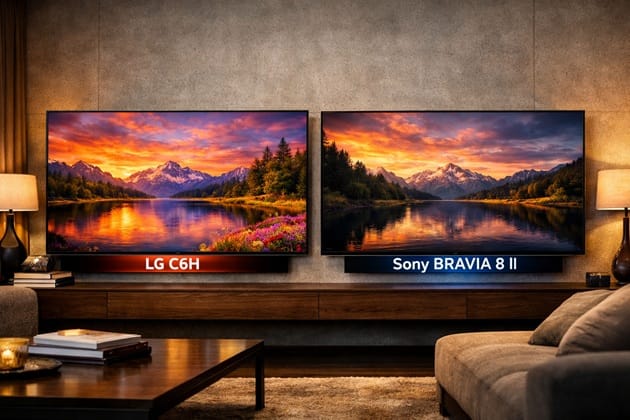
After looking at everything — panel performance, gaming specifications, motion processing, smart TV usability, and real-world audio — the LG C6H vs Sony BRAVIA 8 II comparison has a clear overall winner for the majority of buyers: the LG C6H. (For how this plays out across each brand’s full lineup rather than just these two models, our Sony OLED vs LG OLED compared guide takes the wider view.)
Four HDMI 2.1 ports, 144Hz refresh, near-zero input lag, and a proven OLED evo panel make the C6H the most versatile premium TV at this price point in 2026. It handles gaming at a level the Sony simply can’t match, while still being a highly capable movie and streaming TV for everyday use. If you’re spending serious money on a screen you’ll use for years across multiple activities, the C6H delivers more genuine value.
The Sony BRAVIA 8 II earns its place for a specific buyer: someone who watches films every night, wants the best built-in sound without a soundbar, and values Sony’s XR motion processing above all else. For the full breakdown of where it shines and where it falls short, our full Sony BRAVIA 8 II review covers every detail. It’s an excellent OLED TV — just a more narrowly focused one. For a detailed look at Sony’s full specification breakdown, the official Sony BRAVIA 8 II product page is worth reading before you finalise your decision.
For most people reading this comparison — gamers, mixed-use households, and buyers who want flexibility — the LG C6H is the smarter long-term investment.
Frequently Asked Questions
Which OLED TV has better HDR performance — the C6H or the BRAVIA 8 II?
Both TVs support Dolby Vision, HDR10, and HLG, and both produce exceptional HDR results thanks to OLED’s inherent contrast capabilities — though if you’re also weighing panel technology more broadly, our QD-OLED vs WOLED compared guide breaks down the practical differences. In direct testing, they trade closely on peak brightness, with LG’s OLED evo panel performing particularly well on specular highlights. Sony’s XR processing gives it a slight edge in overall HDR consistency across complex scenes, but neither TV will disappoint a serious HDR enthusiast.
Is the Sony BRAVIA 8 II worth the price over the LG C6H?
At comparable pricing, the Sony BRAVIA 8 II offers genuine value — but only for a specific type of buyer. Its XR motion processing, Acoustic Surface Audio, and cinematic image pipeline justify the cost if movies are your primary use case. For gaming households, mixed-use setups, or buyers who plan to add a soundbar anyway, the LG C6H delivers more measurable performance for the same money. The Sony is not overpriced — it’s just optimised for a narrower audience.
How do the two TVs compare for everyday brightness and living room viewing?
Both TVs are OLED panels, which means they’re better suited to controlled lighting conditions than a bright living room with direct sunlight. In moderately lit rooms, both perform well with their ABL (automatic brightness limiting) systems active. The C6H’s OLED evo panel does offer slightly higher sustained brightness than the Sony in most test conditions, giving it a marginal edge for daytime viewing. For independent lab data on brightness performance, RTINGS’ detailed C5 OLED measurements provide the closest available reference point for C6H panel behaviour.
Will I regret buying the LG C6H over the Sony if I mainly watch movies?
This is the main concern worth addressing honestly. If your primary use is dedicated dark-room cinema viewing — long feature films, high-quality streaming with a focus on motion smoothness — you may find the Sony BRAVIA 8 II more satisfying over time. The LG C6H is an excellent movie TV, but Sony’s XR motion handling and Acoustic Surface Audio create a more immersive cinematic experience in that specific context. For mixed use that includes gaming, the C6H is the better all-round decision.
Is the LG C6H vs Sony BRAVIA 8 II comparison worth considering for PS5 gaming?
Yes, and the difference is meaningful. The LG C6H offers approximately 1 ms input lag at 4K/120Hz, four full-bandwidth HDMI 2.1 ports, and G-Sync compatibility — all of which are directly relevant to PS5 and Xbox Series X performance. The Sony BRAVIA 8 II supports 4K/120Hz gaming but has higher input lag and only two HDMI 2.1 ports, making the LG the stronger gaming choice by a clear margin.

iYaiii
Editor, GearPulse360
iYaiii is the editor and founder of GearPulse360, specializing in TV reviews and consumer electronics. He researches every recommendation before publishing.
✅ Based on spec analysis and WhatHiFi’s – Sony’Official plus RTINGS data — last verified June 2026