Best 77-Inch OLED TVs in 2026: Top Picks for Large-Room Impact
Last updated: August 2026
🕒 10 min read
Disclosure: As an Amazon Associate I earn from qualifying purchases. This article contains affiliate links — we may earn a small commission if you buy through them, at no extra cost to you.
Most people buy a 55 or 65-inch TV and think they’re done. Then they sit in front of a 77-inch OLED and realize there’s a reason people talk about it differently. At this size, the best 77-inch OLED TVs shift from background appliance to the thing the room is built around.
The challenge is choosing the right one. The 77-inch OLED market at this size skews almost entirely toward WOLED panels this year, and the differences between models come down to refresh rate, HDMI 2.1 port count, and price tier rather than panel chemistry. Pick wrong and you’ll notice it every time you sit down to watch.
We put together this guide to help you cut through the options. These four picks cover the best 77-inch OLED TVs across every budget and use case — whether you’re building a dedicated home theater, upgrading your gaming setup, or just want the best picture quality your living room can hold.
Table of Contents
Best 77-Inch OLED TVs: Quick Comparison
| Pick | Model | Panel | Best for | Price |
|---|---|---|---|---|
| Best overall | Samsung 77″ S90H | WOLED | All-round use | Check price |
| Best for gaming | LG OLED77C6H | WOLED (four-stack) | Gaming / HDMI 2.1 | Check price |
| Best for movies | LG 77″ B6 | WOLED | Cinema / HDR | Check price |
| Best budget | Samsung 77S85H | WOLED | Value buyers | Check price |
Amazon prices change frequently — click through for the current price.
Best Overall 77-Inch OLED TV: Samsung 77-Inch S90H
Samsung 77-Inch Class S90H WOLED 4K Smart TV — Best overall 77-inch OLED TV
- Screen size: 77″
- Panel type: WOLED
- Refresh rate: 165 Hz
- HDMI 2.1: 4 ports
- HDR formats: HDR10+, HDR10, HLG
- Best for: Movies, gaming, everyday use
The Samsung S90H earns the top spot because it does everything well at a size where generalist TVs often compromise. Its four HDMI 2.1 ports and 165Hz panel put it ahead of most competitors at this tier on paper, and Samsung backs it with a full HDR10+ format stack alongside the more common HDR10 and HLG.
Based on manufacturer specifications, the S90H’s panel is a WOLED design sourced from LG Display for 2026 — not the QD-OLED panel Samsung uses in its flagship S90F/S95F/S95H tier. That distinction matters less for day-to-day picture quality than the port count and refresh rate do at this size; see the panel-type section below for where QD-OLED still fits Samsung’s 2026 lineup.
Pros
- ✅ Four full-bandwidth HDMI 2.1 ports — no compromises for multi-device gaming setups
- ✅ Native 165Hz panel supports both console and PC gaming without a refresh-rate ceiling
Cons
- ❌ Not a QD-OLED panel — buyers specifically wanting Samsung’s quantum-dot color volume need to look at the S90F/S95F/S95H tier instead
- ❌ No independent RTINGS measurement data confirmed for this exact 2026 revision at the time of writing
Gaming and Smart TV Performance
The S90H ships with four HDMI 2.1 ports and a native 165Hz panel — a combination that makes it one of the more capable 77-inch gaming TVs at this price tier, based on published specifications. AMD FreeSync Premium Pro support is listed for PC gamers who want tear-free output without a separate sync negotiation.
Samsung’s Tizen smart platform is well-organized and receives regular updates. For someone who switches between streaming apps, broadcast input, and gaming frequently in a single session, the S90H’s four-port layout removes the cable-swapping friction that lower-port-count sets create.
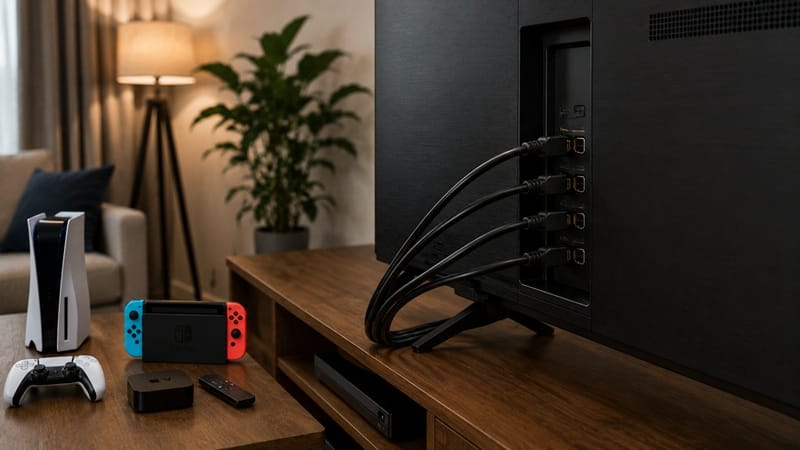
Best 77-Inch OLED TV for Gaming: LG OLED77C6H
LG OLED77C6H — Four-Stack WOLED 4K Smart TV — Best 77-inch OLED TV for gaming
- Screen size: 77″
- Panel type: WOLED (Primary RGB Tandem, four-layer)
- Refresh rate: 165 Hz
- HDMI 2.1: 4 ports (full 48 Gbps)
- HDR formats: Dolby Vision, Dolby Atmos, HDR10, HLG
- Best for: Console & PC gaming
Gaming on a 77-inch OLED is a fundamentally different experience from a 55-inch, and the LG OLED77C6H is built to take full advantage of it. Its four-stack WOLED panel — LG’s Primary RGB Tandem architecture, the same foundational tech built for the G-series — delivers the per-pixel light control that makes OLED a preferred choice for gaming, but with meaningfully more brightness headroom than a standard two-stack WOLED panel across an immersive 77-inch canvas.
What separates the C6H specifically in gaming contexts is that all four HDMI 2.1 ports run the full 48 Gbps bandwidth. Dolby Vision Gaming support means compatible titles on PS5 and Xbox Series X get automatic game-mode activation with full HDR tone mapping. NVIDIA G-Sync compatibility and AMD FreeSync Premium are both supported, so PC users can connect without configuration headaches.
The size advantage that actually matters in games
At 77 inches from 7.5–9.5 feet away, games with wide environments — open-world RPGs, flight sims, racing — fill peripheral vision in a way that changes how you process the scene. It’s not just a bigger picture; spatial awareness and UI readability both improve. For serious gamers who’ve already decided they want a large-screen OLED, the C6H is the set most specifically engineered around that use case at this size.
For the complete picture on how the C6H performs across HDR movies, live sports, and everyday use beyond gaming — plus where it sits against the standard C6H’s sibling sizes and its closest competitors — our LG OLED77C6H review goes deeper than a single-pick summary can. For how it stacks up against other gaming-focused picks across sizes, our best OLED TVs for gaming guide covers the full field.
Pros
- ✅ All four HDMI 2.1 ports run full 48 Gbps — no bandwidth compromises across a four-console household
- ✅ Four-stack panel architecture gives more brightness headroom than a standard WOLED at this size, based on LG’s published specifications
Cons
- ❌ Only available in 77 and 83 inches — no smaller-size option if this room turns out too tight
- ❌ Priced above the standard C6/C6-tier competitors due to the four-stack panel
Best 77-Inch OLED TV for Movies: LG 77-Inch B6
LG 77-Inch Class B6 WOLED 4K Smart TV — Best 77-inch OLED TV for movies
- Screen size: 77″
- Panel type: WOLED
- Refresh rate: 120 Hz
- HDMI 2.1: 2 ports
- HDR formats: Dolby Vision, HDR10, HLG
- Best for: Movies & streaming
The LG B6 is the strongest argument for buying a 77-inch OLED if your living room is primarily a movie-watching environment. It carries full Dolby Vision support — including Filmmaker Mode, which disables motion smoothing and post-processing automatically to deliver the picture closer to how it was mastered.
For dark-room movie watching, WOLED’s per-pixel black levels are the format’s core strength. Scenes with deep shadow detail — space films, noir, or any cinematography leaning on contrast — read as more dimensional on OLED than on any competing panel type at this size, based on the underlying self-emissive technology all WOLED and QD-OLED panels share.
Where the B6 Makes Its Case
The B6 comes in at a lower price point than the C6H by stepping back to 120Hz and offering two rather than four HDMI 2.1 ports. For pure movie and streaming use — a 4K Blu-ray player, a streaming stick, maybe a soundbar — that’s a trade-off that saves real money without touching anything that matters for film viewing.
Dolby Atmos pass-through is supported, so pairing the B6 with a home theater receiver or soundbar works as expected. LG’s webOS smart platform is one of the cleaner interfaces available, with a streaming app library covering every major service. If movies are the primary use case, you’re not giving up anything that shows on screen — just the extra HDMI ports and higher refresh rate a dedicated gamer would care about.
Pros
- ✅ Full Dolby Vision and Filmmaker Mode support for accurate cinema playback
- ✅ Lower price than the four-stack C6H without sacrificing black-level performance for movie content
Cons
- ❌ Only 2 HDMI 2.1 ports — a limiting factor for multi-console gaming households
- ❌ 120Hz ceiling instead of the C6H’s 165Hz, a real difference for high-refresh PC gaming
Best Budget 77-Inch OLED TV: Samsung 77S85H
Samsung 77S85H WOLED 4K Smart TV — Best budget 77-inch OLED TV
- Screen size: 77″
- Panel type: WOLED
- Refresh rate: 120 Hz
- HDMI 2.1: available (VRR supported)
- HDR formats: HDR10, HLG
- Best for: Value buyers
The Samsung 77S85H sits below the S90H in Samsung’s lineup, trading the higher refresh rate for a friendlier price on the same core WOLED technology. For everyday viewers — someone who streams a lot, watches sports, and uses the TV as the household’s main screen — the step down is unlikely to be felt day to day, and Tizen’s smart platform remains one of the smoother-operating TV interfaces available.
Who Should Choose the S85H
The S85H makes the most sense for buyers who’ve decided they want a 77-inch OLED but are working within a tighter budget ceiling. At 77 inches, even the entry-tier OLED experience is considerably more impressive than a similarly-priced QLED at the same price point. For the complete rundown on this exact model’s real-world trade-offs, our Samsung 77S85H review goes deeper than a single-pick summary can.
Pros
- ✅ Lowest price point of the four picks while keeping the same core self-emissive OLED contrast
- ✅ VRR support keeps casual console gaming smooth despite the lower refresh ceiling
Cons
- ❌ HDR10+ dropped in favor of standard HDR10 only — matters if your library leans on HDR10+ content
- ❌ Fewer full-bandwidth HDMI 2.1 ports than the S90H or C6H, based on published specifications
What to Look for in a 77-Inch OLED TV
Panel Type: Where QD-OLED Actually Fits This Year
It’s worth being direct here: all four picks in this guide use WOLED panels in 2026, not QD-OLED. That wasn’t the plan going in — Samsung’s S90H and S85H have historically shipped as QD-OLED, but for the 2026 model year both are built on LG Display WOLED panels instead. If you specifically want Samsung’s quantum-dot color volume at 77 inches, that panel technology now lives one tier up, in Samsung’s S90F, S95F, and S95H models — none of which made this particular Budget/Mid-flagship pick set, but worth knowing before you assume “Samsung OLED” automatically means QD-OLED this year.
Within the WOLED picks here, the meaningful split is between the C6H’s four-stack panel — which trades a higher price for genuinely more brightness headroom — and the standard WOLED panels on the S90H, B6, and S85H, which prioritize per-pixel black level consistency over peak brightness. For a broader breakdown of panel technology tradeoffs beyond this specific pick set, our OLED vs QLED comparison covers where OLED as a category wins and loses against the alternatives.
HDMI 2.1 Ports
At 77 inches, many buyers are pairing their OLED with a PS5, Xbox Series X, or a high-refresh-rate PC — all of which benefit from HDMI 2.1 bandwidth to run 4K at 120Hz or higher. The S90H and C6H both offer four full-bandwidth ports; the B6 and S85H provide fewer. If you’re connecting multiple gaming devices simultaneously, that number matters more than any panel-type distinction.
HDR Format Support
All four picks here support the core HDR formats, but there’s a split between HDR10+ (Samsung) and Dolby Vision (LG). Both are capable formats. Dolby Vision has broader streaming support on Netflix and Apple TV+; HDR10+ is more common on Amazon Prime Video and Samsung’s own device ecosystem. If you have a strong format preference based on your streaming services, factor that into your decision.
Brightness and Ambient Light
Because all four picks here share the same underlying WOLED panel family, brightness differences between them come down mostly to the C6H’s four-stack architecture rather than a Samsung-vs-LG panel-chemistry split. In a room with meaningful daylight or overhead fixtures, the C6H’s brightness headroom will be the most noticeable of the four in ambient-light conditions; the S90H, B6, and S85H perform closer to each other in that scenario, based on their shared panel architecture.
Smart Platform
Both Tizen (Samsung) and webOS (LG) are mature, well-supported platforms with broad app libraries. Tizen’s interface is grid-based and content-discovery-focused; webOS is app-bar-based and marginally cleaner. Neither will frustrate you day to day — the practical split comes down to ecosystem: if you cast from a phone often or use SmartThings devices around the house, Samsung’s integration tends to be smoother. If you have an iPhone household and use AirPlay regularly, LG’s implementation tends to have fewer hiccups.
Is 77 Inches the Right Size for Your Room?
Before committing to any of these best 77-inch OLED TVs, it’s worth confirming your room can actually support the size. The general rule for 4K content is a viewing distance of 1.0–1.5 times the screen’s diagonal measurement. For 77 inches, that works out to roughly 6.5–9.5 feet from the screen to your seating position.
Screen Size Minimum Distance (4K) Recommended Distance Maximum Comfortable 65 inches 5.5 ft 6.5–8 ft 10 ft 77 inches 6.5 ft 7.5–9.5 ft 12 ft 83 inches 7 ft 8.5–11 ft 14 ft
If your sofa sits at 7–10 feet from the wall, a 77-inch panel is well within range. Below 6.5 feet, the screen becomes too large for comfortable all-day viewing — in that case, a 65-inch OLED TV is likely a better fit for your space. If your room comfortably fits more than 11 feet between sofa and screen, our best 83-inch OLED TVs picks are worth a look — that’s the tier where 77 inches starts to feel like the smaller screen in the room.
Also consider wall width: a 77-inch TV measures approximately 68 inches wide (170 cm) without a stand. For wall mounting, allow at least 6 inches of clearance on either side. For most furniture setups, standard seated-eye-level placement puts the bottom of a 77-inch panel at approximately 16–18 inches above the floor when mounted.
How We Picked These 77-Inch OLED TVs
These picks are based on manufacturer specifications, published CSV product data cross-checked against LG’s and Samsung’s official product pages, and category-level positioning (budget/mid-flagship/flagship tier) rather than independent hands-on testing this session. We weigh panel type, HDMI 2.1 port count, refresh rate, and HDR format support against real-world usability factors like price tier and use-case fit.
For the 77-inch category specifically, we also account for how each TV’s spec differences scale at this screen size — a two-port HDMI 2.1 limitation that’s a minor inconvenience at 55 inches becomes a real constraint for a multi-console household running a 77-inch centerpiece TV.
📍 Comparing across every budget and size, not just 77 inches? Our full roundup covers the best OLED TVs at every price point and screen size — from 42 inches to 83 inches. See best OLED TVs of 2026.
Best 77-Inch OLED TV FAQs
Which 77-inch OLED TV is the best overall in 2026?
The Samsung S90H is our top pick among the best 77-inch OLED TVs in 2026. Its four HDMI 2.1 ports support every current gaming and media device, and its 165Hz panel handles both high-frame-rate gaming and smooth motion in sports and action content well, based on published specifications. It’s the WOLED-based set that covers the most use cases at this size without a major compromise.
Are 77-inch OLED TVs worth the premium over 65 inches?
For most living rooms with 8 feet or more of viewing distance, the jump from 65 to 77 inches makes a real perceptual difference — the image fills more of your field of view, and cinematic content in particular feels noticeably more immersive. The price premium at the 77-inch tier is real, but if your room supports the size, the experience upgrade is proportional to the cost. If budget is the constraint rather than room size, our best OLED TVs under $1,500 guide covers which 65-inch models compete closest to 77-inch picture quality.
Is burn-in a concern on a 77-inch OLED TV?
Burn-in risk on modern OLED TVs is lower than earlier generations, but it isn’t zero — particularly on a 77-inch screen where static elements like news tickers or game HUDs cover more physical area. For mixed-use households watching varied content, burn-in is unlikely to be a practical problem over several years of normal use. For dedicated gaming or broadcast-TV setups with persistent static elements, enabling pixel-shift and OLED care features reduces risk further. RTINGS runs long-term burn-in tests tracking panels across thousands of hours, and their findings are worth reading before you decide. For a full breakdown of when burn-in is and isn’t a realistic concern, see our guide on whether OLED burn-in still matters in 2026.
Are any of these 77-inch picks QD-OLED?
No — all four picks in this guide use WOLED panels for the 2026 model year, including the two Samsung models. Samsung’s QD-OLED panel technology at 77 inches currently lives in the S90F, S95F, and S95H tier, which sits above this Budget/Mid-flagship pick set. If quantum-dot color volume is a hard requirement rather than a nice-to-have, that’s the tier to look at instead of the picks above.
What’s the ideal room size for a 77-inch OLED TV?
A 77-inch OLED TV works best in rooms where your primary seating is between 7.5 and 9.5 feet from the screen. At this distance, 4K resolution is fully visible and the screen fills your field of view without requiring neck movement to see the edges. For rooms under 7 feet of viewing distance, the image becomes uncomfortably large for extended sessions — a 65-inch model is a better match for tighter spaces.

iYaiii
Editor, GearPulse360
iYaiii is the editor and founder of GearPulse360, specializing in TV reviews and consumer electronics. He researches every recommendation before publishing.
✅ Based on spec analysis and LG’s and Samsung’s official data — last verified August 2026