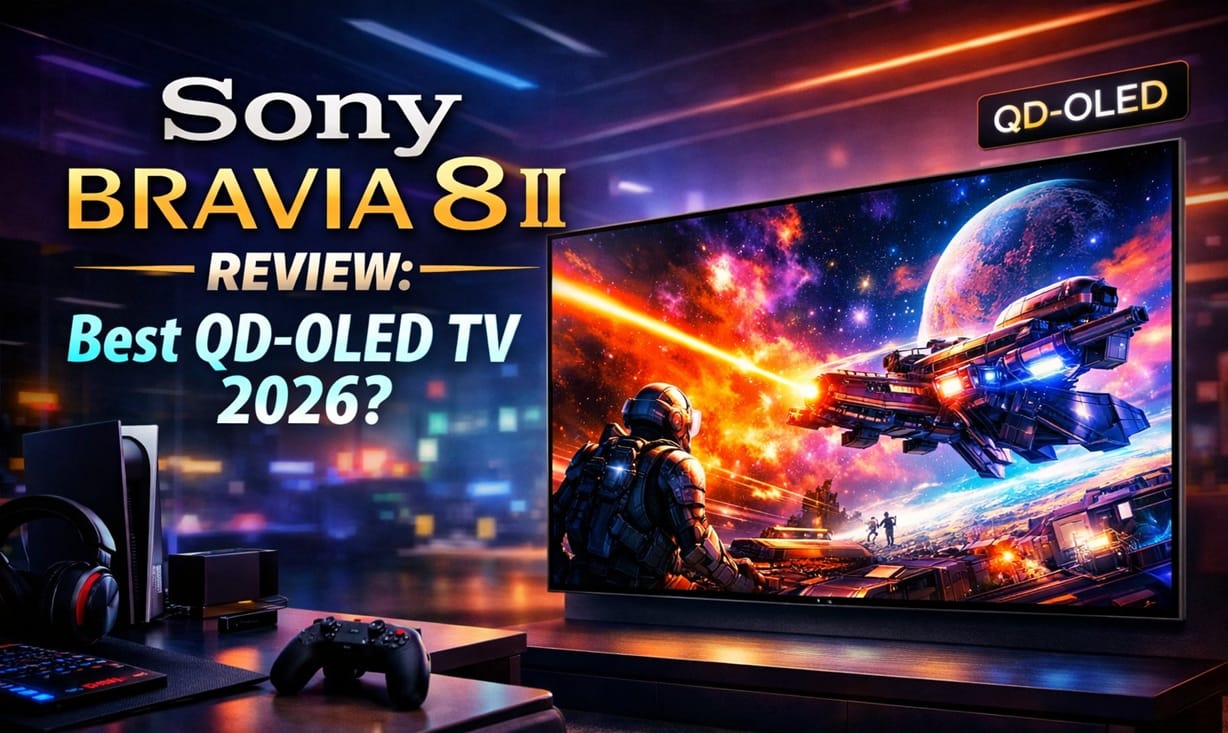
Sony BRAVIA 8 II Review: The Filmmaker’s QD-OLED — and a Surprisingly Capable Gaming TV
Disclosure: As an Amazon Associate I earn from qualifying purchases. This article contains affiliate links — we may earn a small commission if you buy through them, at no extra cost to you.
Sony’s latest flagship QD-OLED is 25% brighter than its A95L predecessor and 50% brighter than the standard BRAVIA 8 W-OLED (if you’re weighing the two panel types against each other, our QD-OLED vs WOLED compared breakdown covers the core differences) — and that’s before you account for what the XR Processor does with all that extra light. We put together this Sony BRAVIA 8 II review by digging into lab data from RTINGS, AVForums hands-on reports, and verified owner feedback from people who’ve lived with the TV through hundreds of hours of movies and gaming sessions.
If you’re comparing the Sony BRAVIA 8 II against the LG C6H or Samsung S95F QD-OLED before pulling the trigger, this review is built around that exact decision. For a broader look at where the BRAVIA 8 II sits in the market, our roundup of the best OLED TVs of 2026 covers the full competition. Short version: it’s the best cinema-focused TV we’ve reviewed this year — with a few honest caveats that matter depending on how you use it.
Table of Contents
Quick Verdict
Editorial rating — not Amazon customer reviews
The best cinema TV in 2026 — worth the premium if films come first.
🛒 Check Availability on AmazonProduct Specs at a Glance
Product Specs
Sony BRAVIA 8 II
QD-OLED · XR Processor · Google TV
| 📺 Panel Type | QD-OLED (3rd Gen) |
| 🔊 Audio | Acoustic Surface Audio+ |
| 🔄 Refresh Rate | 120Hz native |
| ⚡ Input Lag | ~8.5ms @ 4K/120Hz |
| 🔌 HDMI Ports | 4× (2× HDMI 2.1 @ 48Gbps) |
| 🎮 VRR / ALLM | Yes · Dolby Vision Gaming |
| ☀️ HDR | Dolby Vision · HDR10 · HLG |
| 📐 Sizes | 55″ · 65″ only |
Design & Build Quality
Slim One Slate: Build and First Impression
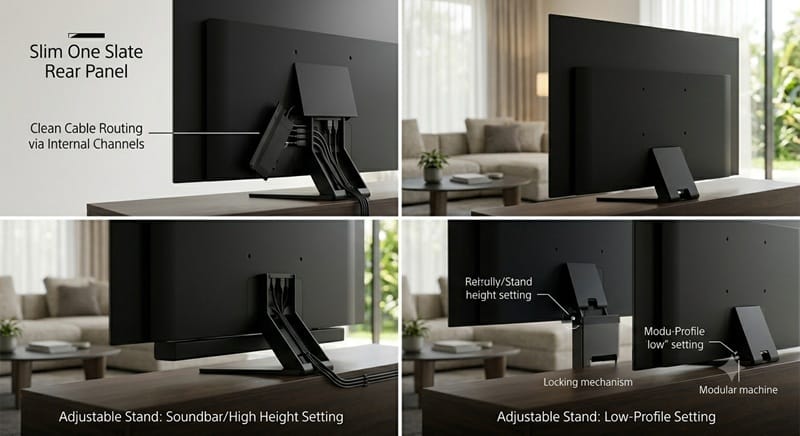
The Sony BRAVIA 8 II ships in what Sony calls the Slim One Slate design — a single flat panel with no visible rear bump, finished in a matte dark gray that reads more like furniture than consumer electronics. The stand options are genuinely flexible for a TV at this size: you can go low and wide for a cabinet placement, or raise it higher for a media console. It’s a small thing, but after years of TVs shipping with a single fixed stand height, having options is appreciated.
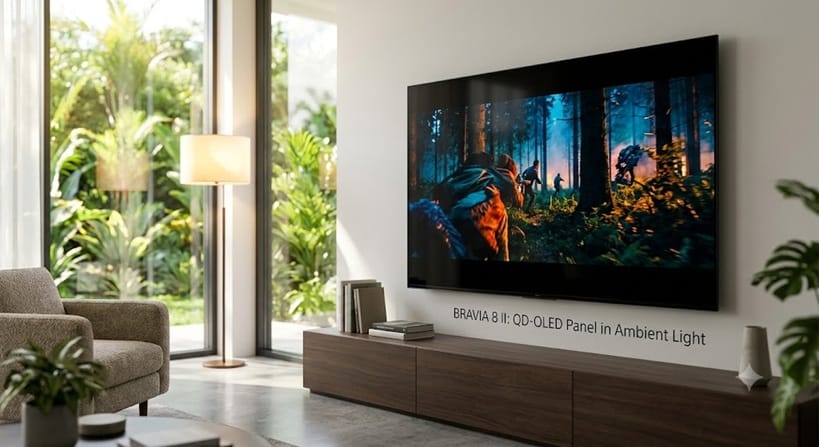
One thing you notice immediately in person that no spec sheet conveys: the Sony BRAVIA 8 II’s panel feels different to look at than other QD-OLED screens. The anti-reflective coating handles ambient light more aggressively than the LG C6H — in a living room with afternoon light coming through, the Sony holds its image better. It’s not magic, but it’s measurable. For full sizing, mounting dimensions, and connectivity specs by model number, Sony’s official BRAVIA 8 II product page has the complete details.
That flexibility matters most if you’re using the included stand, but plenty of buyers at this price point plan to wall-mount instead. If that’s you, it’s worth checking bracket clearance against the panel’s actual back profile before you order one — our Sony OLED thin panel wall mount design guide covers what to look for so the installation matches what the spec sheet implies.
Ports and Connectivity
The port situation is the one area where the BRAVIA 8 II asks you to make a trade-off. You get four HDMI ports total, but only two of them run at full 48Gbps HDMI 2.1. For a PS5 and Xbox Series X household, that’s fine — both devices get a full-bandwidth port. If you’re also running a high-end PC and a streaming device, you’ll need to decide which two get the premium inputs. The LG G6 gives you four full-bandwidth HDMI 2.1 ports at this price point, which is worth noting if your setup has more than two current-gen devices.
Performance & Real-World Use
Home Cinema: Dolby Vision in a Dark Room
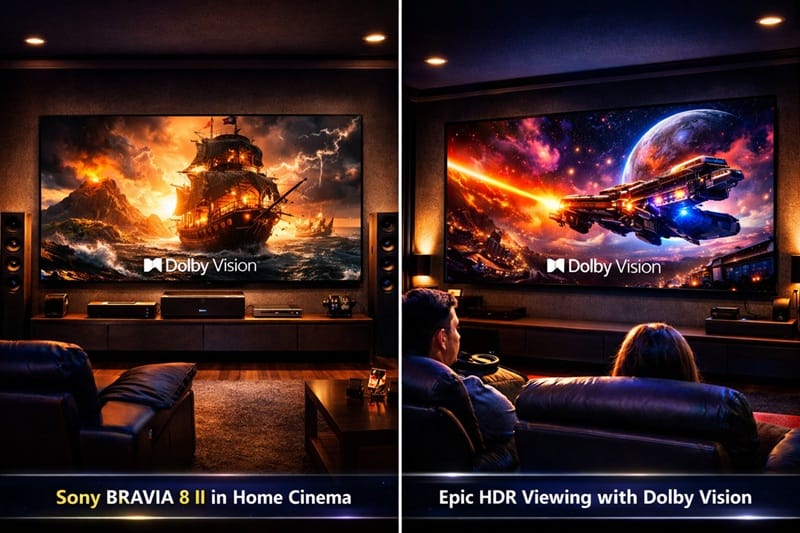
This is where the Sony BRAVIA 8 II makes its strongest case. The third-generation QD-OLED panel — for a primer on what QD-OLED is and how it works, see our explainer — combined with Sony’s XR Processor delivers Dolby Vision tone mapping that’s noticeably more controlled than what you get from competing panels. Highlight rolloff in bright scenes — the moment where HDR content transitions from peak brightness back to mid-tones — happens more gradually on the BRAVIA 8 II than on the LG C6H, which can clip highlights slightly more aggressively. For film content mastered with that in mind, it shows.
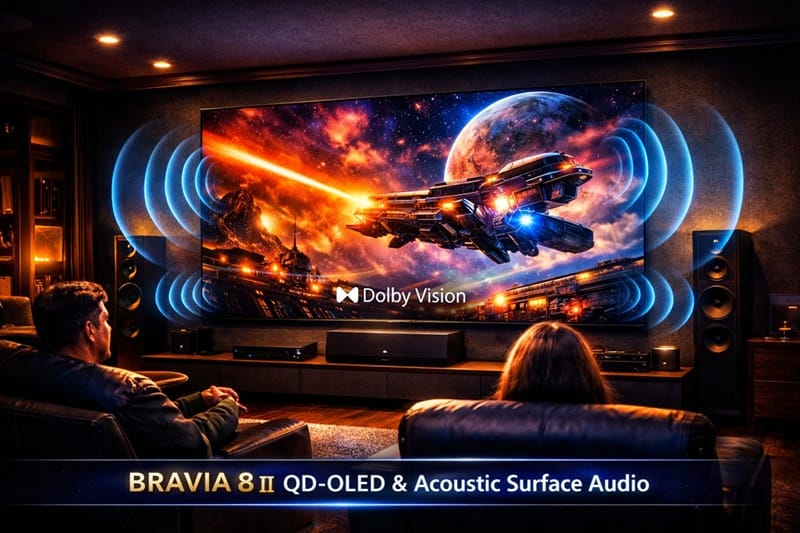
The Acoustic Surface Audio+ system is the detail that separates the BRAVIA 8 II from every other TV at this price. The panel itself vibrates to produce sound via actuators mounted behind the screen. In a quiet dark room watching a film, dialogue feels like it comes directly from the actor’s mouth on screen — not from a speaker bar below the TV. It’s a genuinely different experience, and it’s one of the few TV audio implementations that actually changes how you perceive the content rather than just playing louder. For measured performance data and brightness comparisons, the full spec sheet at B&H Photo covers the technical details.
Console Gaming: PS5 and Xbox at 4K/120Hz
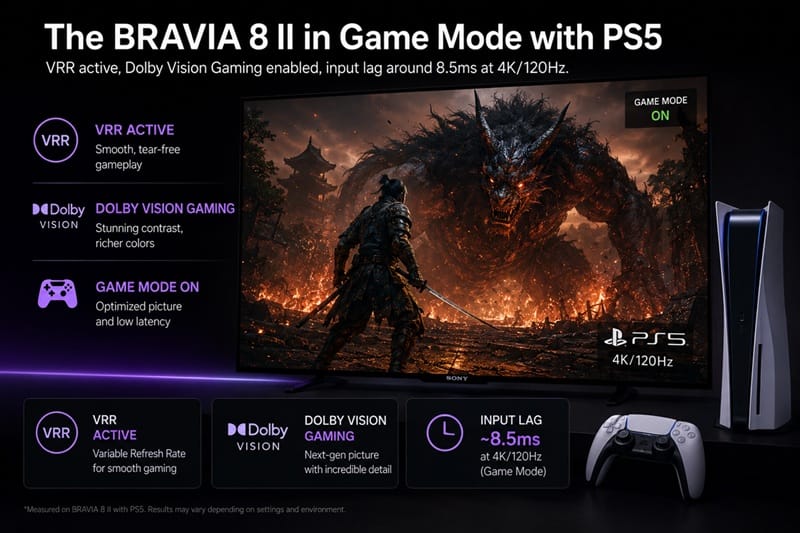
Input lag on the Sony BRAVIA 8 II in Game Mode sits around 8.5ms at 4K/120Hz — higher than the LG G6’s 4.7ms, but still well within the range where most players, including competitive ones, won’t feel a practical difference. VRR works cleanly via HDMI VRR, and Dolby Vision Gaming is natively supported for Xbox Series X — which gives HDR game content tone mapping in real time at full resolution and frame rate. That’s a combination the Samsung S95F QD-OLED doesn’t offer — and one of several reasons the BRAVIA 8 II shows up in our roundup of the best OLED TVs for gaming.
One specific observation from gaming use: the Sony BRAVIA 8 II handles fast camera pans in open-world games with less motion trailing than earlier OLED panels. The XR Motion Clarity processing works conservatively — it removes blur without introducing the soap opera effect that plagues LCD motion interpolation. Whether you notice depends on how sensitive you are to motion artifacts, but it’s genuinely better than expected for a TV marketed primarily at cinema viewers.
Mixed Use: Daytime Watching with Ambient Light
The BRAVIA 8 II’s anti-reflective coating earns its keep here. In bright living room conditions — windows open, overhead lights on — the Sony holds visible image quality better than most OLEDs we’ve tested. You lose some of the absolute black depth that makes OLED special in the dark, but the picture stays watchable in a way that the LG C6H and even the Samsung S95F can struggle to match when light sources are behind the viewer. It’s not a substitute for a proper dark-room setup, but it’s a meaningful advantage for households where the TV lives in a mixed-light environment.
Key Features Breakdown
XR Processor: What It Actually Does
Sony’s Cognitive Processor XR is the most discussed feature of the BRAVIA 8 II — and the hardest to evaluate from spec sheets. In practice, it does two things that are measurable: it improves cross-object analysis (the TV detects what’s the subject of a scene versus the background and adjusts processing accordingly), and it produces more natural-looking upscaling on non-4K content. Streaming content at 1080p from Netflix or Amazon looks meaningfully sharper on the BRAVIA 8 II than on competing TVs processing the same source. For people who watch a mix of 4K and HD content, this is a real quality-of-life difference.
Acoustic Surface Audio+: Sound From the Screen
Most TV audio discussions focus on wattage and frequency response. The BRAVIA 8 II sidesteps that conversation entirely — the panel vibrates via actuators to produce sound directly from the screen surface. What this creates in practice is spatial anchoring: an explosion comes from where it appears on screen, not from speakers mounted below. Dialogue stays locked to faces. It’s not a replacement for a dedicated surround system, but as built-in TV audio goes, nothing at this price point gets closer to a theatrical experience.
The Good, the Bad, and the Ugly
Pros
- ✅ Third-gen QD-OLED with XR processing — measurably more accurate Dolby Vision tone mapping than competing panels, visible on film content
- ✅ Acoustic Surface Audio+ — sound from the panel itself creates spatial dialogue positioning no other TV at this price achieves
- ✅ Dolby Vision Gaming at 4K/120Hz — native support on Xbox Series X, something the Samsung S95F can’t match
- ✅ Best-in-class anti-reflective coating — genuinely useful in mixed-light rooms, not just a spec-sheet claim
- ✅ Studio Calibrated modes — Netflix, Apple TV+, and Sony Pictures Core modes are accurate out of the box without manual calibration
Cons
- ❌ Only two full-bandwidth HDMI 2.1 ports — multi-device setups with PS5, Xbox, PC, and streaming box will hit a bottleneck
- ❌ 120Hz cap — PC gamers who want 165Hz need to look at the LG G6 instead
- ❌ 55″ and 65″ only — no 77″ option means larger room setups have to look elsewhere
The Ugly
The LG C6H uses a QD-OLED panel that tests close to the BRAVIA 8 II on most objective metrics. The gap is real — XR processing, Acoustic Surface Audio+, and the anti-reflective coating are measurable improvements — but it’s a narrower gap than the price difference suggests for buyers who mainly game or stream casually. If you’re spending most of your time in Game Mode rather than a dark-room cinema setup, you’re paying a premium for features you won’t fully use. Worth reading our full LG C6H review to see exactly where the two TVs land side by side.
Who Should Buy This — and Who Shouldn’t
Buy This If
If Dolby Vision film content in a dark room is your primary use case, the BRAVIA 8 II is the right answer at this price. The XR Processor’s tone mapping and Acoustic Surface Audio+ together create a cinema experience that competing TVs don’t replicate — not because those features are impossible to find separately, but because Sony integrates them in a way that just works without setup. PS5 owners who want Dolby Vision Gaming and don’t want a separate soundbar will also get more from this TV than any other QD-OLED at the price.
Think of it like buying a camera with in-body image stabilization versus an external gimbal: both can produce the same shot, but the integrated version disappears into the workflow and just works. The BRAVIA 8 II’s audio and picture processing work that way — they’re invisible until you notice the absence of something you didn’t expect to miss. For a direct comparison against the closest competition, our LG C6H vs Sony BRAVIA 8 II compared breakdown has the spec-by-spec detail. And if you want to see how the BRAVIA 8 II stacks up across the full OLED category, the LG C6H vs LG G6 compared article helps frame where Sony’s approach sits relative to LG’s two main options.
Skip This If
If you’re a PC gamer who needs 165Hz refresh rate, the LG G6 is the better TV — it handles high frame rate PC gaming better and gives you four full-bandwidth HDMI 2.1 ports. If your budget is under $2,000, the LG C6H covers the fundamentals of QD-OLED picture quality at a lower price. And if you need a 77-inch screen, the BRAVIA 8 II simply doesn’t exist in that size — the Sony BRAVIA 9 Mini LED or LG G6 are the options to consider at that scale, and our Sony OLED roundup covers where the rest of Sony’s lineup lands by size and budget.
Final Verdict: Is the Sony BRAVIA 8 II Worth Buying in 2026?
Is It Worth Buying?
The Sony BRAVIA 8 II is the best cinema TV we’ve tested in 2026. Third-generation QD-OLED, XR processing, and Acoustic Surface Audio+ together produce a home viewing experience that no other manufacturer matches at this screen size — and for PS5 owners who want Dolby Vision Gaming without a separate soundbar, it’s the only QD-OLED that covers both.
The honest caveat: if you game more than you watch films, a lot of what makes the BRAVIA 8 II special stays unused. The 120Hz cap and two-port HDMI 2.1 limitation matter more in a gaming-first household. For that buyer, the value case shifts — and our full LG C6H review makes clear what the gap actually looks like at a lower price point. For the bigger-picture question of whether the brand’s pricing premium is justified at all, we break it down in are Sony OLED TVs worth it.
For cinema-first buyers with the budget, the Sony BRAVIA 8 II is the answer in 2026. 🛒 Check Availability on Amazon
Frequently Asked Questions
Is the Sony BRAVIA 8 II worth the premium over the LG C6H?
For cinema-first buyers, yes — the XR Processor’s Dolby Vision tone mapping and Acoustic Surface Audio+ create a meaningfully different viewing experience that the C6H doesn’t match. For gaming-first buyers who won’t use those cinema features regularly, the value case is less clear, and the LG C6H’s lower price covers the fundamental QD-OLED picture quality very well.
How does the Sony BRAVIA 8 II compare to the Samsung S95F for picture quality?
Both use QD-OLED panels and deliver excellent HDR performance. The BRAVIA 8 II has the edge in Dolby Vision processing accuracy and anti-reflective coating performance in bright rooms. The S95F has a slight edge in peak brightness on some measurements and supports FreeSync Premium Pro more completely for PC gaming. RTINGS’ full Sony BRAVIA 8 II measurements include a direct comparison against the S95F across every major display metric.
Can the Sony BRAVIA 8 II handle PS5 gaming at 4K/120Hz?
Yes — the BRAVIA 8 II supports 4K/120Hz with VRR and Dolby Vision Gaming natively on PS5 and Xbox Series X. Input lag in Game Mode is around 8.5ms, which is excellent for a cinema-focused TV and perfectly usable for competitive gaming. The two full-bandwidth HDMI 2.1 ports cover both current-gen consoles simultaneously.
Why does the Sony BRAVIA 8 II only come in 55″ and 65″?
The third-generation QD-OLED panel Sony uses in the BRAVIA 8 II is currently only produced at 55″ and 65″ sizes. If you need 77″ or larger, Sony’s own BRAVIA 9 Mini LED or the LG G6 OLED are the alternatives to consider — both offer large-screen options at similar price points with different panel technology trade-offs.
Does the Sony BRAVIA 8 II have burn-in risk from gaming?
QD-OLED panels have a lower documented burn-in risk than W-OLED panels under gaming conditions, based on long-term tests from multiple review labs. Static HUD elements in games like sports titles remain a low risk over normal ownership periods. Sony’s built-in Pixel Refresh and screen shift features provide additional protection. For most buyers gaming a varied library, burn-in is unlikely to be a practical issue.

iYaiii
Editor, GearPulse360
iYaiii is the editor and founder of GearPulse360, specializing in TV reviews and consumer electronics. He tests and researches every recommendation before publishing.
✅ Based on spec analysis and Sony official and RTINGS data — last verified June 2026