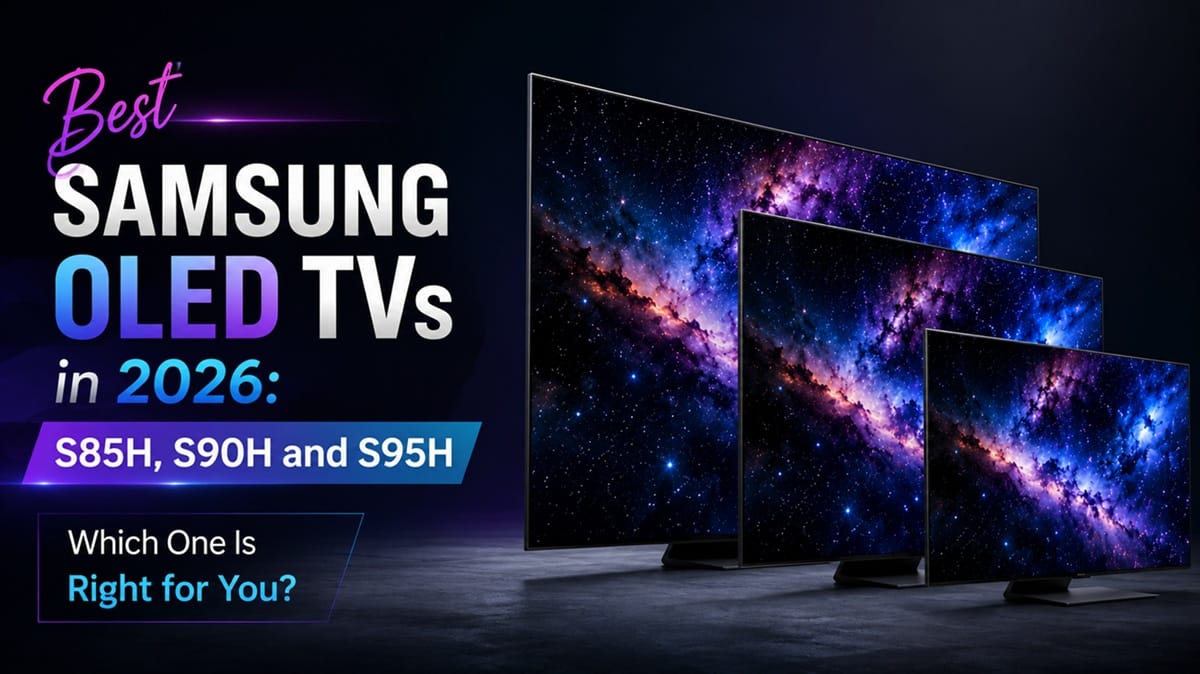
Best Samsung OLED TVs in 2026: S85H, S90H and S95H — Which One Is Right for You?
Last updated: June 2026
🕒 11 min read
Disclosure: As an Amazon Associate I earn from qualifying purchases. This article contains affiliate links — we may earn a small commission if you buy through them, at no extra cost to you.
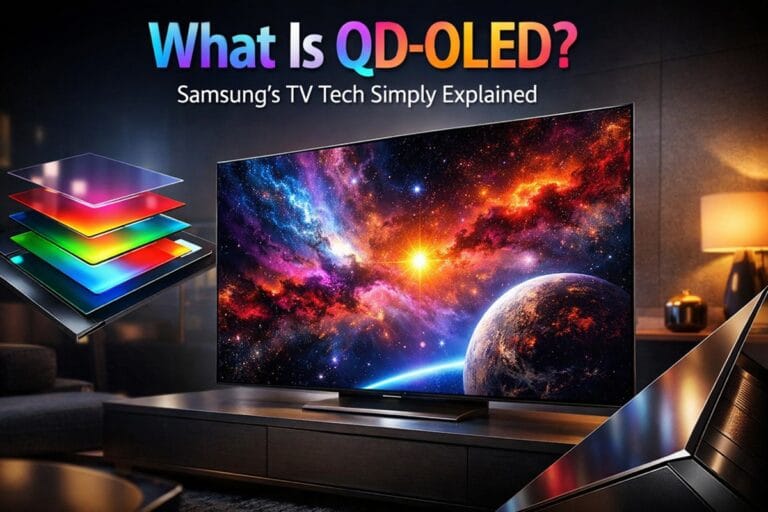
Samsung makes its own OLED panels through Samsung Display, and that’s the detail most competing lineups can’t touch. Most OLED TVs on the market run on white OLED substrates from LG Display, filtering that light through color layers to build the final image. Samsung’s QD-OLED skips the color filter entirely — quantum dots convert blue OLED light directly into red and green, so the light reaching your eyes is purer and more saturated. In practice, that shows up as more vivid color and stronger HDR highlights, particularly in the mid-sized screens most households actually buy.
For 2026, Samsung’s lineup splits into three tiers: the entry-level S85H, the mid-range S90H, and the flagship S95H. The most significant shift this year is that the matte glare-free coating — previously an S95-exclusive feature — now ships standard across the entire lineup. That single change reshapes the value equation more than any spec bump. Our top pick for most buyers is the Samsung S90H: it runs a genuine QD-OLED panel in the popular 55″, 65″, and 77″ sizes, hits 144Hz, packs four HDMI 2.1 ports, and carries the new glare-free screen without the S95H’s price premium.
All three models are broken down below — where each one fits, and where it doesn’t — along with how Samsung stacks up against LG for buyers still deciding on a brand.
Table of Contents
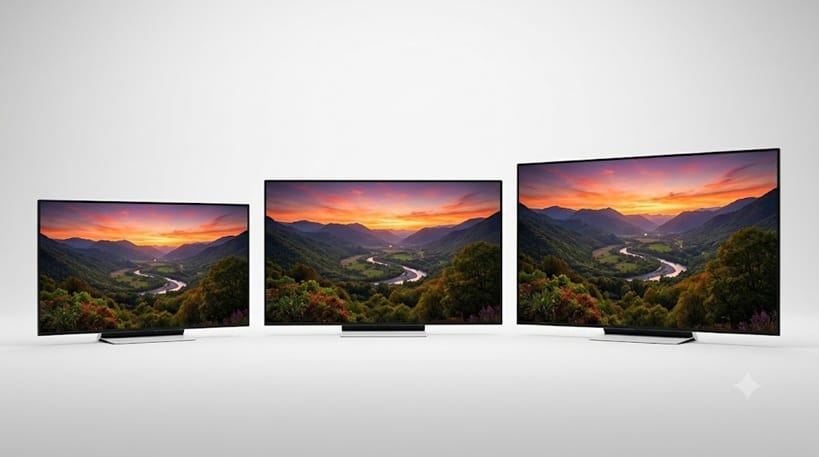
Best Samsung OLED TVs 2026: Quick Picks
↺ Prices change frequently — click through for current pricing.
✓ Scores reflect our independent editorial assessment — not Amazon customer reviews.
Samsung’s 2026 OLED Lineup Explained: S85H, S90H and S95H
Samsung keeps its OLED lineup intentionally lean. Three models, three tiers — each targeting a distinct buyer. The S85H is the affordable entry point, the S90H is the value core, and the S95H is the flagship. What unifies all three in 2026 is the glare-free matte coating and 144Hz refresh rate, features that used to separate mid-range and premium buyers. The gap between tiers now comes down to brightness ceiling, design, and a handful of premium features at the top end.
Panel Type Isn’t the Same at Every Size
One thing worth understanding before buying: not every size in Samsung’s lineup uses a QD-OLED panel. In the S90H and S95H, the 55″, 65″, and 77″ models use Samsung Display’s own QD-OLED panel — the technology Samsung is known for. But the 42″, 48″, and 83″ sizes use WOLED panels sourced from LG Display, the same panel type you’d find in a mid-range LG TV. That’s not a dealbreaker, but if you’re buying specifically for QD-OLED’s color advantage, the 55–77″ range is where you’ll actually get it.
For a deeper look at how the two panel types differ, our QD-OLED vs WOLED breakdown covers the full picture — and if you’ve already narrowed it down to S90H vs S95H, our head-to-head comparison walks through exactly which one to pick.
Samsung announced the full 2026 lineup in April — the official Samsung press release has the complete spec sheet for each model.
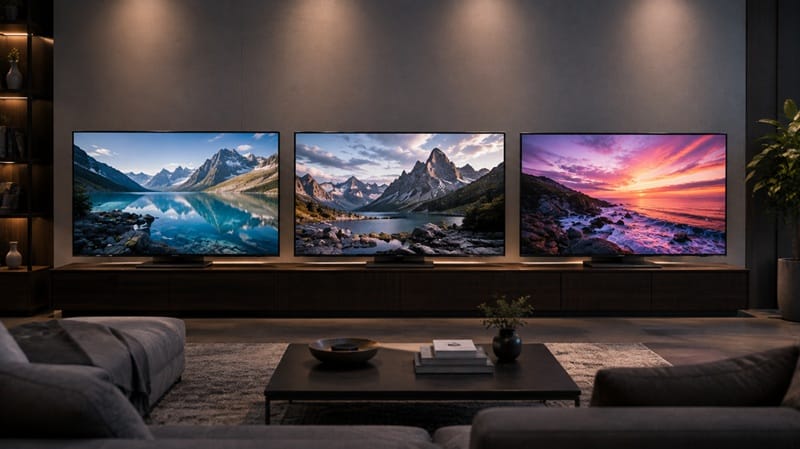
Best Overall: Samsung S90H
The S90H is where Samsung’s lineup starts making serious sense for most households. Pick the 65″ and you’re getting a genuine QD-OLED panel — Samsung’s own, not a sourced panel — running at 144Hz with four full-bandwidth HDMI 2.1 ports, a matte glare-free screen, and Samsung’s NQ4 AI Gen3 processor handling image processing. That’s a meaningful upgrade over last year’s S90F, which launched with a glossy screen and required flagship-tier spending just for glare resistance.
In a dim or controlled-light room, the S90H produces the kind of black levels and color depth that make dark-room movies genuinely impressive, based on manufacturer specifications and independent testing data. Gaming is where QD-OLED earns its reputation — response times are fast and input lag is low, and with four HDMI 2.1 ports you’re not compromising if you run a PS5 and an Xbox at the same time. If you want the smallest QD-OLED-adjacent size in the lineup specifically, our full Samsung 48S90H review covers how the 48-inch WOLED variant holds up on its own.
Buy This If…
- ✅ You want QD-OLED panel performance in the 55″, 65″, or 77″ size range
- ✅ Your room has some ambient light and you don’t want to fight glare
- ✅ You’re splitting gaming between multiple current-gen consoles
Skip This If…
- ❌ Your room is bright enough that the S90H’s lower brightness ceiling becomes a real limitation
- ❌ You want the 42″ or 83″ size and specifically need QD-OLED — those sizes use WOLED panels
- ❌ You’re buying for an extreme HDR setup and want the highest peak nits Samsung offers
Best Premium: Samsung S95H
Samsung reports peak brightness improvements of around 35% over last year’s S95F, putting the S95H at roughly 2,700 nits in a 10% window on QD-OLED sizes — figures from Samsung’s own specifications, pending independent lab verification. Brightness is content- and window-size dependent, so that number won’t show up constantly, but it does mean the S95H holds its own in a sun-lit living room where most OLEDs start looking washed out.
Beyond brightness, the S95H introduces FloatLayer Design — a new chassis with a metallic finish — along with Art Mode, giving access to thousands of artworks from Samsung’s Art Store when the TV is idle. The Slim One Connect Box also returns, routing cables through a single thin connection so the panel can mount flush to the wall. Serious gamers will find OLED HDR Pro’s tone mapping well-suited to modern HDR-heavy titles; for a broader look at gaming performance across brands, our best OLED TVs for gaming guide goes deeper on input lag, VRR, and frame-rate handling.
Buy This If…
- ✅ Your living room gets a lot of natural light and brightness matters to you
- ✅ You want to wall-mount cleanly using the One Connect Box
- ✅ Art Mode is something you’d actually use between viewing sessions
Skip This If…
- ❌ Your room is dim or controlled-light — the S90H’s brightness ceiling is more than enough
- ❌ Art Mode, FloatLayer Design, and One Connect Box hold no value for you
- ❌ Budget is a real constraint — the S90H covers most of what the S95H does at the panel level
Best Entry: Samsung S85H
The S85H is Samsung’s foot-in-the-door OLED, and it’s a more coherent option than previous entry-tier Samsung OLEDs tended to be. You get 144Hz, four HDMI 2.1 ports, and the glare-free coating — all the fundamentals that define the 2026 lineup. The trade-off versus the S90H is mostly in image processing: the S85H runs a less powerful processor, which shows up mainly in upscaling, where standard HD content from cable or older streaming sources looks noticeably softer than it would on the S90H.
Where the S85H makes the most sense is as a bedroom or secondary-room TV for someone who wants OLED’s core advantages — infinite contrast, no backlight blooming, fast response — without committing to the S90H’s price. If you’re eyeing the largest size in the S85H line for a bigger room, our full Samsung 77S85H review covers how the panel and processor hold up at that scale. And if it’s the smallest size you’re weighing rather than the largest, our Samsung 48S85H vs 48S90H compared breakdown lays out whether stepping up to the S90H’s processor is worth it once you’re already down at 48 inches.
Buy This If…
- ✅ You want QD-OLED performance at the lowest entry price Samsung offers
- ✅ The TV is for a bedroom or secondary space rather than a primary home theater
- ✅ You’re upgrading from QLED and want to experience OLED before spending more
Skip This If…
- ❌ This is your main living-room TV — the S90H is worth the step up
- ❌ You’re a demanding viewer who notices upscaling differences on mixed-quality content
Samsung S90H vs S95H: Which Should You Buy?
The S90H and S95H share the same QD-OLED panel in their 55″, 65″, and 77″ sizes, the same 144Hz refresh rate, and the same four HDMI 2.1 ports. At the panel level, the gap between them is narrower than the price gap might imply. What you’re actually paying for when you step up to the S95H is a higher brightness ceiling — roughly 2,700 nits vs an estimated 1,400–1,500 nits for the S90H, based on Samsung’s published specifications — along with the new FloatLayer chassis, Art Mode and Art Store access, and the Slim One Connect Box.
If your room is dim or semi-controlled, the S90H’s brightness is genuinely sufficient — QD-OLED’s color volume still looks rich at its brightness level. But if the TV is going into a bright living room with afternoon sun, the S95H’s strengths become practical rather than theoretical. The S90H is the right call for most buyers; step up to the S95H if your room fights glare, a clean wall-mount matters to you, or Art Mode is something you’d genuinely use. For the full head-to-head breakdown, see our Samsung S90H vs S95H compared guide.
Samsung OLED vs LG OLED: The Short Version
Samsung and LG are the two brands that define the OLED TV market, and the choice comes down to a few genuine differences rather than brand preference. Samsung’s QD-OLED wins on color volume and peak brightness in its core sizes — the combination of quantum dots and no color filter produces more saturated colors, and 2026 pushes brightness further still.
LG counters with Dolby Vision support, which Samsung’s lineup still lacks, plus a wider size range stretching from 42″ to 97″ across its OLED models. Neither brand is wrong here — they’re genuinely different. For the full brand-level breakdown across panel tech, software, and value, see our LG OLED vs Samsung OLED compared guide.
How to Choose the Right Samsung OLED for Your Room
Room lighting is the most important variable. In a dark or semi-controlled room, the S90H is sufficient — OLED’s infinite contrast does the heavy lifting and the brightness ceiling matters less. If the room gets real sunlight, the S95H’s higher peak brightness and matte coating make a practical difference. The S85H covers both environments adequately as a secondary TV; for a primary living-room set, we’d push toward the S90H at minimum.
Size is the next consideration, and this is where the panel-type distinction becomes relevant. For QD-OLED specifically, 55″, 65″, and 77″ are the sweet spot across all three tiers. The 65″ hits the mark for most living rooms — wide enough to fill a wall at 8–10 feet, not so large it overwhelms a standard sofa distance. If you’re considering 65″ or 77″, our best 65-inch OLED TVs roundup broadens the comparison to non-Samsung options at that size.
Gaming setups have an easy answer across the Samsung lineup — all three 2026 models support 4× HDMI 2.1, 144Hz, VRR, and FreeSync Premium Pro. The S95H adds OLED HDR Pro for more aggressive tone mapping in bright HDR scenes, worth considering if you play HDR-heavy titles. For most PS5 and Xbox gamers, the S90H is the practical choice.
📍 Not set on Samsung yet? Our full 2026 roundup ranks top picks from LG, Samsung, and Sony side by side on picture quality, gaming, and value. See best OLED TVs of 2026 →
Samsung OLED TV — Frequently Asked Questions
Which Samsung OLED TV should I buy in 2026?
For most buyers, the Samsung S90H is the right answer. It uses Samsung’s QD-OLED panel in the 55″, 65″, and 77″ sizes, runs at 144Hz, and now ships with a glare-free matte screen — all without the S95H’s flagship price. Only step up to the S95H if your room gets a lot of ambient light, clean wall mounting matters to you, or you want Art Mode. Not sure which tier actually justifies the price for your situation? See are Samsung OLED TVs worth it — we break down each model honestly.
What’s the real difference between the Samsung S90H and S95H?
The core QD-OLED panel is the same in the 55–77″ sizes. The S95H earns its premium through a significantly higher brightness ceiling, the FloatLayer design, Art Mode and Art Store access, OLED HDR Pro tone mapping, and the Slim One Connect Box for cable-free wall mounting. RTINGS’ testing of the previous S95F offers a useful measurement baseline, since the S95H follows the same QD-OLED lineage with added brightness headroom.
Do Samsung OLED TVs support Dolby Vision?
No — Samsung’s OLED TVs support HDR10+ rather than Dolby Vision, and that’s unlikely to change soon. The real-world gap is smaller than it sounds for most content, since HDR10+ is well-supported on Samsung’s own Prime Video and Samsung TV Plus content. Where it matters more is Apple TV+, which leans heavily on Dolby Vision — you’ll get an HDR10 fallback instead.
Is Samsung QD-OLED better than LG WOLED?
They’re genuinely different rather than one being flat-out better. Samsung’s QD-OLED produces more color volume and higher peak brightness in its core 55–77″ sizes. LG’s WOLED lineup supports Dolby Vision, offers more model variety across sizes, and has a longer track record in the OLED market. See our LG OLED vs Samsung OLED compared guide for the full picture.
Are Samsung OLED TVs good for gaming?
Yes — Samsung’s 2026 OLED lineup is well-suited to gaming across all three tiers. Every model runs at 144Hz, ships with four HDMI 2.1 ports, and supports VRR and FreeSync Premium Pro. Response times on QD-OLED panels are consistently fast, based on independent testing data. For a comprehensive comparison of OLED gaming TVs across brands, our best OLED TVs for gaming guide covers what matters at each budget level.

iYaiii
Editor, GearPulse360
iYaiii is the editor and founder of GearPulse360, specializing in TV reviews and consumer electronics. He researches every recommendation before publishing.
✅ Based on spec analysis and Samsung’s official data plus RTINGS — last verified June 2026