LG C5 vs G5 OLED: Which One Is Actually Worth Your Money in 2026?
Last updated: June 2026
Disclosure: As an Amazon Associate I earn from qualifying purchases. This article contains affiliate links — we may earn a small commission if you buy through them, at no extra cost to you.
The LG C5 and LG G5 are more alike than they are different — same processor, same webOS platform, same gaming specs. The only real question is whether the G5’s brightness premium is worth paying for your specific room. For most people, it isn’t.
The short answer: for most buyers, the LG C5 is the right choice. It delivers picture quality that’s very hard to fault, a full gaming feature set, and the same processor and smart TV platform as its more expensive sibling. The G5 earns its premium in one specific area — brightness — and for the right buyer in the right room, that difference is real and meaningful. For everyone else, the C5 is the smarter spend.
In this LG C5 vs G5 comparison, we’ll cover picture quality, brightness, gaming performance, design, and value — the five dimensions that actually determine which TV belongs in your home. If you’re also weighing LG against Samsung and Sony, our LG OLED roundup covers the full lineup in one place.
Table of Contents
LG C5 vs G5: Quick Verdict
LG C5 vs G5: Our Verdict
Winner for most buyers: LG C5 — near-identical picture quality to the G5 in typical viewing conditions, at a meaningfully lower price.
Exception: The LG G5 wins if you have a bright living room, want the best possible HDR highlight performance, or are building a dedicated home theater where peak brightness matters.
Buy the LG C5 if:
- You watch mostly in a dark or moderately lit room
- Gaming is a priority and you want every HDMI 2.1 feature at a lower price
- You want excellent OLED picture quality without the flagship premium
- You’re buying a 42″ or 83″ model — sizes not available on the G5
Buy the LG G5 if:
- Your living room gets significant natural light during the day
- You want the best HDR peak brightness LG’s WOLED range can deliver
- You care about the premium One Wall design for a flush wall-mount install
- Budget isn’t the deciding factor and you want the absolute top of LG’s lineup
How They Compare
Picture Quality — LG C5
Picture Quality — LG G5
Brightness — LG C5
Brightness — LG G5
Gaming — LG C5
Gaming — LG G5
Value — LG C5
Value — LG G5
How the LG C5 and G5 Actually Differ
The LG C5: LG’s Sweet-Spot OLED
The C5 is LG’s mid-range OLED evo — and in 2025, that still means a remarkably capable TV. It uses a standard WOLED panel paired with LG’s α9 AI Processor Gen 8, which handles picture processing, upscaling, and sound optimisation. You get Dolby Vision, HDR10, HLG, and a full webOS 25 smart platform. Available in 42″, 48″, 55″, 65″, 77″, and 83″, it’s also the more flexible choice for rooms where sizing matters.
The C5 isn’t trying to be the brightest OLED on the market. What it does deliver — perfect per-pixel black levels, accurate colour, and a gaming feature set that rivals any TV at its price — is hard to beat in its class.
The LG G5: The Flagship Brightness Upgrade
The G5 sits at the top of LG’s consumer WOLED range for 2025. The key hardware difference is the panel itself: the G5 uses a Primary RGB Tandem OLED — a stacked panel design that adds an MLA (Micro Lens Array) layer to concentrate and redirect light output, resulting in substantially higher peak and full-screen brightness. The C5 uses a single-stack WOLED panel without MLA — which is why its full-screen brightness tops out near 200 nits while the G5 hits 331. Everything else — processor, webOS, HDR support, gaming specs — is essentially the same as the C5.
The G5 is available in 55″, 65″, 77″, and 83″. It also carries LG’s One Wall Design, engineered specifically for flush wall-mounting with minimal gap between the TV and the wall surface. In terms of panel architecture, the G5’s Tandem OLED construction delivers around twice the peak HDR brightness of the C5 — and that single distinction is where the entire upgrade argument lives. To understand the full panel picture behind this, our explainer on QD-OLED vs WOLED compared is worth a read.
Picture Quality and Contrast: Almost Identical — with One Caveat
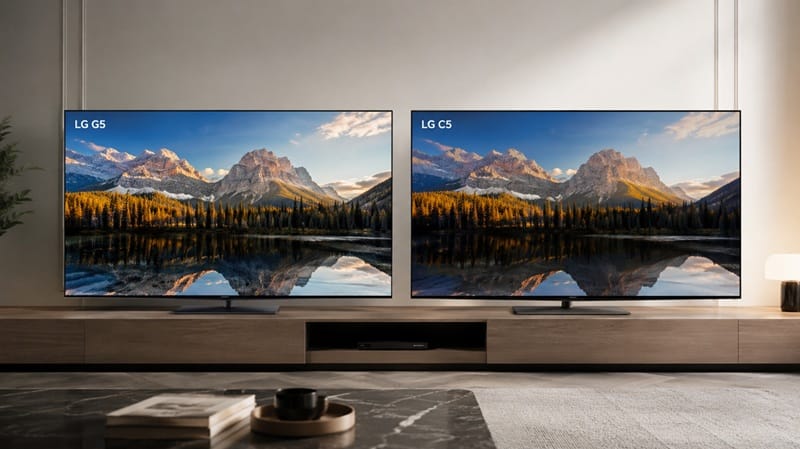
Both TVs share the same WOLED fundamentals: per-pixel black levels, Dolby Vision, and colour accuracy that holds up against professional monitoring standards. The α9 Gen 8 processor applies identical scene detection, upscaling, and HDR optimisation to both models. In a dark or moderately lit room, the gap between the LG C5 and G5 in contrast and colour fidelity is narrow enough that most viewers won’t notice it. Shadow detail, gradation, and overall colour rendering are near-identical.
The caveat arrives in bright specular highlights — the sun glinting off water, a white dress in a sunny scene, the blinding headlights of a car at night — where the G5’s higher peak output adds visible punch and dimensionality that the C5 doesn’t quite match. For dark-room movie watching, both are exceptional. For HDR content where extreme highlights are part of the creative experience, the G5’s advantage becomes real.
Brightness: Where the LG C5 vs G5 Gap Is Real
This is the dimension that defines the entire comparison. The numbers are significant. In independent lab testing in Filmmaker Mode, the G5 measured approximately 2,268 nits peak HDR brightness (10% window) against the C5’s approximately 1,180 nits. That’s nearly double the peak output. More importantly for everyday viewing, full-screen HDR brightness — which governs how bright large bright areas of the picture appear — measured around 331 nits on the G5 versus roughly 195–200 nits on the C5.
What That Means in Practice
Full-screen brightness is the number that determines how well a TV handles bright rooms, reflections, and daytime viewing. At around 200 nits full-screen, the C5 is competitive for a standard WOLED — but it can be overwhelmed in a room with significant window light. The G5’s 331 nits gives it a meaningful advantage in those conditions. Snowy scenes, desert vistas, and bright HDR content pop noticeably more on the G5. If bright-room performance is your top priority regardless of brand, our roundup of the best OLED TVs for bright rooms broadens the search beyond LG alone.
In a darkened or semi-lit room, this gap narrows considerably. OLED’s per-pixel black levels mean contrast is extraordinary on both TVs, and the eye naturally adapts to ambient conditions. The brightness delta between the LG C5 and G5 is most visible precisely in the conditions where OLED is traditionally at its weakest — high ambient light.
Reflections
The G5’s higher brightness also helps it punch through glare more effectively. The C5’s semi-gloss screen can be more susceptible to reflections in bright rooms. Neither LG model has a matte anti-reflective coating — if glare is your primary concern, a competing QD-OLED model with a matte screen may be worth comparing before you decide.
Gaming Performance: A Near-Tie That Favours the C5 on Value
Both the LG C5 and G5 are outstanding gaming TVs, and their specs overlap almost entirely. Four full-bandwidth HDMI 2.1 ports (48Gbps each), 4K/120Hz, VRR (G-Sync compatible and AMD FreeSync Premium), ALLM, Dolby Vision Gaming, and HGIG are present on both models. Input lag on both sits around 0.1ms pixel response time with input delay measured at roughly 9–11ms at 4K/60Hz — imperceptible in real use.
The One Gaming Spec Difference
The G5 supports up to 165Hz VRR when connected via PC, while the C5 caps at 144Hz. For console gaming on a PS5 or Xbox Series X — both capped at 4K/120Hz in current games — this distinction is irrelevant. For PC gamers with a high-end GPU pushing frame rates above 144fps, the G5 has a marginal advantage. For the overwhelming majority of gamers, the C5’s 144Hz ceiling is more than sufficient.
If gaming is the main reason you’re buying, the C5 gives you everything the current generation of consoles can use, at a lower price. See our picks for the best OLED TVs for gaming if that’s your primary use case.
Design and Available Sizes
The C5 and G5 look similar in photos but feel different in person, particularly for wall-mounted installs. The C5 uses LG’s Ultra Slim Design — a modern, clean aesthetic with slim bezels and a slim profile. The G5 uses the One Wall Design, engineered for flush mounting with a near-zero gap between the TV and the wall. The G5’s back panel sits roughly 20mm from the wall when mounted — closer to a framed picture than a typical TV bracket installation. The C5, while slim, has a standard rear protrusion that’s more noticeable against lighter walls.
Size availability is worth factoring in. The C5 comes in 42″, 48″, 55″, 65″, 77″, and 83″. The G5 is limited to 55″, 65″, 77″, and 83″. If you’re looking for a 42″ or 48″ model — popular choices for bedrooms, gaming rooms, and smaller apartments — the C5 is your only LG OLED option in this comparison. For a size-specific shortlist, see our picks for the best 65-inch OLED TVs.
Price and Value: The C5 Is the Stronger Argument for Most Buyers
The G5 carries a significant price premium over the C5 at every equivalent size. What you gain for that premium is primarily: higher brightness, a premium wall-mount design, and the 165Hz PC gaming ceiling. What you don’t gain is a fundamentally different picture quality experience in typical viewing conditions.
The value case for the C5 is simple. Everything that makes the G5 a great TV — the processor, the webOS platform, four HDMI 2.1 ports, Dolby Vision — is in the C5 too. You’re not giving anything up except brightness. For the majority of viewing scenarios — streaming, sports, movies, gaming in the evening — that’s a trade most people should be happy to make.
The G5 is worth the premium if and only if brightness is a real issue in your specific room. If you watch in a bright environment, struggle with reflections, or want the best HDR highlight performance available from LG’s WOLED line, the G5’s premium is defensible. Otherwise, the extra spend doesn’t materially improve your viewing experience.
LG C5 vs G5: Use Case Comparison
🌘 Dark-room movies
C5
Near-identical contrast and picture quality at a lower price
☀️ Bright living room
G5
~331 nits full-screen vs C5’s ~200 nits — fights ambient light better
🎮 Console gaming (PS5 / Xbox)
C5
Identical gaming specs — 144Hz is the PS5 / Xbox ceiling anyway
💻 PC gaming (high frame rate)
G5
165Hz VRR ceiling vs C5’s 144Hz — matters for high-end GPU setups
🖼️ Wall-mount / home theater design
G5
One Wall Design sits flush — minimal gap, cleaner aesthetic
📺 Smaller sizes (42″ or 48″)
C5
G5 starts at 55″ — C5 is the only LG OLED option below that
💰 Best overall value
C5
Delivers 90%+ of the G5 experience at a significantly lower price
Which Should You Buy?
In most rooms, the LG C5 is the right choice. The picture quality case for spending more on the G5 is narrower than it looks on a spec sheet. In a typical living room with controlled or moderate lighting, you’ll be watching one of the best OLED TVs money can buy — and you won’t be thinking about the G5’s extra brightness, because it won’t be visible in your specific conditions. The C5’s combination of perfect black levels, accurate colour, full gaming specs, and broad size availability makes it very hard to argue against.
If your priority is bright-room performance, the LG G5 earns its premium. With roughly 331 nits of full-screen HDR brightness versus the C5’s ~200 nits, the gap is significant enough to matter when there’s ambient light in the room. Scenes with large bright areas — snow, sun, open skies — have more impact, and HDR highlights carry more weight. If you regularly watch sports in the afternoon, or your lounge has floor-to-ceiling windows, the G5’s brightness advantage is the real thing.
If you want the premium One Wall design or the 165Hz PC gaming ceiling, the G5 has those too — but they’re secondary arguments. The core case for the G5 is brightness, and if that’s not a pain point in your room, the C5 is the stronger decision. For a broader view of how LG’s lineup stacks up against Samsung and Sony, our explainer on LG OLED vs Samsung OLED compared is a useful next step.
See every OLED TV ranked for 2026
Our full roundup covers the best models by budget, use case, and size — so you can find the right OLED for your room.
See our OLED TV roundup →LG C5 vs G5: Common Questions
Is the LG G5 significantly brighter than the LG C5?
Yes — and the gap is more than marginal. In independent testing, the G5 measured approximately 2,268 nits peak HDR brightness versus around 1,180 nits for the C5. More relevant for everyday viewing, full-screen HDR brightness measured around 331 nits on the G5 versus roughly 195–200 nits on the C5. That full-screen number is what determines bright-room performance — and the G5 has a clear advantage there. You can compare detailed test results directly on RTINGS’s LG G5 vs C5 comparison page.
Do both the LG C5 and G5 have the same gaming features?
Almost entirely, yes. Both include four HDMI 2.1 ports (48Gbps), 4K/120Hz, VRR (G-Sync and FreeSync Premium), ALLM, Dolby Vision Gaming, and HGIG. Input lag is near-identical on both models. The only meaningful gaming spec difference is the VRR ceiling: the G5 supports up to 165Hz in PC mode, while the C5 tops out at 144Hz. For PS5 and Xbox Series X gaming, this makes no practical difference.
Is the LG C5 good enough for a bright living room?
If your room relies mainly on overhead lighting or indirect window light, the C5 is fine — 200 nits full-screen is enough for those conditions. Where it starts to struggle is direct afternoon sunlight hitting the screen, or a room with multiple large windows and no blinds. That’s when the G5’s extra brightness is the difference between a washed-out picture and a watchable one. If you watch mainly in the evening, or close the blinds during the day, the C5 won’t let you down.
Is the LG G5 worth the price premium over the C5 in 2026?
For the average household, no. The G5’s picture quality advantage in controlled lighting conditions is real but narrow — both TVs use WOLED technology and the same processor, and contrast and colour accuracy are near-identical in typical rooms. The G5’s premium is justified specifically for bright-room viewers who’ll benefit from the higher full-screen brightness every day. For everyone else, the C5 delivers the OLED experience at a better price.
Will LG close the C5 and G5 brightness gap in 2026?
The 2026 LG C6 is already showing early benchmark numbers that suggest a modest brightness improvement over the C5 — though it appears to remain behind the G5’s Tandem OLED panel. LG’s G-series has consistently stayed ahead of the C-series on full-screen brightness, and that structural advantage is unlikely to disappear. The FlatpanelsHD C5 review noted that the C5’s full-screen brightness remains below 350 nits — the level at which ABL becomes significantly less noticeable — suggesting the pattern will continue until the C-series receives a panel architecture change. For a closer look at how that gap plays out in LG’s newest generation, our LG C6H vs LG G6 compared breaks down the 2026 models directly.

iYaiii
Editor, GearPulse360
iYaiii is the editor and founder of GearPulse360, specializing in TV reviews and consumer electronics. He tests and researches every recommendation before publishing.